- City Fajr Shuruq Duhr Asr Magrib Isha
- Dubai 04:26 05:44 12:20 15:47 18:50 20:08

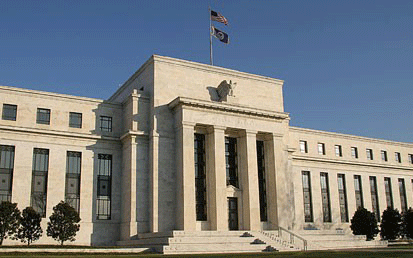
Very soon the Fed would have to print trillions of dollars to cover its explicit and implicit guarantees, warns economists. (SUPPLIED)
Economists peddling dire warnings that the world's number one economy is on the brink of collapse, amid high rates of unemployment and a spiralling public deficit, are flourishing here.
The guru of this doomsday line of thinking may be economist Nouriel Roubini, thrust into the forefront after predicting the chaos wrought by the subprime mortgage crisis and the collapse of the housing bubble.
"The US has run out of bullets," Roubini told an economic forum in Italy earlier this month. "Any shock at this point can tip you back into recession."
But other economists, who have so far stayed out of the media limelight, are also proselytising nightmarish visions of the future. Boston University professor Laurence Kotlikoff, who warned as far back as the 1980s of the dangers of a public deficit, lent credence to such dark predictions in an International Monetary Fund publication last week.
He unveiled a doomsday scenario - which many dismiss as pure fantasy - of an economic clash between superpowers the United States and China, which holds more than $843 billion of US Treasury bonds.
"A minor trade dispute between the United States and China could make some people think that other people are going to sell US treasury bonds," he wrote in the IMF's Finance & Development review.
"That belief, coupled with major concern about inflation, could lead to a sell-off of government bonds that causes the public to withdraw their bank deposits and buy durable goods." Kotlikoff warned such a move would spark a run on banks and money market funds as well as insurance companies as policy holders cash in their surrender values.
"In a short period of time, the Federal Reserve would have to print trillions of dollars to cover its explicit and implicit guarantees. All that new money could produce strong inflation, perhaps hyperinflation," he said.
"There are other less apocalyptic, perhaps more plausible, but still quite unpleasant, scenarios that could result from multiple equilibria."
According to a poll by the StrategyOne Institute published Friday, some 65 per cent of Americans believe there will be a new recession.
And the view that America is on a decline seems rather well ingrained in many people's minds supported by 65 per cent of people questioned in a Wall Street Journal/NBC poll published last week.
"It is true: Today's economic problems are structural, not cyclical," argued New York Times editorial writer David Brooks.
He said the United Sates is losing its world dominance much in the same way the British Empire began to crumble more than a century ago.
"We are in the middle of yet another jobless recovery. Wages have been lagging for decades. Our labor market woes are deep and intractable," Brooks said.
Nobel Economics Prize winner Paul Krugman also voiced concern about the fate of the fragile economic recovery if voters return the Republicans to political power.
"It's hard to overstate how destructive the economic ideas offered earlier this week by John Boehner, the House minority leader, would be if put into practice," he wrote in a recent editorial. "Fewer jobs and bigger deficits - the perfect combination."
The Wall Street Journal, usually more favorable to Boehner's call for tax cuts, ran a commentary from another Nobel Prize-winning economist - Vernon Smith - that failed to provide much comfort for readers.
"This fact needs to be confronted: We are almost surely in for a long slog," Smith wrote. And it seems such pessimism has even filtered into the IMF, which warned on Friday that high levels of national debt and a still shaky financial sector threaten to derail the global economic recovery.
"The foreclosure backlog in US property markets is large and growing, in part due to the recent expiration of the home buyer's tax credit. When realised, this could further depress real estate prices."
This could lead to "disproportionate losses" for small and medium-sized banks, which could in turn "precipitate a loss of market confidence in the recovery," the IMF warned.
 Follow Emirates 24|7 on Google News.