Islamic banks urged to tackle profit ambiguity
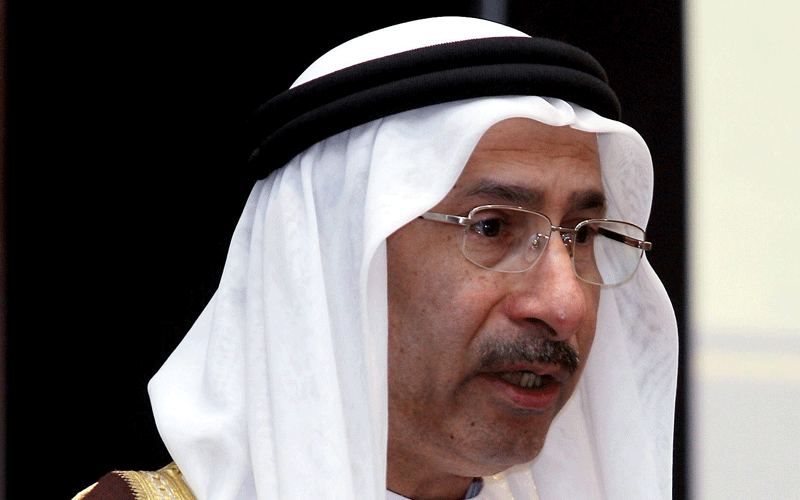
Islamic banks need to work for tackling ambiguities surrounding their profits as well as rulings by their boards to ensure credible standards for Shariah-compliant units, the Central Bank governor said on Thursday.
Sultan bin Nassir Al-Suwaidi said such uncertainties are among several challenges besetting Islamic banks in the UAE and other countries, including what he described as short-term liquidity management.
Addressing an Islamic banking seminar in the capital, he said the UAE now has eight Islamic banks with 260 branches, controlling nearly Dh269 billion in assets that account for around 17 per cent of the total bank assets.
Deposits at Islamic banks were estimated at around Dh198 billion at the end of 2010, accounting for 18.7 per cent of the total deposits of around Dh1,105 billion controlled by the UAE’s 23 national banks and 28 foreign units.
Suwaidi put loans and advances at about Dh169 billion, nearly 16.4 per cent of the total credit of the banking system.
He said assets of Islamic banks grew by around 10.9 per cent in 2010 while deposits expanded by nearly 7.6 per cent. Loans and advances also increased by nearly 5.6 per cent in the same period.
“Figures of Islamic banks are impressive, but there are some challenges that would need the focused attention of the scholars, and also our distinguished speakers,” Suwaidi told the conference at the central bank, entitled “Islamic Finance in a Global Perspective.”
“The first such challenge is the short-term liquidity management at Islamic banks and other Islamic financial institutions. This is not a straight forward issue and has been under discussion between Islamic banks and Central Bank of the UAE for several years before we were able to produce any instrument.”
He said that during the fourth quarter of 2010, the Central Bank was able to create Islamic certificates of deposit which he described as “very successful”, adding that they have a balance of Dh12 billion.
“Another challenge for Islamic finance is the distinction between profit to shareholders and profit to investors / depositors, which is not a clear–cut issue at the moment. We need a standard formula to calculate profit in an equitable and fair way at all Islamic banks,” Suwaidi said.
“The third challenge is the rulings by the various Shariah boards of Islamic banks, which should be better coordinated and harmonized. This will satisfy an important requirement, i.e, setting of credible standards for Islamic banks.”