- City Fajr Shuruq Duhr Asr Magrib Isha
- Dubai 04:32 05:49 12:21 15:48 18:47 20:04

Retail petrol prices at Dubai’s ENOC/EPPCO stations could surge by up to Dh1.7 per litre if local distributors decide to match international gasoline prices, Emirates 24/7 calculations show.
With the price of a barrel of oil (Nymex WTI) hovering around the $90-mark in the international market, pressure on local distribution companies to hike the retail price of petrol at local pumps seems to be mounting.
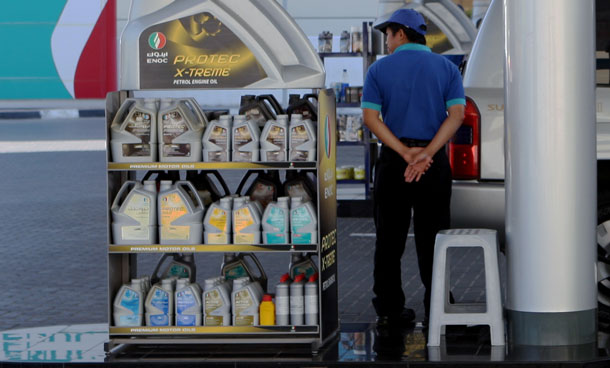
An uncharacteristically frankly worded statement by Emirates National Oil Company (ENOC) yesterday quoted a company spokesperson putting on record its discontent over the losses that the company has had to sustain because of buying refined fuel at international prices and distributing it locally at pre-set subsidized prices.
“The current scenario, where ENOC has to bear the burden of higher international fuel prices while at the same time distributing fuel at subsidized rates, is clearly not sustainable or viable for the company,” the spokesperson said, adding that ENOC estimated incurring a loss of Dh2.7 billion this year on account of such price differential. “This also has a serious impact on our ability to expand our retail network to meet the growing demand,” he said.
Indeed, such losses are not new to this year alone, and local retailers have been sustaining losses for some years now. “The losses of [UAE’s] oil marketing and distribution companies are estimated at about Dh3bn just in 2009,” the Economist Intelligence Unit (EIU), a research firm, estimated in a report issued last year. “The losses were particularly acute in 2008, when oil prices reached record levels, but they accumulated again this year [2010] as prices crossed the $80/barrel mark,” the EIU confirmed.
Despite the fact that Dubai-based fuel retailers increased the price of petrol by 35 fils in 2010, the current retail price (Dh1.72 per litre for Special, or Octane 95 grade petrol) is still more than Dh1.19 cheaper than the conventional Singapore grade Octane 95 and Dh1.35 cheaper than the Los Angeles grade, data shows.
The basic grade of petrol in Dubai costs Dh1.72 at local filling stations (ENOC and EPPCO) while Bloomberg Singapore 95 Octane Gasoline fob Spot Cargo Price was $125.9 per barrel (approx. 159 litres) as of October 14, 2011 – which works out to Dh2.91 per litre.
Similar calculations reveal that local retail prices will have to go up to Dh3.07 per litre to match the Los Angeles Reformulated RBOB Regular Gasoline Spot Price, which was at $3.159 per gallon on October 12, 2011.
As we all know, the spot price of crude – and with it that of refined fuel – fluctuates on a daily basis, this leaves room for further appreciation of prices. In fact, refined fuel peaked on April 24 this year, with Singapore grade surging to an equivalent of Dh3.21 per litre and LA grade at Dh3.39 per litre – literally double the retail price in Dubai.
In effect, it will be safe to conclude that UAE fuel retailers are now subsidising petrol at the pump by more than Dh1.2 per litre, and that is without even taking into account the cost of importing the refined product, storing it, distributing it, marketing it and eventually dispensing it to the consumer.
Yesterday’s statement by ENOC said the international fuel price has risen at a record pace recently, which is adding to the burden on local fuel retailers. “The substantial rise in the price of fuel in the international markets – the highest ever recorded since 2008 – has put a severe burden on ENOC and EPPCO, which for many years have distributed and continue to distribute fuel to end-users at a highly subsidised rate,” the ENOC spokesperson said.
“Very few stations have been added in Dubai recently and a number of stations had to be closed to undertake infrastructure development work,” the spokesperson further added, perhaps referring to the recent closure of ENOC/EPPCO’s operations in neighbouring Sharjah on account of an unspecified “upgrade”.
The statement concluded with ENOC expecting an intervention by the “concerned authorities” in the matter. “ENOC looks forward to the support of the concerned authorities in addressing the concern,” it said.
Now this could mean one of two things – that ENOC is looking for the government to either write off its losses on account of a fuel price differential by writing it a cheque of the amount it expects to lose, or, more importantly for the consumer, it could be asking for a go-ahead to increase the retail price of fuel in order to break even or start making a profit on its fuel distribution service.
While local retailers had last year announced that they intended to eventually raise the fuel price – albeit gradually – to international levels, some commentators maintain that the Arab Spring, which saw political turmoil in some countries of the Middle East earlier in the year, acted as a dampener on their plans and thus retail petrol prices have remained steady this year.
However, if the latest media statement by ENOC is to be seen as a sign of things to come, expect a fuel price hike as soon as before the end of this year.
Following last year’s hike, the cost of fuel in the UAE is the highest in the GCC at Dh1.72 (46 US cents) litre, which is four times as high as in Saudi Arabia, and more than triple the price in Qatar.
According to the EIU, the rethink of the UAE’s petrol pricing policy has come about for two primary reasons. “Oil companies have been pushing for price rises for some time, because the revenue from sales has not been covering the cost of production, leading to losses,” it says.
“The price increases are also aimed at curbing rapidly growing domestic consumption, which, encouraged by subsidies, has put pressure on government budgets and fuelled wasteful practices. Cutting waste should help to reduce the UAE’s high per capita greenhouse gas emissions and free up oil for export, which in turn will improve public finances,” the EIU report added.
In 2010, the three UAE petrol distributors, Abu Dhabi National Oil Company (ADNOC), Emarat, and ENOC, which also operates through its affiliate the Emirates Petroleum Products Company (EPPC), formed a committee to monitor and discuss petrol prices and retailers’ losses.
The committee, which meets every other month, then recommended increases in prices at the pump. “Recommendations of the committee formally need to be approved by the federal government, but it seems that their policy priorities are aligned,” the EIU said.
The think tank also maintains that the situation of the UAE’s three fuel dispensers differs only slightly. “ENOC and Emarat source the majority of their petrol on global markets paying the prevailing international rates, suffering sizeable losses when they sell petrol to Dubai consumers at the government capped price,” the EIU explained.
“Adnoc is in a slightly better position, as it obtains its fuel from the parent company’s refineries, but still claims not to be able to make a profit on retail sales in Abu Dhabi and the smaller emirates,” it added.
Current retail prices
not viable: Enoc
 Follow Emirates 24|7 on Google News.