Soaring prices hit UAE's gold imports
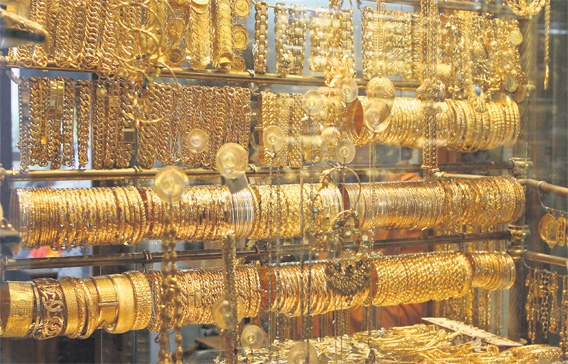
A surge in gold prices has allied with a consumer preference shift to other jewellery and a post-crisis fall in tourists to depress the UAE's imports of the yellow metal by nearly three times over the past few years, semi-official data showed yesterday.
From around $300 (Dh1,101) per ounce in 1998, gold prices have nearly quadrupled to $1,200 this year, largely affecting gold demand in the UAE and other countries, said the report by the government-run Emirates Industrial Bank (EIB).
The EIB said the gold industry in the UAE, the Middle East's hub of jewellery business, is undergoing what it described as turbulent times due to volatility in gold prices, global economic slowdown and changing consumer preferences. "However, the dramatic rise in price is of the most significance to the large gold jewellery industry in UAE," the bank said in its June economic bulletin.
"The virtual explosion in gold prices has had a considerable impact on demand for gold, particularly from the jewellery industry. The impact of the price rise is clearly evident from the import demand in the country."
Its figures showed the volume of gold imports by the UAE plunged from a record high of around 915 tonnes in 2005 to less than 350 tonnes over 2006 to 2008.
"These are roughly the import demand levels seen in the early 90s. After 1997, gold demand had shot up dramatically and remained at high levels till the decline in 2006… there is a large fluctuation in imports because demand for gold not only for jewellery but also from central banks and their sporadic bulk bullion purchases are not related to consumer demand behaviour. Nevertheless, the decline is quite unmistakable since 2006," the study said.
The EIB noted that gold is the only precious metal with significant demand in the UAE, adding that the amount of silver jewellery sold "pales" in comparison.
It showed that silver demand by quantity is at best a mere 15 per cent of gold demand. The price of gold being several times the price of silver, the value of silver demand is insignificant at around one to two per cent of the value of gold demand, it said.
Worldwide, the study estimated the value of the global jewellery industry at around $146 billion in 2008, of which the Gulf Co-operation council (GCC) market represents nearly 10 per cent with a value of $14.5bn.
According to the EIB, almost 8,000 GCC nationals are involved in the industry. Dubai's jewellery business has about 1,800 active trade licences, about 1,000 of which represents retailers and the remaining wholesalers, distributors and manufacturing companies.
In the UAE as a whole, there are close to 40 modern jewellery manufacturers and around 200 artisan type of jewellery workshops.
To support the jewellery manufacturing business, gold refining facilities are being set up in the country with the support of Dubai Multi Commodities Centre (DMCC), the EIB said, adding that the DMCC has also supported the establishment of two high-tech operating refineries, whose combined output is expected to boost the country's refining capacity by a significant margin.
As for silver, one refinery has been set up in the UAE and it has been awarded the Dubai Good Delivery status, thereby enabling it to achieve international ranking, according to the report.
It said this enables jewellery manufacturers and traders in the country not to have to turn to international suppliers for their requirements. "From the behaviour of the market in the past few years during times of high price rise, it is evident that demand for gold is relatively inelastic and that consumers continue to buy gold despite the enormous price rise," it said.
"Nevertheless, the enormous rise in cost of raw material, which is unavoidably passed on to the consumers, has had an adverse impact on the jewellery business. Consumers have felt the pinch and demand has fallen, while the cost of holding inventory and profit margin has declined." The EIB noted that the global slowdown has further reduced demand since the jewellery business depends almost 50 per cent on tourist buyers, whose numbers slightly declined after the slowdown, but "more importantly were spending less because of the recession".
"As the financial crisis of September 2008 unfolded, there was a big fall in demand for gold jewellery in early 2009, with a reported decline of as much as 60 per cent in the earlier months. This is not surprising as jewellery is a luxury product and such non-essential products faced the brunt of the crisis. Market sources also report a fall of annual jewellery sales in Dubai by nearly 30 per cent in 2009 compared to 2008," the study said.
"However, in 2010, the first quarter sales figure was up by 13 per cent compared to the same period in 2009. While this is a welcome recovery, indications are that sales are currently well below the levels of 2008."
The EIB also reported what it dubbed changes in the jewellery demand structure, which it said posed another challenge to manufacturers in the UAE.
"Jewellery demand, particularly, at the higher end, is gradually shifting away from pure gold jewellery to precious stones jewellery and gems like diamonds, sapphire, rubies etc. Consequently, the trade in precious stones is on the rise."
Its figures showed Dubai's total trade of diamond volumes jumped by nearly 22 per cent to 182 million carats in 2009. A total of 80 million carats of polished diamonds were traded through the emirate in 2009, leaping by more than 150 per cent from 2008 when 32 million carats were traded, the report showed. The emirate also recorded Dh99.6 million worth of pearl trade in 2009, slightly higher than the Dh95m posted in 2008. Imports rose by 30 per cent, boosting the trade value by 3.8 per cent.
"The current outlook for gold price is bullish as another crisis in Europe looms large. Such periods strengthen gold demand and could lead to further rise in gold price. If gold price rises, the outlook for gold jewellery is not very good, particularly, given the changes taking place in consumer tastes," the EIB said. "However, demand for precious stones and gem-embedded jewellery is expected to rise and businesses will have to make this structural change and move to such jewellery. Since gem-work jewellery lends itself more to artisan work and individual craftsmanship rather than machine-made jewellery, businesses will have to rise to this challenge."