Saudi ETFs to further open market: NCB
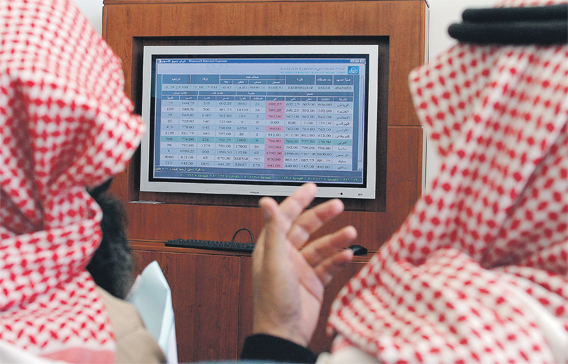
Saudi Arabia's plan to introduce exchange-traded funds (ETFs) into its bourse will contribute to further liberalising the stock market following its decision to partially open it to foreign investors, the kingdom's largest bank said yesterday.
National Commercial Bank (NCB) said the Saudi Capital Market Authority (CMA), which manages the local bourse, is in advanced stages of allowing ETFs, to be created from stocks of Saudi companies and listed on foreign bourses.
The plan coincides with a sharp recovery in Tadawul, the Middle East's largest and busiest stock market, following its poor performance in 2009 compared with global markets, mainly because of local debt default problems.
According to NCB, there are 138 firms listed on Tadawul, with a combined market capitalisation of SR1,321 billion (Dh1,293bn), nearly 95 per cent of the 2009 GDP.
"In the Saudi market perspective, ETFs may be attractive for small investors as investments vehicle because of their low costs, and stock-like trading features. Interestingly, an ETF combines the valuation feature of a mutual fund or unit investment trust, which trades throughout the trading day at prices that may be more or less than that of its net asset value," NCB said in its weekly economic bulletin, sent to Emirates Business.
"The CMA's move is a step in the right direction for further liberalising and gradual opening up the largest equity market in the Arab World."
An ETF is an investment fund traded on stock exchanges, much like the way listed stocks do. An ETF holds assets such as stocks or bonds (Sukuk) and trades at about the same price as the net asset value of its underlying assets over the course of a trading day.
Most ETFs track an index, such as the US stock market (S&P500) and the trading of ETFs is quite simple because investors have to pay the same commission to their brokers as they do on any other regular order.
Saudi Arabia's market is the second GCC bourse to consider the introduction of ETFs. The Abu Dhabi Securities Exchange (ADX) said last week it could be begin trading in ETF soon after relevant laws were approved by authorities. ADX is also considering the introduction of derivatives but the plan has been delayed by the eruption of the global fiscal distress in September 2008.
Saudi Arabia has been locked in a drive to develop its bourse to encourage local investors and attract foreign capital as part of overall economic reforms aimed at reducing reliance on unpredictable oil export earnings.
Tadawul's intention to introduce ETFs followed a report that it underperformed most other markets in 2009 but is projected to rebound this year.
"There has been a clear disconnect between the performance of the stock market and the economy in Saudi Arabia compared to that in many leading global economies," Jadwa Investments said.
"Economic performance in the kingdom has been much better than in developed countries, but its stock market has underperformed. We think the main reasons for this are a lack of confidence, the small role of institutional investors and a lack of investor awareness of economic conditions."
Jadwa said the performance of Tadawul, which accounts for nearly a third of the total Arab market capitalisation, had been expected to be much better on account of what it described as the domestic growth dynamic within the Saudi economy.
Its figures showed the kingdom's non-oil private sector grew by 2.5 per cent in real terms last year compared to a contraction of 2.5 per cent in the US. "We would expect performance to be closer to that of emerging markets; however, the divergence here is even greater. The MSCI emerging markets index is now 96.5 per cent above its low."