Far from the madding crowd
Swathed in cloud, the dreamlike karst scenery slides past on both sides of the boat as it drifts down the Li River in China's Guangxi province.
With all the attention on the Olympics in Beijing, you might be forgiven for thinking there's nothing else to see in this vast country. But almost 2,000 km to the south of the capital, I'm discovering a different world.
The steep and bizarrely-shaped limestone mountains, covered in lush vegetation and stretching off into the distance, are unlike any landscape I've ever seen before. They have an unreal quality to them and I find myself inescapably reminded of Vietnam war films such as Apocalypse Now.
Such an environment is a world away from the sandy Middle East – but one that has now come a step closer to UAE residents thanks to Emirates' new direct flights to Guangzhou in southern China, from which the city of Guilin in Guangxi is but a short hop westwards and the gateway to a host of fantastic tours and activities including rafting, hiking and cycling.
I start with the must-do experience – the Li River cruise down to the river town of Yangshuo, a trip so popular that it attracts everyone from luxury tourists to backpackers travelling on a shoestring. This results in an eclectic mix of people on the boat, including the former UN worker who many years ago taught electrical skills in the Gaza Strip to none other than the current leader of Hamas, Khaled Meshaal.
The boat trip lasts some four hours, including lunch, and sweeps through stunning and ever-changing vistas, including a scene featured on China's 20 yuan note, before docking at Yangshuo.
While Guilin is a bustling and prosperous provincial town, Yangshuo is much smaller, more relaxed and tourist-oriented, with a pedestrianised centre and hosts of hotels, cafes and restaurants. It's the ideal base for a few days exploring the area.
I decide to rent a bicycle and cycle up the Yulong River, a tributary of the Li. It's the rainy season so I make sure I get a tough mountain bike with fat tyres, ideal for getting off the beaten track.
This is a great way to get to see Chinese rural life up close. Take side paths and cycle through the incredibly green rice paddy fields and past pools full of carp, peasants in straw hats taking their water buffalo out for a walk or carrying bundles of plants.
Despite the lush appearance, tending this agriculture is back-breaking work – and unlike in most countries, about half of this work is done by women, many of whom appear tiny, wizened and bent.
I cycle through the village of Jiu Xian, where families still live in homes dating back to the Ming dynasty (1368-1644) and Qing dynasty (1644-1912), made out of crumbling yellowy brick. In addition to the red posters and lettering found on doorways across China, branches of herbs also hang from the doorframe, meant as a defence against pestilence and disease, as well as a mirror to scare evil spirits by giving them a glimpse of their own reflections.
The villagers look poor, their clothes are thin and ragged, but they all have mobile phones and drive around on motorcycles. They are friendly people and upon hearing "Ni Hao?" – "How are you?" – will break into grins.
In another village I speak to a local peasant – he tells me they eat meat once every five days and travel to a big city like Guilin maybe once or twice a year. But peasants enjoy certain advantages over urban Chinese. The one-child policy is not enforced in many country areas and this man has three children, one working in Yangshuo and the other in booming Guangdong province.
Not everyone is friendly though. On a dirt track heading for Dragon Bridge, an impressive stone bridge across the Yulong built in 1412. I pass a small child. He looks determined as I approach and then hits me on the leg as hard as he can as I pass, which fortunately is not very hard at all.
Back in Yangshou I'm tempted by a foot massage, a popular and easily available activity in China, but opt instead to check out the cormorant fishing, China's equivalent to falconry on the Arabian peninsula.
In this example of man and bird working together for mutual gain, the fisherman has a team of six cormorants – big black birds that have the ability to pursue fish fast underwater. Their throats are tied with a wire, which prevents them from swallowing any good-sized fish they might catch.
The birds swim alongside the grizzled old fisherman's bamboo raft, diving under the water. When he notices one of the birds struggling to swallow a fish, he hooks a wire trailing from its leg with a bamboo pole and hauls it flapping and spluttering onto the raft before forcing it to disgorge the fish into a basket. It's fascinating and sometimes comical viewing. Some argue that it's cruel to the birds, whose necks are untied after they have finished fishing, but the real danger to this centuries-old practice is ever-diminishing fish stocks in the river thanks to over-fishing.
I return to Guilin for my final trip in Guangxi, a tour of the Dragon's Backbone rice terraces in a mountainous area populated by the Yao, one of China's 55 ethnic minorities whose women are famous for having incredibly long hair. According to tradition, they cut it about once in a lifetime, aged about 16. They keep the cut tresses on their heads, winding it around like a turban.
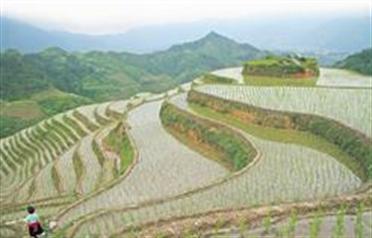
The bus drops me just below the Yao village of Ping An, which nestles among the paddy fields. There are no roads, just paths made out of slabs of rock winding between the timber houses. I climb through and above the village and look out over the paddy fields, an extraordinary feat of agricultural engineering.
The fields are on steep mountainsides, but no square metre of land is wasted and the amount of work that must have gone into their creation makes me tired just thinking about it. The reflection of the white cloudy sky on the water surface of the paddy fields creates a wonderful vista of abstract stripes curving with the mountainside. It's a photographer's dream.
There are two areas of rice paddies and I decide to trek across to the village of Da Zhai in the second area. On the way I bump into a group of Yao women, who are accustomed to tourists and are only too pleased to unwind the bundles of hair on their heads for a few yuan. It is astonishingly long, longer than their bodies.
Tourism has made life easier for the Yao, and many make their money by selling trinkets and guiding visitors along the unmarked mountain paths, which are a pleasure to hike along but all too easy to get lost in.
One Yao girl decides I have no chance of making it to Da Zhai alone – it is already getting dark. She pursues me at speed along the trail until I give in and allow her to take me as far as her elder sister's guesthouse in the village of Tian Tou, which turns out to be a terrific place to spend the night.
The following morning I get up at 6am to see the blue dawn light give way to a cloudy haze over the terraces.
No sparkling sunlight today. I hike down to Da Zhai and arrange transport back to Guilin, refreshed after these few days in some of the most beautiful and lush natural surroundings on the planet.
If you're looking for a break from the arid Middle East, Guangxi Province should now figure high on your list of destinations.
Essential guide
How to get there
Emirates (www.emirates.com) has direct flights to Guangzhou six times a week
Tour information
All these tours can be booked via tour agents and hotels in Guangzhou, Guilin and Yangshuo or undertaken independently (except the Li River cruise, which must be booked). Tours mean you don't have to arrange local transport, which can be confusing. I would suggest booking tours for the Li River cruise and the rice terraces while arranging your own excursions from Yangshuo on site. In general, you can rely on recommendations from your hotel staff. For more information, see www.chinatraveldepot.com
Where to stay
Guilin and Yangshuo are full of hotels. In Guilin, try the Guilin Bravo Hotel (www.glbravohotel.com)
For real peace and quiet away from the touristy centre of Yangshuo, try the American-run Yangshuo Mountain Retreat (visit www.yangshuomountainretreat.com)
The Giggling Tree guesthouse on the banks of the Yulong River (www.gigglingtree.com)
In the Dragon's Backbone area, cheap and clean guesthouses abound in the villages of Ping An and Tian Tou. In Ping An, try the Li Qing Guesthouse (+86 773 7583021, liqing_gh@hotmail.com), in Tian Tou, try the Tian Ti guesthouse (+86 773 7584203)
Where to eat
Guilin's specialities include soups of endangered species of snake, wild cat and bamboo rat.
Great Sichuanese food can be found at Yiyuan Fandian (Nanhuan Lu).
In Yangshuo, try Le Votre cafe (Ledefashi Canting, +86 7738828840), which has French food. Most guesthouses in Ping An and Tian Tou has tasty cuisine
Best time to go
Guangxi has a hot and humid climate. September and October offer the most pleasant weather
Important numbers
Visitors from most countries require a visa. Contact the Chinese consulate in Dubai (www.dubai.china-consulate.org/eng)