Six photographs, six philosophies
Some of the world's finest photographers converge on Dubai's Knowledge Village next week, and camera-happy professionals and amateurs are flying in from everywhere in the hope of being able to take better pictures.
"We've got bookings from the United States, Nigeria, China, Hong Kong and Belgium," event organiser Mohammed Somji told Emirates Business. "Tickets are at about the 70 per cent mark, which is where we were last year at this time." He says ticket prices have been reduced in keeping with the recessionary climate, overall, that sales are going well. "It's harder to get sponsors than to sell tickets," he says. Emirates Business asked six of the experts attending the event to share a picture they consider among their best.
The week-long event, which begins on Monday, sees 14 experts taking nearly 80 workshops, with subjects are wide ranging as photography for beginners to discussing new trends in photojournalism and the business of photography. Tickets can be booked for individual workshops or for the day-long Photo Friday event, with its panels, workshops and equipment sales.
Ticket and venue details are available online at gulfphotoplus.com
Cliff Mautner
What's this image about? If I had to choose one image that exemplified my work, it's probably this one of a wedding couple's reflection in a puddle. It's easy to create images on a wedding day when all of the conditions are perfect. But the ability to create images with impact is hindered when facing the adversity of bad weather, or bad lighting conditions. The fact that I took this on a horrible, rainy afternoon makes it special, but the image has impact regardless of the conditions I faced. I once called it my signature image, but I'm always trying to outdo myself, so I'm not sure anymore!
Was it planned or serendipitous? It was most certainly not planned. I saw the puddle, then worked the composition after that. It was one of those wonderful things that happen when you observe your surroundings.
Technical details? It's an older image from my film days. It was shot on a Nikon F5, an 80-200mm 2.8Nikkor lens, and shot on Ilford XP2 super film. It was handheld at 1/30th @ F2.8 and I was zoomed out to about 135mm or so. It was very difficult to hand hold this that slow. I was very fortunate!
www.cmphotgraphy.com
Bobbi Lane
What's the picture about? It's an interpretive portrait of Chris Eyre, the Native American director of Smoke Signals. I like it for its unusual aspects and the creative process that went into it. It was part of a book project called Filmmakers on Creativity.
Was it planned? Chris's office is in midtown Manhattan and I wanted to show the dichotomy of a different "culture" in the midst of New York City. The idea was to shoot from the roof top, with the view of Manhattan behind him. For this image, I actually dreamed the idea and combined it with photographic technique. I had my partner wave a piece of purple chiffon behind and above Chris using a long exposure, causing it to blur and look like smoke, or a spirit. Chris comes from a spiritual place and the image works as a blending of old and new.
Technical details? The light was fairly flat on the overcast day, which worked well with the subtlety of the idea and made it easier to use a slow shutter speed to make the material blur. It was shot on black and white Plus-X Professional film, at f8 and 1/8 second, on the Hasselblad with an 80mm lens.
www.bobbilane.com
David Hobby
What is the subject of this photograph? My parents, who celebrate their 50th anniversary this year. It was taken at the lake of the small rural Florida town they live in. I wanted to photograph them in their retirement, in the environment they've chosen to spend their lives.
Was it planned? I saw this photo in my head weeks before I made it, and created it to match that vision. Only the quality of the sunset was serendipitous, and thus beyond my control. That was luck.
Technical details? It was digital (Nikon D3, 18mm lens) at 1/320th of a second at f/5.6, if memory serves. I hid a small flash (a Nikon SB-800) under the roof of the hut to create light similar to that of a small light bulb at sunset.
www.strobist.blogspot.com
Chris Hurtt
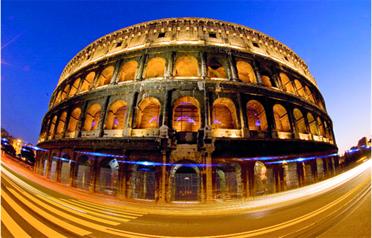
Why do you like this image? I took it in the last holiday my wife and I had before having our son. We were alone. We were exploring. We were together, and felt like the Coliseum in Rome belonged to us!
Why this subject? I wanted to take a shot of a much photographed place, but from a different angle.
Was it planned? Yes, that's one reason this shot is so significant to me. My wife and I together sought out this angle. Fitting the entire Coliseum into the frame was something we hadn't seen anywhere – in stock libraries or on postcards. So that became the challenge.
What makes this image different? Point of view and time of day. This shot required standing in the middle of the road… with traffic flying by in front of and behind me… at rush hour in Rome. Anybody who has been in a car in Rome can understand that this alone is a feat!
Technical details? I chose my exposure based on shutter speed. I wanted to get that traffic flowing by and there happened to be a police car going by to add more drama. The exposure is 25 seconds and was shot at an aperture of f/16.
What does this image say about you? This is a dramatic shot. The scene looked nothing like this to the naked eye. However, it is dramatic. It looks just about as it did straight out of camera, and captured the dramatic beauty I felt as I saw these sacred places for the first time with my own eyes.
It is as close as I can come to communicating how it felt to run my fingers along the rough stone of the Coliseum. That is what I am trying to do with my photography.
www.chrishurtt.com
Asim Rafiqui
What's the picture about? It's part of a work called Pakistan: Possibilities & Paranoias and should really be seen in the context of the rest. It's a flower vendor outside a Sufi shrine in Pakistan.
Sufi dargahs in South Asia are frequently surrounded by businesses catering to the spiritual and ritual needs of the pilgrims coming there. These dargahs and the social, religious and personal life that surrounds them are important, if threatened, counter voices to the more orthodox, intolerant and increasingly violent religious interpretations brewing in the country.
They bring people of all faiths (Muslims, Hindus, Sikhs and others) into contact with each other, and, in that, allow us to be reminded of the variety of human beliefs and paths to God.
Technical details? It was shot on Kodak Ektachrome colour slide film with a Leica M7 rangefinder and a 50mm fixed focal length lens. I don't remember the shutter speed or aperture, but given the light, I was probably using f/16 or 5/11 and shooting the late afternoon sun at a shutter speed between 125 and 250
www.asimrafiqui.com
Carol Dragon
Why this subject? It's representative of my project, Anomalies: Challenging Our Perceptions of Beauty. The project was inspired by a news story I heard explaining that Florida farmers are prohibited from out-of-state shipments of tomatoes that are imperfect in appearance. I finally understood why tomatoes from Florida are tasteless. The story led me to think about what "imperfect" means in contemporary culture and how that influences the way we make all of our judgments.
What are you trying to say? It's a question. Does the viewer see a simple tomato, or does the image elicit a response that has nothing to do with produce?
Technical details? Hasselblad, H3DII-39, 120mm macro lens. Digital. F11, 1/125. Canon 580EXII flash used manually.
What does this image say about you? The entire project represents the influence that Wabi Sabi has had on me. This Japanese aesthetic principle celebrates the beauty of the transient, the modest, and the imperfect. So do I.
www.caroldragon.com