Going green helps companies to stay in the black
Being good to the environment is good for the bottom line of businesses and companies in the UAE report big benefits from creating a carbon management strategy, says a report.
According to the white paper titled Improving the bottom line: Corporate carbon reduction efforts across the Gulf, by EcoVentures, which was released on the occasion of the 40th Earth Day today: "The most obvious benefit organisations obtain from reducing their carbon footprint is the reduction of money spent on electricity and water."
For example, Tecom, a real innovator in sustainability in the region, saved Dh7.3 million in 2008 alone through various projects, the report said, while Jumeirah Group stated in its 2008 corporate sustainability report annualised savings of Dh14m from water and electricity conservation measures.
Similarly, Jebel Ali Resort calculated savings of Dh2.6m per year due to its ongoing efforts to reduce energy and water usage. Next, Dubai Chamber of Commerce and Industry reports having saved approximately Dh7.1m through energy and water conservation measures at its head office over a decade.
However, despite the obvious monetary benefits experienced by firms making efforts to reduce their carbon footprint, experts feel that governments and the companies in the region need to do much more to promote sustainable development.
Talking to Emirates Business about the about the biggest problems facing sustainable development in the region and the UAE, Jerry Yudelson, Principal, Yudelson Associates, said: "First is recognising the need. While energy is cheap today in the GCC, water is dear, so a comprehensive approach is the most economical solution to dealing with issues of comfort and productivity.
"If we talk about the UAE in particular, some of the biggest problems facing sustainable development are keeping up the momentum of the initial efforts such as Masdar City in Abu Dhabi. And having the people and the government recognise there is a golden opportunity to take steps today to create a solar-based economy for the next 50 to 100 years."
Darcy Hitchcock, President, Axis Performance Advisors, added: "Over time, many great nations have had to deal with changing circumstances. They have had to reinvent themselves and the basis of their economy. The UAE and Qatar are an example of this where pearling and fishing were major industries in the past and now natural gas and oil fuel the economy."
This has led to great prosperity and likely will support their economies for some time, she said. Natural gas, in particular, is likely to be a key transitional fuel. However, as the world starts to take climate change seriously, the time for another shift is on the horizon for GCC.
"They have to think, what will be the basis of their future economy? How will they provide a high quality of life for all their people? A low-carbon world is likely to be as different from our life now as the industrial revolution was from the century before. Where will their food and water come from? What sustainable energy sources can they develop? What population size can they support? These are some of the questions to ponder now so they can build a bridge to a sustainable society," she said.
"No one knows what the future may bring. So scenario planning can be a useful tool to use at a societal level. What possible scenarios might unfold? What public policies would help countries weather those changes? Which of those policies make good sense in most or all of the scenarios?"
According to the report, the second and most widely cited benefit that organisations enjoy from conducting environmentally friendly activities, including emissions reduction, is increased and improved visibility and brand awareness.
Participants in the survey conducted by EcoVentures mentioned many instances where their emission reduction initiatives helped them attain press coverage.
For example, Enviromena Power Systems was one of the first companies in the UAE to become CarbonNeutral1. Once Enviromena completed this process, the company issued a press release that generated a significant amount of coverage in the local media.
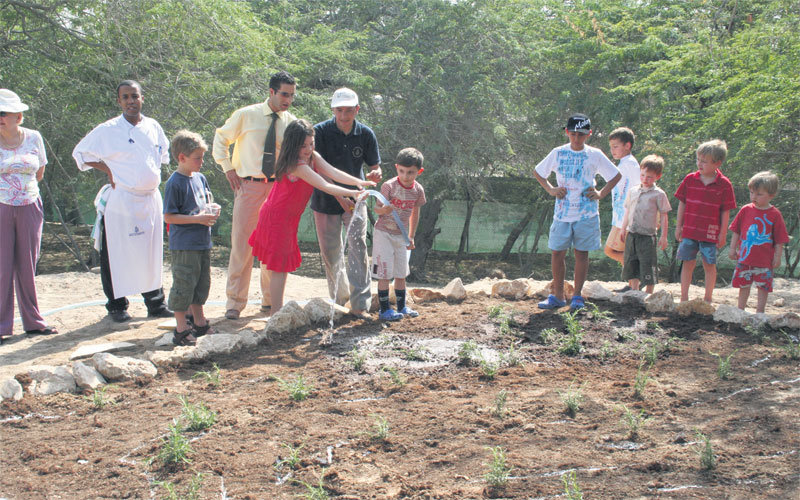
Another strategy firms have used to generate value is to leverage their emissions reduction actions to differentiate themselves from their competitors and establish a novel brand positioning, the report said. For example, in 2008 Jebel Ali Resort launched a biogarden in which they grow majority of the herbs and vegetables used in their restaurants. They were featured in Hotelier Magazine, Gulf Gourmet Magazine, and they were featured on a popular Dubai cooking show called Maa Osama Atyab, in which the TV chef went through recipes using BioGarden ingredients with the resort's chef.
Finally, behaving like a leader or innovator is another way that organisations made headlines. For example, Qatar Airways made headlines last May for being the only Middle East carrier to join the Aviation Global Deal Group, an industry-wide body aimed at helping develop a global policy for tackling aviation emissions. Then, last July, the carrier was elected to be a member of the International Air Transport Association's Environment Committee. Qatar Airways has also joined a consortium to create a hybrid biofuel alternative to jet fuel, which has attracted much press coverage.
The companies also listed two other ways their green initiatives win them press attention through awards and speaking engagements. Winning green awards is a great way to receive press attention that is third-party validated. And these awards show customers and suppliers that these firms are making contributions towards the fight for the environmental responsibility beyond their own self-promotion.
Also, speaking engagements raise public profile of firms as speaking opportunities position them as leaders in their respective fields. Improved customer acquisition and retention is another benefit for businesses.
"Many firms in our survey found that they retained or acquired more customers due to their emission reduction programmes. For instance, Jebel Ali Resort participated in the One Billion Tree campaign by holding a Tree Planting Day in which guests could plant a tree in the resort and put their name on it. They found in the subsequent year that many guests had returned to the resort to visit their tree," said the report. "Also, organisations throughout the region have noticed that as they implemented their carbon reduction and environmental programmes, their employee productivity and talent retention levels increased as a byproduct."
Giving an example, the report said: "Tecom is one of the most advanced firms in the region in the area of green building and, therefore, has a particular focus on improving indoor air quality. As the number of green buildings grew, the firm noticed a decrease in sick days and, therefore, an increase in productivity."
Emission reduction efforts also help organisations retain talent. The biogarden at Jebel Ali Resort is tended completely by employees in their free time. According to Quality Manager Kathy Marshall, the garden is loved by the resort's employees, who often come back from vacation with seeds to plant in the garden. "Our environmental programme definitely helps us retain staff. They appreciate what we're doing here," Marshall said.
But experts say such benefits should not be the basis for countries and companies adopting sustainable development practises, they need to see the bigger picture and plan for the long term.
Talking about how the UAE and the GCC can reduce their carbon footprint, Yudelson said: "There are many practical solutions for green practices and sustainable development in the UAE. For example, design buildings to use 50 per cent less energy than today's average; reduce water use by 30 per cent from today's levels; design buildings appropriate to the climate of the UAE, including better building envelopes; learn how to grow food in controlled environments; improve the efficiency of the transportation sector by 50 per cent."
Hitchcock said: "The most important thing is to think long term. Face the scientific facts that tell us how unsustainable our societies are now. Challenge your fundamental assumptions. Engage your citizens in a dialog regarding what to do about the current/emerging challenges and build a future vision for a sustainable society (carbon neutral, zero waste, sustainable harvesting of any natural resources and social justice). Then take action today to lay the stepping stones to a sustainable future."
How to Get Started
Make a commitment to reduce and offset your carbon footprint as a company. This means that a high-level decision needs to be taken to embark upon a range of initiatives that will aim at reduction and carbon neutrality.
It is highly unlikely that any initiative taken without the backing of the organisation's senior management will truly succeed.
Formulate a climate change policy to enshrine your organisation's principles in a clear statement of intent and to map out the organisation's goals in a structured and achievable way.
Consider making the initiative staff-led or at least staff-participative, as true organisational change is always easier when it is collaborative.
Understand your impact on the environment and do a carbon footprint assessment in order to identify in which ways and to what extent the organisation is creating greenhouse gases or causing those gases to be created.
This assessment will outline concrete steps that can be taken to reduce emissions and will give a range of required actions to maximise the reduction.
Then, by using offsetting, the organisation can neutralise its unavoidable carbon impact.
Develop and implement a carbon reduction plan based on the results of your carbon footprint assessment. Organisations should initially focus on those activities that contribute the most to their overall carbon footprint.