An artist who is inspired as well as enabled by 'No'
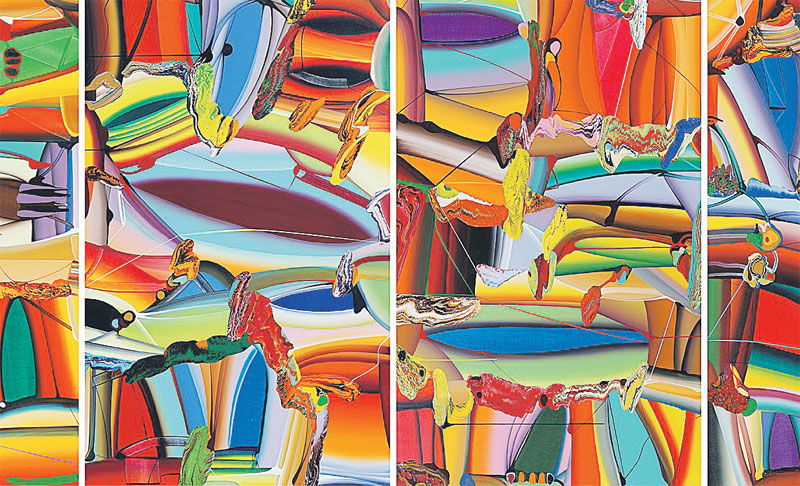
Renowned Indian contemporary artist Bose Krishnamachari is showcasing his works in Dubai along with a few other famous and not-so-famous contemporary Indian artists. Emirates Business spoke to the artist whose work will be on display at the 1x1 Contemporary, art gallery in Al Quoz until April 30.
Your exhibition in Dubai is tilted "No". What is it all about?
It's a reflection of my life and career. I have experienced too many "nos" in my life. I have always had to prove myself. Nothing has come easy to me. I came to Mumbai from a small town in Kerala and I wanted to get admission in the JJ School of Art there. But they told me "no" we can't give you admission as you are already an artist. You are not a student. I had a long battle and I had to prove myself to them before they allowed me to become their student.
So "no" has always been a part of my life and this is reflected in my other works also. But this "no" has always inspired me, given me strength, and I have turned this "no" into a "yes" and made things happen for me.
What is your take on the MF Husain controversy? Do you think artists should be allowed their creative freedom and people should respect that?
I wish Husain comes back to India. He is a close friend and I wish the Indian government had done more to make him feel protected. Also, I agree that artists should be allowed their creative freedom. Because art is about freedom and expression. You take freedom. You make what you feel like making. If you can't make what you want, it is like a commissioned work. I wish contemporary Indian artists can enjoy the same freedom as the ancient Indian art of Khajuraho and miniature paintings did. Where they could paint and sculpt nudes and not get into trouble. Then we will get good art.
It is said that your work bears the influence of Andy Warhol and Piet Mondrian?
I am an iconoclast. I don't believe in rules and my art does not follow rules. I love the work and lives of Andy Warhol and Piet Mondrian, but I can't say that they influence me. I have taken from their history as I admire Andy Warhol who brought such recognition to pop art. His way of living was encouraging for an artist like me. I admire him and Mondrian's practice. I love so many other artists as well such as Damien Hirst, but they don't influence me or inspire me.
So what influences and inspires you?
Mumbai does. When I came to Mumbai in 1985, I did not know English – only Malayalam – and I only had my art. I lived in chawls and I had to survive here. Hedonism and low life co-exist in that city. There is extreme poverty and extreme wealth there. It inspires me. For example, the painting that I have of Mahatma Gandhi in the background and me in the forefront is inspired by the huge hoardings we have in Mumbai where everyone gets their face painted or printed alongside legends such as Gandhiji or actor Amitabh Bachchan. Especially the hoardings of political parties. I get my inspirations from Mumbai.
Is curating something you are looking at seriously as a career option?
Curating for me is almost like art making. It is a very serious business. It is another side of my art practice. Also in India just a few people can curate. Out of this, very few people are formally trained in curating. So I thought it would be nice to take the challenge and put together a show.
Are you still promoting upcoming new artists?
I am interested in new talent. I have an art gallery in Mumbai by the name of Gallery BMB and I am doing a show of 26 women artists in two parts there. It's called "Her work is never done." I decided to showcase their works as there are many young women artists in India and few men artists. And while I was checking out people and their work I realised this and decided to put together the huge number of women artists we have and showcase their works collectively. Only three or four out of these 26 women have done a few shows, the rest of them are totally new. I am not interested in hobby painters. The painter must have a serious approach to art and its history. I look for talent and I believe in the young people and their ideas.
What are your plans for the future?
To keep working and to hold more shows abroad. Also I am building a residence in my hometown in Kerala Alwaye, where artists, designers, architects can live and work. I am also building a small museum in it where I will display my collection of some contemporary Indian and global artists. It will take one-and-a-half years more to complete.
How has the response to the exhibition in Dubai been?
It has been great. Well, to begin with the timing of the show was right as we opened during the Art Dubai fair and the global art community was here. So not only did artists from all over the world come to the opening, many important curators from around the world such as Hans Ulrich Obrist also came to the show and they just loved my work. They understood my work. So within the art community I got a tremendous response and I have not as yet asked the gallery about the commercial side of it. That we will deal with at the end of the show.
Are Indian artists looking at Dubai as the new market?
I, for one, am not looking at the market. I just wanted to do a good show. I wanted people to see what is happening in the art world in India. I took the pains of bringing a huge installation arts such as the White Ghost and Red Carpet and Roots + Maps = Mondrianity, to Dubai. It took tremendous amount of hard work and planning to bring them here. If I were just interested in the market I would have brought a few paintings. This show is about the work, the ideas. However, yes, Indian artists are looking at Dubai as the gateway to the Middle East art scene. Art is a growing thing here. They want to bring culture, show culture and when more museums come up here it will be a great thing.
How is Indian art doing in Dubai?
It's doing well. Buyers, mostly Indians, are seriously collecting Indian art in Dubai. During the recession, the art market, both in India and Dubai, was hit as it was globally. Earlier they were collecting anything now they are more cautious and are only picking up the best works but the market is picking up.
Profile
Born in 1963, Kerala, India, Bose Krishnamachari is a multi-disciplinary artist who has exhibited in numerous solo and group exhibitions internationally. Bose believes in maximum to minimum and minimum to maximum, and for him every thing around him and by him is art.
He also actively curates exhibitions and projects of artists around India.
Krishnamachari feels strongly about supporting the younger generation of artists, to help them make inroads in the contemporary art world.
His oeuvre is experimental and constantly evolving. Living and working in Mumbai, his varied inquiry lends a depth to the mediums he engages with. Krishnamachari's curatorial practice is suggestively intertwined with his own artistic production, centring on an intellectual and physical participation in his works. In his drawings of individual portraits, we see a face that appears beneath the unyielding grid of realism.
In his "Stretched Bodies" series, the absence of the body resound through the blocks, waves and swashes of neon colour, disintegrating the boundaries between what is natural and what is man made.
The bodies and ghosts he refers to are not just traces of the physical, but engage in a kind of historical record as well. His kaleidoscopic and sometimes vertiginous compositions are documents of Bose's complex reading of super-modernity, with its rapidly absorbed images and cultural signs.