Nine in 10 parents say kids safe in UAE schools
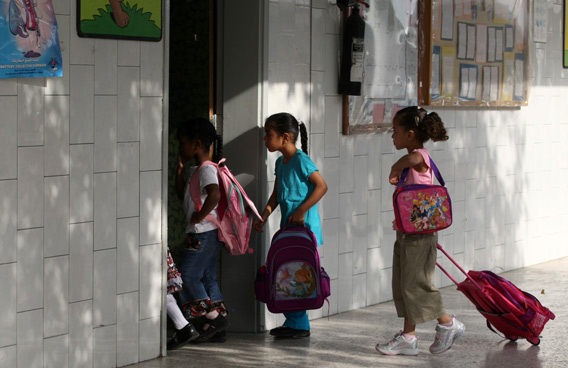
The vast majority of parents with school-going children across the UAE feel that their child is safe at school and there is adequate supervision during school hours, according to a joint study of Zarca Interactive and GolinHarris, which also showed that school transportation, is also perceived to be safe for the students who use it.
The findings of the study surfaced only days after the Ministry of Education’s launch of a Quality Control designed to promote a culture of excellence and continuous improvements across all educational sectors and districts.
According to the report, which was conducted amongst 429 parents of various nationalities and cultural backgrounds, schools seem to have improved their standards and environments significantly as a result of a raft of government initiatives designed to address certain operational issues.
Specifically, the survey showed that 91 per cent of those asked were comfortable that their children are very safe at their schools and 72 per cent said that school buses provide a safe environment for their offspring. This comes hard on the heels of a recent agreement between the Ministry and the Emirates Transport designed to safeguard safety of children on kindergarten and the first grade school buses.
“The Ministry of Education has adopted an educational development strategy called ‘Education 2020’, based on successive five-year plans. On basis of that it’s interesting that many of the parents who participated in the survey feel that the recent improvements in their child’s school are of good (45 per cent) or outstanding (14 per cent) quality,” said Javed Farooqui, Executive Director & Head Middle East and Africa, Zarca Interactive, a feedback management specialist.
He further added: “It’s also not surprising that parents showed greater concern and emphasis about their child’s overall learning in the school with 88 per cent stating ‘Child learning’ as the most important factor.”
However, one out of ten of those parents stated that they are unsatisfied with any progress made by the schools of their children and some 31 per cent agreed that improvements are marginal. Sharjah was the emirate with the highest number of parents (23 per cent) who said that school improvements have been exceptional.
Teaching methodology and the school’s ability to handle discipline and safety issues are also considered important factors which were selected by 79 and 80 per cent respondents, respectively, with half of the respondents also expressing that qualifications and performance of the teachers is an equally important component.
Only two in ten respondents of the survey felt that the demographic makeup of the student’s body is also a key factor.
“The UAE’s education authorities communicate with stakeholders on a daily basis in an increasingly open and transparent way and it is easy to see the various initiatives of the government designed to address various parental concerns.
This strategy has clearly paid off as it has dramatically improved the public’s perception of UAE schools,” said George Kotsolios, Joint Managing Director, GolinHarris, a communications consultancy in Dubai.
Three out of four parents believe that UAE schools’ assessment practices are fair.
The study also tackled other issues such as fees and canteen food quality.
Overall, less than half of the UAE parents (44 per cent) claimed that school transportation is available at reasonable fees. However, almost 40 per cent in Dubai mentioned that school transportation is not available at reasonable fees.
In general, four in ten claimed that canteen at their child’s school provides fresh and hygienic food while, only 18 per cent in Sharjah believe canteen provides fresh and hygienic food.
A marginal majority of parents in Abu Dhabi remained neutral with their views regarding canteen providing food items at reasonable price while, only 18 per cent in Sharjah stated that canteen provides food items at reasonable price.