Traffic woes as Abu Dhabi shuts more streets
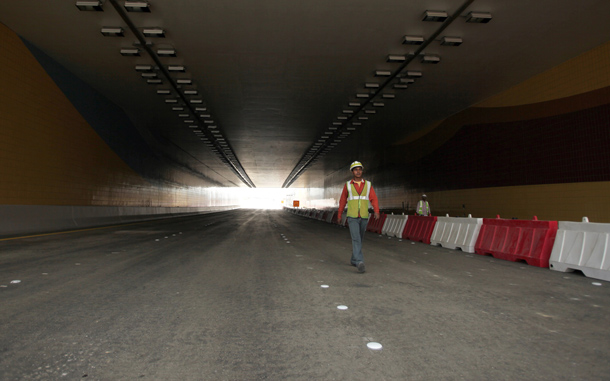
Abu Dhabi authorities have shut more streets to aggravate traffic woes as the capital braces for the launching of the Middle East’s largest car underpass project that also involves causeway to a newly-developed island.
The Abu Dhabi Municipality said it had just closed the main entrance leading to the Ministry of Labor and the Ministries Complex for drivers leaving the city and those heading from outside along the eastern coastal road.
The Municipality said the move is designed to facilitate construction works on Al Salam Street, which will be the first freeway on Abu Dhabi Island that is going through a major infrastructure development plan to cope with a business upsurge and an increase in the emirate’s population by nearly three times in 20 years.
“Motorists who want to access the Ministry of Labor and the Ministries Complex can follow traffic signs placed before the tunnel near Khalifa Park in both inbound and outbound Abu Dhabi,” the Municipality said.“Drivers coming from outbound Abu Dhabi have to stay on rightmost lane and do not enter the tunnel whereas drivers coming from inbound Abu Dhabi have to stay on rightmost lane and take the right exit to make a U-turn.”
Municipality sources said Al Salam project, costing nearly Dhfive billion, would involve the Middle East’s longest traffic tunnel that could accommodate 6,000 vehicles in each direction per hour.
“Upon completion of Al Salam Street Project, motorists will be able to travel through Al Salam Street without any traffic signals from Sheikh Zayed Bridge outside the city straight to Mina Zayed. The project will also positively impact the environment by reducing traffic volumes that will lead to a decrease in air pollution.
Likewise, the tunnels’ central system is among the most advanced in the world and comes with enhanced safety features,” the Municipality said.
Other roads shut last week include the left lane of Alfalah to reduce lanes to two from the intersection of the street with Al Salam as well as the intersection of Al Salam street with Hazaa Birdge, according to the Municipality, which said the closures are intended to facilitate the final stage of construction work.
“The closure is in line with the ongoing efforts of the Municipality to complete the project and the construction of tunnels and surface roads that will be opened gradually leading to the full completion of the project by the end of 2010.”
Al Salam project, launched more than two years ago, has already caused daily traffic mess on the main road as well as in the eastern Tourism Club area and the ring road stretching from that area out of the city.
After it was one of the most organized areas in the city, the Tourist Club has become a messy spider web-like road network that most motorists try to avoid.
Their agony is underscored during peak hours as massive lines of cars and heavy trucks strangle the dirty roads that have been reduced to one or two tiny lanes. Many roads have also been either closed or diverted, causing confusion to most drivers who sometimes find themselves heading in the wrong direction.
The Abu Dhabi Municipality said it had completed more than 70 per cent of Al Salam project and it could be inaugurated late this year or in early 2011.
Some parts of the three-kilometre-long project have already been opened to traffic while massive causeways have been constructed to link the mainland to the nearby Reem Island, which will receive its first dwellers this year. Municipality officials said the causeways would be opened to traffic in a few weeks.
More than 4,000 workers have been involved in the construction of the tunnel and causeways, one of the largest infrastructure ventures in the region.
Once the tunnel is completed, passengers coming from Dubai and other emirates will have two optional directions - either to take the expanded surface road into the capital or plunge around 15 metres underground into the tunnel. Those heading for Reem can just turn right and drive along the causeway.
The tunnel will run underground from the capital’s northeastern entrance straight to Port Zayed and other coastal areas in the southern part of the city, where the fish market and harbour, the sprawling vegetable market, the ageing Iranian free port, cooperative societies and other facilities are located.
South Korea’s Samsung construction company is the main consultant for this project, part of a long-term blueprint by Abu Dhabi to expand its inhabited areas and road networks to cope with a sharp rise in the population.
The tunnel will run just under Al Salam street while a causeway will connect the new junction at the entrance of the tunnel with the 900-hectare Al Reem Island, which will be inhabited by a few thousands people this year.
Al Reem, around 300 metres off the coast of Abu Dhabi, is being developed by Sorouh (Shams Abu Dhabi), Reem Investments and other property developers.
It will be one of the largest and most impressive tourist developments in the world once after the completion of those projects, which involve residential, commercial and recreational centres.
It will also house hotels, restaurants, gardens, museums, an aquarium, amusement parks for children and a wildlife reserve.