Scepticism abounds after ME peace talks 'show'
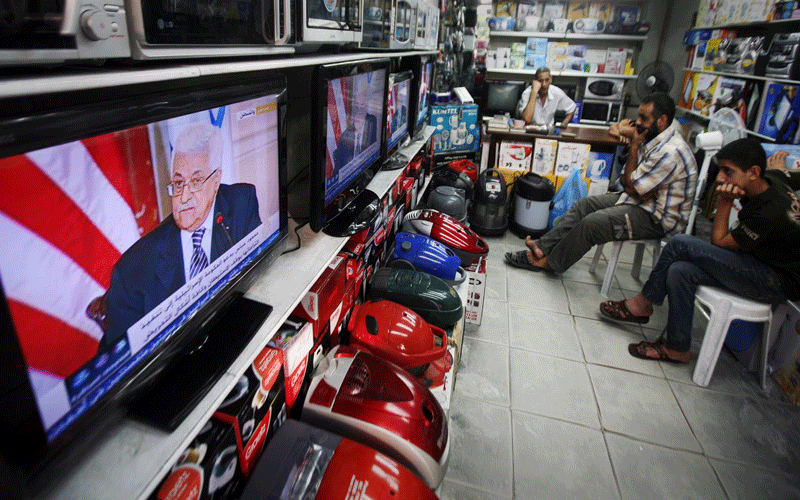
Observers across the Middle East expressed deep pessimism pierced with glimmers of hope on Friday after the launch of yet another round of Israeli-Palestinian talks in a 17-year-old quest for peace.
Israeli and Arab columnists described Thursday's fanfare around the relaunch of talks in Washington as political theatre, while doubting the ability of present leaders to reach an historic breakthrough.
But the veteran Israeli columnist Nahum Barnea expressed cautious optimism, noting the strong US involvement in the process and the apparent "personal commitment" of hawkish prime minister Benjamin Netanyahu to reach an agreement.
"The dramatic difference is in the extent of American involvement," he wrote in Israel's mass-selling Yediot Aharonot. "Maybe this wasn't a show. Not just a show. Not this time."
The right-leaning Jerusalem Post was more sceptical, noting the twin attacks carried out by the Islamist movement Hamas ahead of the talks, which killed four Israeli settlers and wounded two others in the occupied West Bank.
It expressed doubt that Palestinian president Mahmud Abbas would follow in the footsteps of the late Egyptian president Anwar Sadat, who signed a landmark peace agreement with Israel in 1978.
"The heart so fervently wants to see all the current pessimism proved wrong," editor David Horowitz wrote.
"But the head deduces that Netanyahu's admirable hope of finding in Abbas a new Sadat will prove forlorn and fears that this week's return to terror attacks was only the first murderous consequence."
Palestinians also expressed little optimism about the talks, noting that Abbas had failed in his efforts to secure an Israeli settlement freeze or clear terms of reference.
"Israel sees that there is an 'opportunity' -- 10 years after Camp David -- to impose a solution on the Palestinians that they have previously rejected," Mohammed Yaghi wrote in the Al-Ayyam newspaper.
He went on to say that Israel's real goal was to "remove the Palestinian issue from the international and regional agenda."
The Al-Quds newspaper called for Palestinian unity and criticised the Hamas attacks, which it said "would have a negative impact on the talks, which the US administration is exerting great effort to see succeed."
"What is needed is for all Palestinian factions to give a full opportunity for these negotiations, through which the Palestinians do not lose anything, because even if they do not reach an acceptable outcome, they will reveal that the Israeli side is the one that does not want peace."
The Arab press took a harsher line on the talks, to which Arab League foreign ministers had reluctantly lent their support in July.
"Optimism is out of place when you consider the policies of Benjamin Netanyahu ... and the stubbornness of the hardliners in his government," said the United Arab Emirates daily Al-Bayan.
The Saudi daily Al-Watan said Thursday's ceremony was primarily aimed at shoring up domestic support for Obama's Democratic Party ahead of mid-term elections in November, saying that US engagement would diminish afterwards.
To succeed, the talks would need "a moderate Israeli government with a genuine desire for peace, a strong and united Palestinian leadership ... and an American administration ready to put pressure on Israel," the paper said.
"We're going to have to wait a long time for that."
The Beirut daily Al-Anwar echoed the Israeli press, saying "Hollywood-style ceremonies are no guarantee that the strategic obstacles to compromise can be overcome."
It went on to warn that "failure this time would lead to a period of violence ... or even a major war."
In Egypt, the state-owned media dwelled on President Hosni Mubarak's role in supporting the talks while the independent press was more downbeat.
"The conflict with Israel is not some lover's tiff where you have a row but then kiss and make up," the Al-Shuruq newspaper said.
In Jordan, which has also strongly backed the talks, the English-language Jordan Times called on all parties to rally behind them, saying a peace agreement would "thwart the acts of extremist elements."
But it too admitted that "the task ahead is arduous."