Indian plan to deter Pakistan more myth than reality
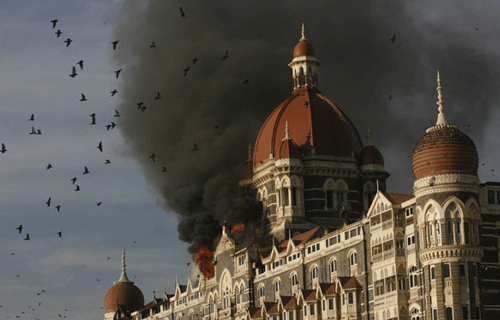
A strategy developed by the Indian military to fight a lightning and limited war with Pakistan without crossing nuclear red lines has stirred concern across the border and in the United States, but the plan is years, if not decades away from battle readiness.
Cold Start involves the deployment of battle groups inside Pakistan within 72 hours of a Mumbai-style attack to carry out a punitive operation without threatening the survival of the Pakistani state and triggering a nuclear confrontation.
It flows from the Indian government's slow-footed response to an attack on parliament in 2001, which was also traced back to Pakistani militant groups, when it took months for the large, lumbering army to deploy on the borders.
By then, the element of surprise was long gone, and Delhi had come under intense international pressure to climb down.
Pakistan says the Indian battle plan is at the heart of its refusal to move forces away from the Indian border to fight militants on the Afghan borderlands, hindering the US war against al Qaeda and the Taliban.
It has drawn concern in the Pentagon too, which worries about any disruption of its long supply line for troops in Afghanistan that runs through Pakistan.
But as the US ambassador to Delhi said in secret cables published by Wikileaks and corroborated by independent military experts, the Indian army's Cold Start doctrine is a mixture of myth and reality.
The military has neither the manoeuvrability or the firepower to rapidly deploy and fight the air and land battle envisaged in the strategy, and it is not even clear whether the civilian authorities have signed off on the plan.
Above all, the idea that you can fight a conventional war without risking a nuclear confrontation between two neighbours with a troubled history for more than 60 years is a vast gamble, say military analysts.
"It has never been and may never be put to use on a battlefield because of substantial and serious resource constraints, but it is a developed operational attack plan announced in 2004 and intended to be taken off the shelf and implemented within a 72-hour period during a crisis," Ambassador Tim Roemer wrote in a February 2010 cable.
Indeed, as Roemer notes, if the Indian government really intended to implement Cold Start and thus risk "rolling the nuclear dice", the Mumbai attacks were an opportunity.
"First, the GOI (government of India) refrained from implementing Cold Start even after an attack as audacious and bloody as the Mumbai attack, which calls into serious question the GOI's willingness to actually adopt the Cold Start option."
Roemer also questioned Pakistan's sincerity in drumming up fears over the Indian military plan, saying it had failed to deter Pakistani mischief inside India even though they had known its existence since 2004.
On Tuesday, a bomb went off in a holy Indian town, killing a child and wounding several Hindu worshippers, an attack that reinforced concerns that India remained vulnerable, and that ties with Pakistan could quickly unravel if acts of violence were linked to militants based there.
Pakistan has warned that the Indian battleplan further de-stabilised regional security, and that it would take measures to counter the strategy. Retired Pakistani army general Talat Masood said it was a fallacy to think the two countries could fight a limited war without the risk of escalation.
"So the potential of a nuclear conflict as a result of Cold Start doctrine is very much a possibility and surely, it will result in escalation to the conventional level," he said.
OPERATIONAL PLAN
But there is no denying that the Cold Start plan exists in some form and there are proponents in the Indian security establishment who think they can fight a limited war without crossing Pakistan's nuclear threshold.
"I would say that Cold Start is in the experimental state of development, having moved beyond pure speculation but more than a decade or two away from full implementation," said Walter Ladwig, a South Asia security affairs expert at Oxford University who has written a seminal paper on Cold Start.
Ladwig said the army had yet to organise itself into integrated battle groups envisaged under the plan and the tank corps are not fully operational.
Only 20 per cent of armoured vehicles had night vision capabilities and the artillery had less than 10 per cent of the self-propelled guns that ground forces would require for a rapid thrust across the border.
The army also did not have enough attack helicopters and the transport helicopters that it had could barely lift 15 per cent of the troops and armour required for such an operation.
Pakistan was well aware of the shortcomings of the Indian army and for all its protests over the plan, it was not as concerned as made out to be, Ladwig said.
"What it has done is handed Islamabad and Rawalpindi a propaganda coup," Ladwig said.
"Although Cold Start is explicitly a response to Pakistan's support for terrorism, leaders in Islamabad have managed to portray India's pursuit of a limited war capability as evidence of New Delhi's 'hostile intent' and 'hegemonic' designs that will 'destabilize the regional balance'."
Retired Indian army brigadier Gurmeet Kanwal who heads the Centre for Land Warfare Studies in New Delhi says the doctrine was essentially an attempt to address the problem of mobilisation of the 1.1 million-strong army. It is also aimed at taking the battle into Pakistan.
"It is essentially a pro-active deterrence strategy with the clear implication that the Indian armed forces will take the initiative and the next war in the plains will be fought in the adversary's territory," he said.