Seven dead as Matthew slams Central America
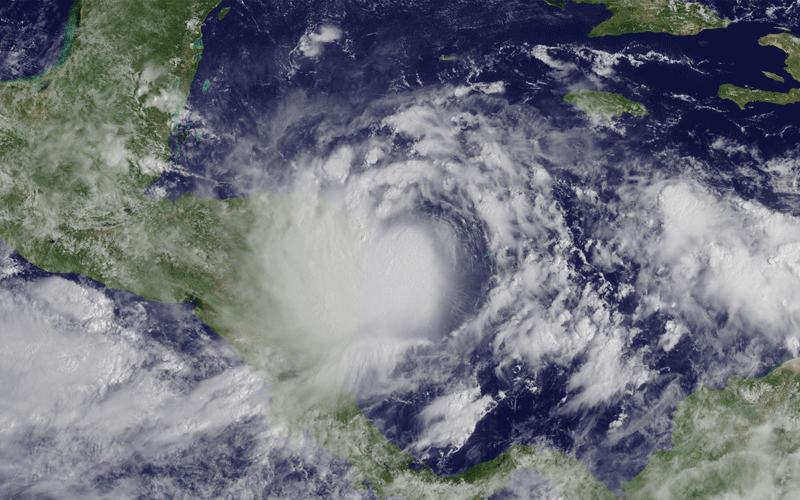
Venezuela was counting the cost on Saturday after Tropical Storm Matthew killed seven people and brought fresh misery to a region were hundreds have been killed in flooding and landslides this year.
An unrelated freak storm in Haiti killed at least five survivors from its devastating January quake and wounded dozens as it blasted through the capital Port-au-Prince, tearing down shabby tent homes, trees and power lines.
Citing local fire department officials, Venezuela's VNA state news agency said Tropical Storm Matthew killed its seven victims Friday in the Santa Ana de Antimano neighbourhood after their home was flooded.
Caracas fire chief William Martinez said authorities also conducted preventive evictions in other high-risk areas.
Thousands of people had been evacuated elsewhere in Central America ahead of Matthew, which made landfall in a lightly populated area of northeastern Nicaragua, then headed west, dumping rain across much of northern Honduras.
The storm struck further south than expected, Rosalba Silva of Nicaragua's Meteorology Institute told AFP.
At 0900 GMT, Matthew's center was approaching the northern coast of Honduras from inland about 55km east-southeast of the coastal city of La Ceiba, according to the US National Hurricane Center (NHC). It packed top winds of 85km per hour.
The storm was moving west-northwest at 26km per hour.
There have been no reports of victims or serious damage in Honduras, though the Honduran government expanded a red alert nationwide because Matthew threatened all 18 departments. About 15 young men were missing after boarding a sailboat.
"This is a new threat. Tropical Storm Matthew has entered the territory and we predict heavy rains throughout the country," President Porfirio Lobo told reporters.
Randolfo Funez of the national emergency commission pointed to high water levels in rivers, noting that the soil was already highly saturated from frequent rains since Tropical Storm Agatha made landfall in May.
Some 10,000 Miskito Indians living on Nicaragua's Caribbean coast were evacuated ahead of the storm, said Civil Defense chief Mario Perezcassar.
Another 5,000 were evacuated to temporary shelters from areas in Nicaragua at risk of flooding, mainly near the Rio Coco.
Matthew is a large storm, with tropical force storm winds extending outward up to 175 miles (280 kilometers) to the north of the center, the NHC said.
It was expected to produce total rain accumulations of 15 to 25 centimeters (six to 10 inches) over portions of Honduras, Nicaragua, southern Belize and Guatemala, with up to 38 centimeters (15 inches) in isolated areas.
"These rains could produce life-threatening flash floods and mud slides," the NHC warned.
Central America is in the midst of one of the most intense rainy seasons in the past 60 years, with flooding and landslides that have killed more than 300 people, left tens of thousands of people homeless and caused billions of dollars in damage in recent months.
But Lisandro Rosales, the head of the Honduras government disaster office, urged calm.
While Matthew can bring "a lot of rain, it is not a reason for panic or unnecessary alarm," he said, responding to reports of people swarming grocery stores and gas stations for last-minute buying.
The storm was expected to move across Belize and Guatemala later Saturday.
Belize placed its entire coastline on a tropical storm watch. Guatemala declared a red alert in eight of its 22 departments and an orange alert in the rest of the country.
Meanwhile, Hurricane Julia formed out in the eastern Atlantic with maximum sustained winds of 120km per hour. It was expected to weaken to a tropical storm later Saturday.