Beijing sweeps out migrants in pre-Games clean-up
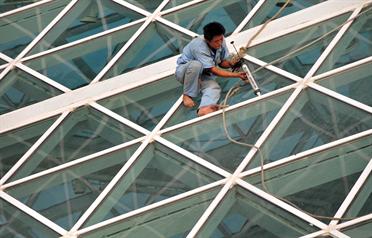
Dai is one of many labourers and others who lack Beijing residence papers who say they have been ordered out as the city's pre-Games clean-up turns towards its millions of ragtag migrants.
"The authorities will not let us stay. It's because of the Olympics," said the diminutive labourer, his work-roughened hands as he draged two beat-up suitcases through a crowd at Beijing's main train station recently.
Headed home to poverty-stricken Anhui province, Dai lost the roughly 1,000 yuan ($145) in monthly earnings that was an important lifeline to his extended family of eight back home.
"I don't have a job now so I won't be able to make any money until I figure out what to do," he said.
Dai and other migrants said they were instructed by authorities to leave Beijing as the city entered the homestretch for the Beijing Olympics, which begin on Friday.
The last-minute makeover for the city of 17 million people has included a crackdown on its huge vice industry, a shutdown of work at construction sites, and measures to curb Beijing's notoriously foul air.
The clean-up also includes the rough-hewn migrants from China's vast countryside whose hard work in often dangerous conditions and for low pay has helped fuel Beijing's growth and built Olympic venues.
The number of migrants in the city topped five million at the end of last year, or nearly one in three people in the capital, the city government said at the time.
It was not clear how many such people would leave. An official with the Beijing government's press office contacted by AFP denied migrants were ordered out.
But several migrants told AFP an exodus was under way.
"My feeling is that it is not fair," said Yuan Daxin, 36, who was also at the train station on his way home.
Yuan, from the northwestern province of Gansu, laboured at an office tower construction site until last month, when a lot of such work across the city was halted.
His employer told workers they were getting an "Olympic holiday".
However, Yuan noted cheerily that his Beijing work helped his family back home buy its first television, which they will use to watch the Games.
"We have to leave to make sure Beijing is not too crowded and dirty for the Olympics. It is our responsibility to help the Olympics be a success," he said.
Human rights and labour activists have long voiced concerns about China's migrants, saying they routinely endure labour rights violations, including on Olympic projects.
Besides the Olympic clean-up effort, however, Beijing officials had expressed concern about strain on water and other resources if too many people are in the parched city during the Games.
Another worry of Chinese authorities could be the prospect of hordes of idle labourers lingering in the city during the Olympics, especially as China sees thousands of public outbursts by its marginalised masses each year.
"Beijing has been turned into a giant stage for the Olympics but it is an artificial window that does not reflect any of the tensions or problems that beset China today," said Nicholas Bequelin, a China researcher with Human Rights Watch.
Wu Zuoliang, a 42-year-old pedicab driver from Tianjin, a city about two hours' drive from Beijing, said police told him he could return after the Paralympic Games end in September.
In the meantime, he will help harvest the corn and bamboo crops his family grows on a tiny plot of land outside Tianjin.
"There's nothing we can do about (the order to leave). But it's alright. It's like a holiday," he said with a laugh.