News
A casual approach to making money
img_08012008_2e6bf400-deea-4907-9dbe-83dd9bf1a617.jpg
They may arrive at work dressed in flip-flops and shorts but when the European financial markets open for the day, the ten traders of the Dubai Professional Trading Group (DPTG) mean business.
Despite their casual attire and calm personas, these market players are men on a mission, wheeling and dealing in futures of fixed income, equity and commodities and making thousands of dollars a day.
Last month, the DPTG hit the one million contracts, or deals, per month mark, which, its members believe, is a clear indication of where the future of the trading arcade in the Middle East is headed.
"It is proof that high frequency trading is possible in Dubai and that the future of the arcade is very good," says Benedict Floyd, right, the executive director. "We are ahead of our business plan, which shows that our business model works."
Located in the Emaar Business Centre in The Greens, the arcade hopes to expand by the end of the year and is already training three individuals keen on making a success in the business – and there are plans to have 20 full-time traders by the end of 2008.
Escaping gruelling 5am journeys to work in London or any other European cities – often under dark, grey skies – these traders are now benefiting from a tax-free lifestyle here.
And as the Middle East's first trading arcade, the members believe they are at the forefront of what could be a new wave of such ventures that could transform the UAE's financial landscape – despite the DPTG not trading on Dubai's three financial markets or the one in Abu Dhabi.
"What we are doing is bringing traders to Dubai. Going forward, and as these local exchanges grow, we will eventually migrate to the local markets here in the UAE. We all expect and hope this will happen," says Floyd, who has traded for Credit Suisse and Bank of America.
According to Mark Fisher, Vice-President Market Development at Dubai International Financial Exchange, all trade on the Dubai markets is currently carried out through brokers. "These include internationally through Deutche Bank and Merrill Lynch and locally through EFG-Hermes and Mashreq," he says.
Following the closure of the London International Financial Futures and Options Exchange (Liffe) in 1998, where traders would actually be on the trading floor wearing different coloured jackets, professional trading groups, or arcades as they are better known, were set up by traders who wanted to continue their livelihoods.
The purpose of trading arcades, which are essentially a collection of traders working electronically and are now popular in Europe, America and Asia, is that those individuals can work the markets for themselves, independent of banks and other companies and save a significant amount of money.
Each trader at the 10-member DPTG has to lay down $50,000 (Dh183,600) as a deposit to show their liquidity and pay $2,500 (Dh9,182) desk rental per month. In return they have access to 47 markets across the world and full-time risk assessors. However, this rental cost is more than offset by the vastly reduced trading fees the traders pay in the arcade. "By trading the kind of volume we are doing, we are able to obtain significant discount in terms of execution fees that normally far outweighs the cost of renting a seat in the arcade," Floyd says.
As they are trading with their own money the professionals keep 100 per cent of the money that they make, which at the top echelon varies between $50,000 and $100,000.
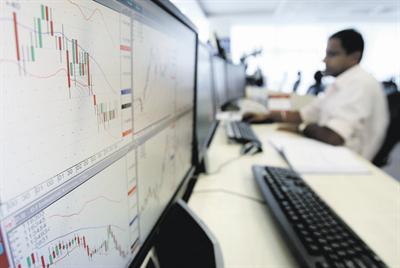
Facilities at the arcade include a $250,000 (D918,125) per year direct line to London so traders can get quick and uninterrupted access to the markets. Some traders have nine screens, which are connected to the markets, news wires and computers with internet and graphs so they do not miss a trick.
Set up last year and launched in February, the arcade is a joint venture between DPTG and Dubai Multi Commodities Centre, with each trader registering as a company.
Floyd says that more and more people are drawn to Dubai as its reputation as a financial centre grows, coupled with tax-free earnings and the timings of the markets.
Applicants for the training courses come from a variety of people and although there are no set academic qualifications needed, applicants have to pass a test before being accepted on the course of which DPTG do not charge for.
"Anyone who says you can pick up trading in a few hours or from the internet is not being realistic. Our business is to make successful traders who will stay with the arcade and, therefore, we choose who we think will be successful and train them to be so. We are not in the business of profiting from education programmes," says Floyd.
One of Europe's largest arcades Schneider Trading Associates, which has 300 traders in offices in London, Spain, Cyprus and France, says it is yet to venture into the Middle East, but does not rule out the possibility.
Richard Brown, head of business development at Schneider, says opening an arcade in Dubai would need the commitment of traders to make it work. "In 1998, just about all the trading floors closed in Europe and when that happened you needed a place to trade," he says. "We made a decision that we wanted to become not just a group of traders but a business.
"None of the senior managers now trade even though some of them have 10 to 20 years of experience. We have lost some traders who have gone to Dubai to set up an office there and if I had five guys who would stay in Dubai for at least one year then we may consider opening an office there.
"The problem is we do not think there is enough personal traction at the moment for us to open an office there. We speculate the market but not business."
Power traders
-- Francois Henriet, 45, from Normandy in France used to be a trader for banks in Paris, London and Monaco, working on the foreign exchange markets. In 2000, he began to trade from his home in Barcelona for four years before working for Schneider in their London offices. Following a six-month 'sabbatical' that took him all over Asia and the Middle East, he joined the DPTG on May 23. "The great thing about this job is that you can pop in when you want to. It's very elastic, very flexible. But if you want to make money you have to be prepared to lose it," he says.
-- Tariq Arees, 28, was born in Baghdad but has lived in England from the age of 10. He says he has been trading since his teenage years. Before he came to Dubai, Arees was trading at Schneider in London for four years.
"I had been looking at moving after a few successful years in London," he says. "Tax bills were getting hefty in the UK and there is no legal way to avoid it. As traders, we have this discussion about what makes us successful and it is hard to pin point a specific term. At the end of the day, without doubt, it comes from hard work."
-- Malek Bouteraa, 32, is a trainee who moved to Dubai from Paris. Having previously worked in the tele- communications industry, he says he has always been interested in the financial markets. "I joined DPTG a month ago to gain some trading experience," he says. "I was trading stocks on an amateur basis at home while I worked. But I was making mistakes and using the wrong tools. Now at DPTG I am using the best tools and learning from professionals. I was looking to go to London, but now I am in Dubai."
Despite their casual attire and calm personas, these market players are men on a mission, wheeling and dealing in futures of fixed income, equity and commodities and making thousands of dollars a day.
Last month, the DPTG hit the one million contracts, or deals, per month mark, which, its members believe, is a clear indication of where the future of the trading arcade in the Middle East is headed.
"It is proof that high frequency trading is possible in Dubai and that the future of the arcade is very good," says Benedict Floyd, right, the executive director. "We are ahead of our business plan, which shows that our business model works."
Located in the Emaar Business Centre in The Greens, the arcade hopes to expand by the end of the year and is already training three individuals keen on making a success in the business – and there are plans to have 20 full-time traders by the end of 2008.
Escaping gruelling 5am journeys to work in London or any other European cities – often under dark, grey skies – these traders are now benefiting from a tax-free lifestyle here.
And as the Middle East's first trading arcade, the members believe they are at the forefront of what could be a new wave of such ventures that could transform the UAE's financial landscape – despite the DPTG not trading on Dubai's three financial markets or the one in Abu Dhabi.
"What we are doing is bringing traders to Dubai. Going forward, and as these local exchanges grow, we will eventually migrate to the local markets here in the UAE. We all expect and hope this will happen," says Floyd, who has traded for Credit Suisse and Bank of America.
According to Mark Fisher, Vice-President Market Development at Dubai International Financial Exchange, all trade on the Dubai markets is currently carried out through brokers. "These include internationally through Deutche Bank and Merrill Lynch and locally through EFG-Hermes and Mashreq," he says.
Following the closure of the London International Financial Futures and Options Exchange (Liffe) in 1998, where traders would actually be on the trading floor wearing different coloured jackets, professional trading groups, or arcades as they are better known, were set up by traders who wanted to continue their livelihoods.
The purpose of trading arcades, which are essentially a collection of traders working electronically and are now popular in Europe, America and Asia, is that those individuals can work the markets for themselves, independent of banks and other companies and save a significant amount of money.
Each trader at the 10-member DPTG has to lay down $50,000 (Dh183,600) as a deposit to show their liquidity and pay $2,500 (Dh9,182) desk rental per month. In return they have access to 47 markets across the world and full-time risk assessors. However, this rental cost is more than offset by the vastly reduced trading fees the traders pay in the arcade. "By trading the kind of volume we are doing, we are able to obtain significant discount in terms of execution fees that normally far outweighs the cost of renting a seat in the arcade," Floyd says.
As they are trading with their own money the professionals keep 100 per cent of the money that they make, which at the top echelon varies between $50,000 and $100,000.
Facilities at the arcade include a $250,000 (D918,125) per year direct line to London so traders can get quick and uninterrupted access to the markets. Some traders have nine screens, which are connected to the markets, news wires and computers with internet and graphs so they do not miss a trick.
Set up last year and launched in February, the arcade is a joint venture between DPTG and Dubai Multi Commodities Centre, with each trader registering as a company.
Floyd says that more and more people are drawn to Dubai as its reputation as a financial centre grows, coupled with tax-free earnings and the timings of the markets.
Applicants for the training courses come from a variety of people and although there are no set academic qualifications needed, applicants have to pass a test before being accepted on the course of which DPTG do not charge for.
"Anyone who says you can pick up trading in a few hours or from the internet is not being realistic. Our business is to make successful traders who will stay with the arcade and, therefore, we choose who we think will be successful and train them to be so. We are not in the business of profiting from education programmes," says Floyd.
One of Europe's largest arcades Schneider Trading Associates, which has 300 traders in offices in London, Spain, Cyprus and France, says it is yet to venture into the Middle East, but does not rule out the possibility.
Richard Brown, head of business development at Schneider, says opening an arcade in Dubai would need the commitment of traders to make it work. "In 1998, just about all the trading floors closed in Europe and when that happened you needed a place to trade," he says. "We made a decision that we wanted to become not just a group of traders but a business.
"None of the senior managers now trade even though some of them have 10 to 20 years of experience. We have lost some traders who have gone to Dubai to set up an office there and if I had five guys who would stay in Dubai for at least one year then we may consider opening an office there.
"The problem is we do not think there is enough personal traction at the moment for us to open an office there. We speculate the market but not business."
Power traders
-- Francois Henriet, 45, from Normandy in France used to be a trader for banks in Paris, London and Monaco, working on the foreign exchange markets. In 2000, he began to trade from his home in Barcelona for four years before working for Schneider in their London offices. Following a six-month 'sabbatical' that took him all over Asia and the Middle East, he joined the DPTG on May 23. "The great thing about this job is that you can pop in when you want to. It's very elastic, very flexible. But if you want to make money you have to be prepared to lose it," he says.
-- Tariq Arees, 28, was born in Baghdad but has lived in England from the age of 10. He says he has been trading since his teenage years. Before he came to Dubai, Arees was trading at Schneider in London for four years.
"I had been looking at moving after a few successful years in London," he says. "Tax bills were getting hefty in the UK and there is no legal way to avoid it. As traders, we have this discussion about what makes us successful and it is hard to pin point a specific term. At the end of the day, without doubt, it comes from hard work."
-- Malek Bouteraa, 32, is a trainee who moved to Dubai from Paris. Having previously worked in the tele- communications industry, he says he has always been interested in the financial markets. "I joined DPTG a month ago to gain some trading experience," he says. "I was trading stocks on an amateur basis at home while I worked. But I was making mistakes and using the wrong tools. Now at DPTG I am using the best tools and learning from professionals. I was looking to go to London, but now I am in Dubai."