Middle East shipping industry projected to grow 35 per cent
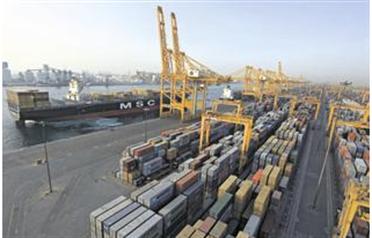
The Middle East shipping industry is projected to grow by 30 to 35 per cent this year, increasing its share of the global sea freight market, according to senior analysts and industry experts.
The regional industry is also expected to outpace the projected growth in the global shipping industry.
Last year, the global shipping industry grew by 20 per cent and it is expected to maintain the same level of growth. Analysts predict growth by around one-third in regional shipping industry compared to the 25 per cent registered last year.
The high demand for oil worldwide, the increasing demand for commodities within the Middle East and the positioning of the region as a major logistics hub are helping the regional shipping industry to grow further.
"Strong growth in trading activities backed by increasing demand for commodities is keeping the Middle East shipping industry afloat. But oil and gas shipments remain the key factors for strong growth in the region," said Abdullah Al Shuraim, Chairman for Gulf Navigation Holding.
Increased demand for energy from the expansionary BRIC economies (Brazil, Russia, India and China) is expected to drive the demand for crude oil upwards, despite deceleration in the growth of western economies.
Current growth trends in global shipping are being attributed to increased shipment of goods from China, but are being also boosted by massive demand for materials and supplies needed to sustain the growth in the Middle and the Far East.
The International Energy Agency (IEA) has estimated a 1.5 per cent year-on-year increase in world energy consumption in 2007 forecasting an increase of 2.4 per cent in 2008.
Accordingly, the worldwide oil consumption is expected to increase from 85.9 million barrels per day in 2007 to 87.9m bbls per day in 2008. The world demand is set to grow to 118m bbls per day by 2030 as a result of population increase and rise in development activities.
The growth in demand will continue to require transportation of oil and redistribution of shipping movements to cater to the rising consumption.
"The demand for Middle East oil is increasingly becoming a major lure for capital from offshore companies that are now establishing bases in the region. We expect investments especially in crude carriers to increase tremendously this year as operators seek to tap into the market," said Sharafuddin Sharaf, President of UAE Ship Owners Association.
The top 30 container ports around the world that accounted for a throughput of 274m twenty foot equivalent units (TEUs) in 2007, comprising 56 per cent of the world throughput of 484m TEUs are expected to grow by 17 per cent, compared to the projected 25 per cent growth in the regional container throughput, according to Drewry Shipping Consultants.
Last year, UAE terminals increased container cargo throughput by 19 per cent to 14m TEUs, with Dubai's ports of Jebel Ali and Port Rashid growing at 20 per cent to reach 11m TEUs. The growth in UAE ports matched the 19 per cent average set by the Middle East, Europe and Africa.
Jebel Ali Port, one of the largest in the world, is expecting over 40 per cent increase in cargo container throughput from the last year's 9.9m TEUs to 14 million TEUs in February 2009.
DP World, the fourth-biggest port operator in the world, recently said its container volumes at Jebel Ali and Port Rashid in the first half of 2008 increased by 17 per cent, while the throughput for Asia Pacific and Indian Subcontinent rose 15 per cent and for Americas and Australia together at 12 per cent.
"Shipping globally has felt the tremors of the slowing US economy that has compromised global demand in the US and European markets. This threatens to slow down the global growth of the shipping industry," said Eivind Grostad, Senior Vice-President and Regional Manager of Det Norske Veritas, a maritime classification society.
The global shipping industry is also witnessing a paradigm shift in trade, which has reduced dependency on the trans-Atlantic route. New routes such as Asia-Europe and Asia-Middle East are now the busiest of all.
While the industry remains profitable overall, its revenue margins are falling, according to UBS, an investment bank. The main problem is that growing demand in 2003 prompted shipping lines to order too many new ships. About 60 per cent of the global capacity is about to be floated, adding to a huge increase in supply over the past three years.
The glut of shipping capacity has forced rates down. But the shortage of crews and the rising oil prices mean the cost of running ships is rising. And because inflation is pushing up the value of cargoes, insurance costs are going up as well.
The Middle East shipping industry has not been hit hard by the increasing fuel prices compared to shipping firms operating outside the region.
To increase profit margin, European shipping firms are taking tentative steps towards consolidation. Maersk Line, the industry leader, plans to begin sharing vessels with competitors on some transpacific routes, as part of a broad cost-cutting programme. Singapore's Neptune Orient Lines has is eyeing a tie-up with TUI of Germany.