News
Al Ain and Sharjah offer good opportunities
img_06022009_e53b5606-8722-4cff-a1ca-722bdccbfd6c.jpg
There are still good pros-pects in Al Ain and Sharjah, according to a senior executive of a landscaping firm.
"Big mega projects are no longer the case. But there is a lot happening in Al Ain and Sharjah and we are involved in those projects," said Steven Velegrinis, Projects Manager, GCLA.
GCLA is a landscape architecture studio having a team of specialists in landscape architecture, horticulture, engineering, urban design and project management. The firm is based in the UAE with offices in Dubai and Abu Dhabi and work experience in Saudi Arabia, Qatar, Kuwait, Lebanon, Syria, Jordan, Pakistan and India (see box for list of projects).
"For the period 2006-2007, we experienced 100 per cent growth and for 2007-2008 it went up to 120 per cent. This year, we do not forecast any growth but we are maintaining our revenue at previous-year levels," Velegrinis said.
It is important to be involved in projects from the inception stage, he said.
"Where we have been involved in the master planning in the beginning as with Dar Al Omran in the Sharjah master plan, we have found that we can resolve problems. For example, Sharjah has a problem sometimes with the Khalid Lagoon in terms of sewage flowing in. Hence, we set up the landscape framework. Additionally, we were appointed to do the master plan and environmental assessment for Khorfakkan and Kalba and have successfully recommended that they must protect the environment before any master planning is done," he said.
The firm is also working with X-Architects on a project in Al Ain for Al Qudra. It is also looking for prospects outside the UAE.
"We have just registered an office in Saudi Arabia and will have an office in Riyadh in the next two months. We have a 12km park project in Jeddah and a large residential developmental project in Riyadh with the Al Bustan Group. Together with Savannah, a master-planning consultant from Singapore, we have also participated in a design competition in Doha for a re-development project at the airport. We made the first round and have submitted for the second round. It is a large project that will depend on market sentiment and there are two or three contenders in the second phase," said Velegrinis.
The company is also working with a professor from the University of Toronto who is collaborating with another one from Harvard. "We are in the process of coming up with plants systems for a book that they are writing on innovative uses of water in arid climates," he added.
The firm is also working with the International Centre for BioSaline Agriculture. "They study plants that can be grown using saltwater for irrigation," he added.
So when the Dubai Chamber of Commerce and Industry (DCCI) announced a $200 million (Dh734m) Dubai Food City in February, GCLA offered a concept design proposal for a self-sustained project based on this background. According to media reports, Farouk Qasim, head of the food and beverage group at DCCI, then said Dubai Food City will be a five million sq ft self-contained development, aimed at wholesale food merchants and the project was in the planning stages.
"While developments such as Masdar are great initiatives, moving us in the right direction it is yet to be seen whether it will be sustainable in terms of food sources, embodied energy in building materials and proper use of the landscape as a biological and organising medium," said Velegrinis.
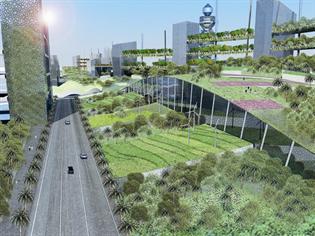
"Hence in our proposal for Food City, we are looking at inverted landscapes where the roof of the entire development was created as an artificial landscape formation of topography that becomes a continuous agricultural mat for the planting of traditional multiculture oasis plants, public park as well as the grazing of livestock."
The vertical farm creates a 30-storey project capable of producing enough organic food for a population of 50,000 inhabitants within the development boundaries and including a beam-down concentrated solar array for energy generation and desalination. It also features aquatic farms.
"We have sent them the proposal, which compiles a range of features, and are waiting for a reply," he said. "Since it is a trade-based concept, we did a design by the sea. It could be shifted anywhere by the coastline."
The sustainability systems designed into Dubai Food City include towers clad in thin-film photovoltaic solar cells, wind turbines dispersed on the landscape surface, methane harvesting through sewage percolation tanks, black and grey water recycling through biocell greenhouses and wetlands, central composting of all green and food waste and use of site-grown materials for construction.
Ongoing GCLA Projects
- Sharjah Al Qasba Masterplan, Sharjah (Phase II Design in progress)
- Sharjah East Coast Masterplan (Preliminary Masterplan Prepared)
- Khorfakkan Corniche (Concept Design)
- Kalba Corniche (Concept Design)
- Al Turath Culture Village, Dubai
- Olive Point Villas, Jumeirah Golf Estates, Dubai
- Sienna Lakes Villas, Jumeirah Golf Estates, Dubai
- Sunland White Bay Residential Development (Detailed Design)
- Majaz Park Development, Sharjah (Concept Design Stage)
- Mamzar Development, Sharjah (Concept Design Stage)
- Sheikha Jawaher Convention and Reception Centre, Sharjah (Detailed Design, Construction Ongoing)
- Heart of Sharjah Heritage Area, Sharjah (Preliminary Study)
- Al Raha Beach Development – Landscape, Abu Dhabi (Varying Stages)
- Crowne Plaza Hotel & Staybridge Apartments, Yas Island, Abu Dhabi (Construction ongoing)
- Al Reem Island, Three Towers, Abu Dhabi (Detailed Design)
- Masoudi Park Ghaf Forest Reserve and Visitor Centre, Al Ain (Commencing Concept Design)
- RAK Bank Headquarters, Ras Al Khaimah (Construction Ongoing)
- Residential Estate, Riyadh, Saudi Arabia (Masterplan)
- Al Bustan II Residential Resort, Riyadh (Schematic Design)
- Rafal Residential Development, Riyadh (Concept Design)
- Tunis Sports City Landscape, Tunisia (Concept Design)
"Big mega projects are no longer the case. But there is a lot happening in Al Ain and Sharjah and we are involved in those projects," said Steven Velegrinis, Projects Manager, GCLA.
GCLA is a landscape architecture studio having a team of specialists in landscape architecture, horticulture, engineering, urban design and project management. The firm is based in the UAE with offices in Dubai and Abu Dhabi and work experience in Saudi Arabia, Qatar, Kuwait, Lebanon, Syria, Jordan, Pakistan and India (see box for list of projects).
"For the period 2006-2007, we experienced 100 per cent growth and for 2007-2008 it went up to 120 per cent. This year, we do not forecast any growth but we are maintaining our revenue at previous-year levels," Velegrinis said.
It is important to be involved in projects from the inception stage, he said.
"Where we have been involved in the master planning in the beginning as with Dar Al Omran in the Sharjah master plan, we have found that we can resolve problems. For example, Sharjah has a problem sometimes with the Khalid Lagoon in terms of sewage flowing in. Hence, we set up the landscape framework. Additionally, we were appointed to do the master plan and environmental assessment for Khorfakkan and Kalba and have successfully recommended that they must protect the environment before any master planning is done," he said.
The firm is also working with X-Architects on a project in Al Ain for Al Qudra. It is also looking for prospects outside the UAE.
"We have just registered an office in Saudi Arabia and will have an office in Riyadh in the next two months. We have a 12km park project in Jeddah and a large residential developmental project in Riyadh with the Al Bustan Group. Together with Savannah, a master-planning consultant from Singapore, we have also participated in a design competition in Doha for a re-development project at the airport. We made the first round and have submitted for the second round. It is a large project that will depend on market sentiment and there are two or three contenders in the second phase," said Velegrinis.
The company is also working with a professor from the University of Toronto who is collaborating with another one from Harvard. "We are in the process of coming up with plants systems for a book that they are writing on innovative uses of water in arid climates," he added.
The firm is also working with the International Centre for BioSaline Agriculture. "They study plants that can be grown using saltwater for irrigation," he added.
So when the Dubai Chamber of Commerce and Industry (DCCI) announced a $200 million (Dh734m) Dubai Food City in February, GCLA offered a concept design proposal for a self-sustained project based on this background. According to media reports, Farouk Qasim, head of the food and beverage group at DCCI, then said Dubai Food City will be a five million sq ft self-contained development, aimed at wholesale food merchants and the project was in the planning stages.
"While developments such as Masdar are great initiatives, moving us in the right direction it is yet to be seen whether it will be sustainable in terms of food sources, embodied energy in building materials and proper use of the landscape as a biological and organising medium," said Velegrinis.
"Hence in our proposal for Food City, we are looking at inverted landscapes where the roof of the entire development was created as an artificial landscape formation of topography that becomes a continuous agricultural mat for the planting of traditional multiculture oasis plants, public park as well as the grazing of livestock."
The vertical farm creates a 30-storey project capable of producing enough organic food for a population of 50,000 inhabitants within the development boundaries and including a beam-down concentrated solar array for energy generation and desalination. It also features aquatic farms.
"We have sent them the proposal, which compiles a range of features, and are waiting for a reply," he said. "Since it is a trade-based concept, we did a design by the sea. It could be shifted anywhere by the coastline."
The sustainability systems designed into Dubai Food City include towers clad in thin-film photovoltaic solar cells, wind turbines dispersed on the landscape surface, methane harvesting through sewage percolation tanks, black and grey water recycling through biocell greenhouses and wetlands, central composting of all green and food waste and use of site-grown materials for construction.
Ongoing GCLA Projects
- Sharjah Al Qasba Masterplan, Sharjah (Phase II Design in progress)
- Sharjah East Coast Masterplan (Preliminary Masterplan Prepared)
- Khorfakkan Corniche (Concept Design)
- Kalba Corniche (Concept Design)
- Al Turath Culture Village, Dubai
- Olive Point Villas, Jumeirah Golf Estates, Dubai
- Sienna Lakes Villas, Jumeirah Golf Estates, Dubai
- Sunland White Bay Residential Development (Detailed Design)
- Majaz Park Development, Sharjah (Concept Design Stage)
- Mamzar Development, Sharjah (Concept Design Stage)
- Sheikha Jawaher Convention and Reception Centre, Sharjah (Detailed Design, Construction Ongoing)
- Heart of Sharjah Heritage Area, Sharjah (Preliminary Study)
- Al Raha Beach Development – Landscape, Abu Dhabi (Varying Stages)
- Crowne Plaza Hotel & Staybridge Apartments, Yas Island, Abu Dhabi (Construction ongoing)
- Al Reem Island, Three Towers, Abu Dhabi (Detailed Design)
- Masoudi Park Ghaf Forest Reserve and Visitor Centre, Al Ain (Commencing Concept Design)
- RAK Bank Headquarters, Ras Al Khaimah (Construction Ongoing)
- Residential Estate, Riyadh, Saudi Arabia (Masterplan)
- Al Bustan II Residential Resort, Riyadh (Schematic Design)
- Rafal Residential Development, Riyadh (Concept Design)
- Tunis Sports City Landscape, Tunisia (Concept Design)
Keep up with the latest business news from the region with the daily Emirates Business 24|7 newsletter. To subscribe to the newsletter, please click here.