Ready-mix concrete set to cost more
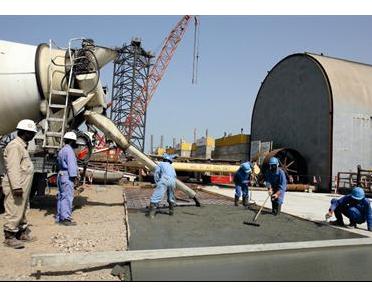
Manufacturers of ready-mix concrete in the UAE plan to hike their prices following continuous increase in the cost of diesel.
Concrete is currently sold at about Dh480 per cubic metre in Abu Dhabi and about Dh430 in Dubai.
Companies said discussions are on to raise the price by about Dh25.
Last week Dubai-based Emirates National Oil Company (Enoc), Emirates Petroleum Products Company (Eppco), and Emarat raised diesel prices to Dh19.25 per gallon – an increase of more than four per cent. Abu Dhabi National Oil Company (Adnoc), which sells only in Abu Dhabi and follows a separate, subsidised pricing policy, charges Dh8.6 per gallon of diesel.
Several transportation companies said the cost of transporting materials has increased by almost Dh5 to Dh7 per tonne in the past six months. A senior official of Unibetton Readymix told Emirates Business that companies could raise prices within this month.
"Transportation and shipping of clinker has become a major issue. Earlier we could arrange for shipping from abroad in 20 days. Now it takes more than two months and still we find transport companies unwilling," said Charanjeet Singh, Operations Manager, Maintenance and Construction, Unibetton.
Another official at Readymix Beton LLC said although diesel sells in Abu Dhabi at just 50 per cent of Dubai's prices, the fact that cement is transported from the Northern Emirates makes it more expensive to operate and supply in the capital.
"There is no other option for companies but to increase the price marginally. A Dh25-Dh30 price increase per cubic metre is inevitable," added the official.
Several Abu Dhabi based companies said their agreements with Adnoc ensured that they got diesel supplies for their Dubai operations at Abu Dhabi rates.
"Every day our company's operations in Dubai alone require about 10,000 gallons of diesel. But our agreement with Adnoc has ensured that we get supplies for less than Dh9 per gallon, compared to almost double that in Dubai," said the official who did not want to be named. His operations in Abu Dhabi only require 7,000 gallons of diesel daily, he added.
Nizar S Darwish, General Manager of Unimix, said: "The increase in the price of diesel poses a serious problem to industries like ours [ready mix concrete companies], where diesel is utilised for power generation as well as for transport and to power the heavy equipment used in construction. To complicate matters further, company managers have to watch the daily rates like stock brokers because any increase can mean a loss to the business.
"Also the price differential between Adnoc and other suppliers provides a certain competitive edge to some companies, which is not fair to others who cannot buy from Adnoc."
Meanwhile, contractors in the UAE are worried escalating costs of diesel could add to the burden of increasing construction costs. Diesel is extensively used in the construction industry and according to experts, constitutes almost 10 to 12 per cent of the construction costs.
It is diesel that powers the construction industry said, Sarfraz H Dairkee, General Manager of Khoory Engineering and a member of the Emirates Green Building Council. "The impact of diesel price hikes on the construction industry should not be underestimated. Power suppy to most construction sites is provided via generators running mainly on diesel," he said.
"Diesel continues to be the prime mover in most aspects of civil construction. Its impact on transportation and production starts from the crusher itself. It accounts for almost 10 per cent of the overall cost of a project," Dairkee added.
Imad Al Jamal, Vice-President of the Higher Technical Consultative Committee, UAE Contractors Association, said diesel continues to be the lifeline of the whole construction industry and affects projects at several levels. "One of the main factors is transportation of goods. Every product has to be transported from the production and distribution outlets to the construction site and an increase in the price of diesel will definitely result in higher transportation costs and increase the price of products," said Jamal.
"Also, trucks and on-site machinery require diesel to function. Cranes operating in Dubai itself require thousands of gallons of diesel every day," he added.
Oil is also used to manufacture many products used in the construction industry, he added. "Particularly affected are civil contractors and road builders who use asphalt paving, which is based on petrochemical products. Add to this other raw material price escalations. Contractors' margins are being severely strained and, as a result, a fluctuation clause has become a must," Jamal said.
Contractors, however, feel nothing much can be done to avoid the consequences of the price hike.
Construction costs have increased by more than 100 per cent in the past 12 months – with higher prices of cement, steel and diesel being the major contributors. The price of a one-tonne cement bag almost quadrupled in the past year. Presently, a tonne of cement is priced at Dh480 in the black market and about Dh410 for cement obtained from factories in Ras Al Khaima and Ajman.
Quince George, Purchase Manager at Gulf Precast Concrete, said there was, luckily, enough supply of cement in the market. "The first quarter of this year witnessed severe shortage of cement. If the situation had continued there would have been chaos in the market. Thanks to government intervention, coupled with increased production within the country, the shortage of cement has eased significantly," said George.
One contractor said he has plans to make up for the cost increases by inflating estimates. "Of late contractors are negotiating price structures with some additional margins. Moreover, there are also clauses specifically aimed at sudden increases in the prices of certain commodities. There are fears that the oil price will rise further," said Abdul Hisham from Cairo Contracting.
Although the UAE Government intervened recently and introduced several measures to cap the prices of cement and steel, contractors feel nothing much can be done about diesel prices.
According to Jamal, it is very difficult for individual governments to control the rise in oil prices. Moreover, Dubai and the Northern Emirates have to depend on external supplies and are buying oil from the international market. Several construction sites in the Northern Emirates run on diesel-powered generators. It is a grim scene, according to the contracting industry.
However, a leading equipment manufacturer pointed out that the construction industry has not demonstrated enough awareness in achieving fuel efficiency.
"With the current pace of projects we have not experienced any drop in demand and sales are going north. But internationally, the primary driver in the fuel issue is reducing emissions.
"However, this market is neither looking at emission issues nor at the possibility of achieving fuel efficiency by training the machine operators. Though we have the capabilities to train, we still do not have get any enquiries. With the steep rise in prices, we believe the industry will eventually start to look at a shift from standard diesel engines to hybrid technologies," he said.