Two firms in race for Dh10bn Pearl Dubai contract
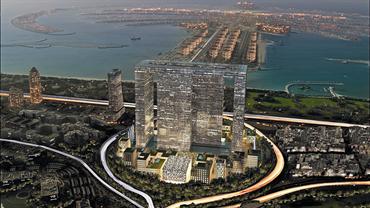
Next week, Pearl Dubai will award its Dh10 billion main contract to one of the two companies in the final shortlist for its Dubai Pearl project. Meanwhile, the first phase of construction has begun in April, when Pearl Dubai awarded a contract worth Dh305 million to Al Habtoor STFA Soil Group to carry out enabling works.
The project had its share of issues and had received much flak after its initial launch in 2002 by the Omnix Group. Due to the slow progress, master developer Tecom Investments sold the project to a group of investors led by the Al Fahim Group, which repositioned the development and re-launched it.
Emirates Business spoke to Santhosh Joseph, President and CEO of Pearl Dubai, on the turnaround of the project and how it made business sense to redo the master plan instead of spending 98 per cent of the project investment into saving the existing two per cent of history.
When did you join the project?
I took over as President and CEO of the project in 2006. We brought in Schweger Association Architects in early 2007 after a design competition.
What happened to the previous infrastructure?
We had to start from scratch. Spending 98 per cent of our investment into saving the two per cent of what was built was not a good idea. We wanted to put good money after good money. Currently, we are doing the piling work for the main tower. Shoring and dewatering is going on and the main contract worth Dh10 billion will be awarded the next week. There were four companies shortlisted, which has now come down to two.
What was the baggage that came with this project?
This was a project that was launched four years ago. We were not comfortable with the old master plan because it had technical and viability issues. Fortunately, we could turn it around into something much more than expected. The size of the site is 1.8 million square feet. But it was not an easy task to get the old 250 customers who bought into the old project to agree to the change in design.
So what is the USP of the new offering and what are the changes in design?
The new design had to be an iconic one, which made the old customers happy to being part of the new project. The new design is also simple, technically and financially feasible and efficient.
Besides, we believe this site needed a spectacular building. The main building will occupy 13 to 14 per cent of this project. The emphasis has been on greenery and open spaces since we believe in creating a pedestrian-friendly city. The site is surrounded by Knowledge Village, Media City, Internet City and Palm Jumeirah.
With the current design of the main building, the project looks like a gateway to Palm. The design is very efficient in terms of floor plates because it does not have columns between the façade and the core. Also, the podium buildings around the main building are classic and contrast with the main building, which is very modern. This has been done so because we are building a city. The main building has 73 floors, of which the top three are sky palaces.
The project comprises five clusters, which will be branded into crystal, fashion, jewellery, music and entertainment and technology and sport themes. We have launched Baccarat as the first offering (crystal). The other four will be launched next year with the sky palaces. The project will also house a 2,000-seater theatre.
What was the problem with the old design?
The old design had nine towers on the periphery with a dome in the centre, which was the shopping mall. The problem was that each of the buildings went through the car parking space. Hence the first project had a low efficiency level in terms of 2,000 car parks per level with six levels.
We believe that in such a project, the most important thing is the sense of arrival. If you arrive into a car park, you do not get a luxurious feeling. So we planned the parking on a grid, which will ensure 15,000 parking spaces below the development. A visitor now will have a different feeling when he drives into the project. The development will support people who live, work and play there – 30,000 people plus additional traffic from the surrounding areas.
How do you address the issues of handling construction on such a tight site?
The logistical issues do exist and we have worked out a comprehensive plan in terms of bringing in labourers, materials, deciding the lay down areas and so on. It has good and bad aspects but this is a great location, in the sense that it is the last plot in a developed area.
How did you address the noise problem created by the demolition of the existing building?
The demolition did create noise but that is behind us. Fortunately, this is not predominantly a residential area and more of a commercial, given the surrounding free zones.
When did you decide to go for a Gold Leed rating?
This year, we initiated the decision following the initiative of His Highness Sheikh Mohammed bin Rashid Al Maktoum, Vice-President and Prime Minister of the UAE and Ruler of Dubai, and plan to aim for Gold for the project as a whole. Meinhardt, who is the lead engineers, will do the certification.
What do you think of the economic scenario of the past six months in the construction industry and how does it affect your schedule?
The prices of steel and cement have dropped which is helping us. We are on schedule and I see the current market scenario as a temporary situation.
Santhosh Joseph: President and CEO, Pearl Dubai
Joseph has over 20 years of management expertise developing and executing new investment strategies and in monitoring the growth of real estate on an international level. He has a history of success in companies ranging from apparels to business process outsourcing. He has served on the board of several start-ups and has led a number of information technology companies to substantial investor returns. Prior to establishing Dubai Pearl, Joseph served as Managing Director for a leading exporter of menswear in India.
DESIGN AND PLANNING
Dubai Pearl is to be built entirely on urban infill.
The podium is divided into two separately defined building zones – on the Palm side are the residential buildings, while the hotel and office buildings are on the Sheikh Zayed Road side, which also includes a business zone at ground floor and first floor.
The Central towers will be a mixed-use building.
The podium-level buildings are to be seen as part of a single design concept, primarily because of the unique position it has in the overall context of the urban plan, according to Schweger Association Architects.
Architecturally, the buildings of the podium articulate themselves as low-rise in order to contrast the high-rise of the central Towers.
Each tower dimension will stand at 28.5m x 90m.
The main building will be constructed of steel and concrete columns with glass façade.
The crown of the building is an 18 metre high steel structure connecting the central cores for the different towers.
Although the low-rise building's appearance is more stone-like in contrast to the transparent glass facades of the high-rise, they communicate to each other by their reduced and plane surfaces of the facades and their clear articulated volumes.
The landscaping area will be around 45 per cent. The development will be pedestrianised with climate-controlled walkways.
The site
The site is located in the beach environment of what is becoming the centre of Dubai's southern urban spread along Jumeirah Beach. This area is now being referred to as "New Dubai".
The Pearl, as among the major developments in this area, will help complement and complete this hub.
The site is surrounded to the north by the existing development of Knowledge Village and to the south by the existing Media and Internet Cities.
The master plan
The subject land shall be developed as a mixed-use development consisting of a mixture of building uses that include retail gross floor area (1,033,202 sq ft), office gross floor area (3,231,853 sq ft), residential gross floor area (3,878,362 sq ft) and hotel gross floor area (1,539,803 sq ft). The total gross floor area is 9,683,220 sq ft.
Access and exit strategy
The Ring Road will be the point of direct access to the site.
The Metro system of the Palm will be supplemented by a proposed light rail system with adjacent stations, to provide access to public transport.
The project will feature five access areas – The Palm (entrance), Ring Road (entrance and exit), Al Sufouh (exit), Tecom roundabout (exit and entrance) and Dubai Media City (exit).