Record oil rally has a long way to run
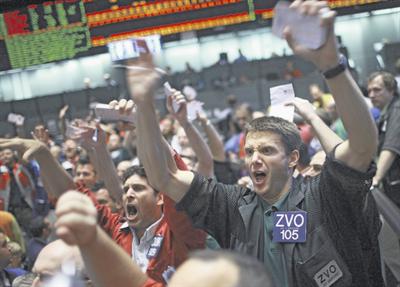
The old saying what goes up must come down seemed true of oil markets this week as falling demand helped wipe more than $10 off the price, but long-term supply constraints could keep investors keen.
Bullish forecasters say the record rally that took prices to more than $147 a barrel last week has a long way to run and that it will take years to make up for a chronic lack of investment in bringing on new supplies.
Soaring energy prices have eroded households' purchasing power and pushed up producers' cost curves, squeezing both revenue flows and profit margins.
Concerns about the health of the United States and major European economies are expected to remove some of the speculative froth currently built into most commodity prices, particularly oil.
Federal Reserve Chairman Ben Bernanke on Tuesday gave a downbeat outlook for the US economy, putting a question mark on the oil demand from the largest consumer of oil.
Others say prices, which fell below $130 a barrel on Thursday, have hit the kind of levels that have a significant impact on demand.
"We believe the 100 per cent rise in the oil price over the last year is not sustainable going forward," said Richard Batty of Standard Life Investments. "While cheap oil may be a thing of the past, oil prices could be much more volatile, falling and rising with the business cycle in the years ahead."
Oil contracts for delivery as far into the future as December 2016 have traded above $140 and are still above $130, implying strength in the market will be maintained.
Goldman Sachs, one of the most active investment banks in the commodities markets, earlier predicted prices could reach $200 and oil tycoon T Boone Pickens, the owner of hedge fund BP Capital Management with an estimated current net worth of about $3 billion (Dh11bn), said this month prices would not ever fall below $100.
But US investment bank Goldman Sachs is maintaining its $149-a-barrel year-end price target for crude oil because inventories remain "extremely low" and the market is vulnerable to supply shocks.
Oil prices may fall in the "near term" on rising inventories in developed nations as the US and Japanese imports increase, Goldman analysts Jeffrey Currie and Giovanni Serio said in a report.
Still, the low inventory levels that underscore the risk of price "spikes" haven't been eliminated.
New York crude oil futures for August delivery are down 10.4 per cent this week and are poised for a record weekly slump in dollar terms after declining $14 a barrel since July 11. Prices fell as crude inventories increased in the US amid concern that an economic slowdown would cut demand, while Opec's biggest producer Saudi Arabia boosted production.
While an increase in US and Japan crude oil inventories in the next few weeks "would lower the risk of a dangerous tightening of near-term fundamentals, the potential for upward price volatility in the next few months is still meaningful", the Goldman analysts said.
US crude supplies rose 2.95 million barrels to 296.9 million barrels last week, the US Energy Department said, while the forecast in a Bloomberg News survey was for a drop of 2.2 million barrels. Crude oil stocks in Japan, the world's second-largest economy, gained 8.7 million barrels last week, Goldman said, citing Petroleum Association of Japan data.
"Higher imports could be the first sign that the announced rebound in Saudi production" is resulting in increased purchases by developed nations and that could help avoid "tightening" of supplies after large stockpile declines in the past two months, the Goldman analysts said. Nymex August crude oil options expired at the close of trading on Thursday. August $130 puts, which represent the right to sell oil at that price, were the most actively traded options contract on the Nymex yesterday.
"Given the current open interest in put options, the next critical values would likely be $120 a barrel, $110 a barrel and $100 a barrel. The open interest in put options struck at those prices has increased recently along with the overall volume in options," the Goldman analysts said.
The open interest, or contracts outstanding, on $120 put options more than doubled to 36,004 contracts as of July 16 from a month ago, according to Nymex data.
But $100-plus oil and fall-out from the credit market crisis is spilling over into the wider economy.
Investors, such as pension funds and insurers, who tend to buy for the long term are unlikely to flee en masse.
The shorter-term speculators, however, could leave and some say losses could be steep. What is bearish for equities – economic slowdown and weak corporate profit growth – can also ultimately be bearish for oil, as consumers and companies feel squeezed and cut demand.
Even the demand from emerging economies led by China and India that has spurred the record oil rally might not be immune to the economic slowdown taking root in the United States.
Following the oil crisis of the 1970s Japan switched from being one of the most oil intensive economies to being one of the most fuel-efficient in the world.
The pressures are growing on the Chinese authorities to follow the path of Japan when it was industrialising rapidly. "If trends like this were repeated across the developing world, the demand-supply balance could alter radically in the years ahead," said an analyst.
Prices rise
Oil prices rose above $130 a barrel yesterday, after a 10 per cent decline in the past three trading sessions lured buyers. Easing tensions between Iran and the West and worries that high prices and a weaker US economy will undermine demand have sent US crude down $15 in just three days, putting it on track for its biggest weekly fall since the contract started trading in New York in 1983. US light crude rose $2.75 to as high as $132.02 a barrel and it was trading at $131.08 by 1145 GMT.