Green certificate for dozens of buildings
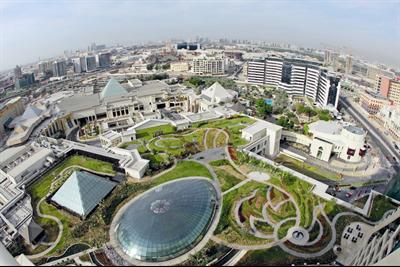
Dozens of building across the UAE are in line to be awarded Leadership in Energy and Environmental Design (Leed) certifications, the global standard for sustainable development.
So far only three projects in the country have been ranked under the scheme.
"There are a further 70 buildings in Dubai and Abu Dhabi registered so far and waiting to be accredited with green building certifications," said Mario Seneviratne, Managing Director of Green Technologies, and a board member of the World Green Building Council.
Dr Sadek Owainati, Chairman of the Emirates Green Building Council (EGBC), said: "The Wafi district cooling project in Dubai was the first to be awarded Leed gold and the Metito building in the emirate was given the same ranking. The highest Leed certification, platinum, has been given to the Pacific Controls headquarters in the emirate.
"The next Leed announcement will be for a building in Abu Dhabi, which has yet to be named by the certification authorities," he said.
The Leed Green Building Rating System, developed by the United States Green Building Council in 1998, provides a set of standards for environmentally sustainable construction.
Owainati, speaking to Emirates Business, said there were plans to introduce the Leed for Neighbourhood Development programme, covering residential communities.
"There are a couple of master-planned projects in Dubai, which may be developed along these lines, but the product is still a pilot project in the US," he said.
"The focus will always be on energy, water and indoor air quality when it comes to sustainable programmes," said Owainati.
"Air-conditioners take up more than 55 per cent of the energy load and lighting takes up between 15 to 18 per cent."
Seneviratne added: "The whole building sustainability theme has been accelerating worldwide in the past two years. If you take China or India, they are all in their infancy in terms of applying sustainable theories.
"From that perspective we have not been slow in introducing green initiatives into the UAE."
A sustainable building can achieve energy savings of up to 50 per cent, according to the EGBC.
His Highness Sheikh Mohammed bin Rashid Al Maktoum, Vice-President and Prime Minister of the UAE and Ruler of Dubai, has ordered that all new buildings in Dubai should be constructed along green lines.
Seneviratne added: "Leed is a practical tool and there is always a cost payback for developers or owners of buildings – even existing buildings."
Apart from Leed there are other certification programmes such as Bream-Green and Green Star. Abu Dhabi is working on its own green rating system.
Owainati said: "In the whole of the Gulf the most serious issue is water. We estimate daily per capita consumption to be in the range of 300 to 500 litres.
"Per capita energy consumption in the UAE is about 12,000kW, double the figure in England. The main issue is air-conditioning. If a building is better oriented then it will have a better heat load control and if that is taken care of then that can amount to tremendous savings on capital investment for the developer."
A building achieving 34 to 42 points on the green building scale is classed as a certified Leed development.
A building achieving 43 points to 50 points will qualify as silver, a building achieving 51 points to 67 points will receive the gold rating and a building achieving 68 points to 92 points will be platinum.
The EGBC is working towards creating its own system, which will be a version of the Leed scheme adapted to suit local conditions.
The Dubai-based company Dubai-based Energy Management Services (EMS) has been working with a number of developers in the UAE with a view to converting over-budgeted projects into cost-effective propositions.
EMS Chief Executive Khaled Bushnaq said: "Most real estate developers face the problem of having an over-budgeted proposal presented to them by contractors - and the contractor always sets a price according to the design of the building.
"In most cases the capacity of utilities far exceeds the actual requirements. In a master-planned development the consultant develops a plot of land and sometimes if a particular project is over-designed there can be proposals for over-budgeted utilities. In such cases what we do is review the designs and incorporate energy-saving techniques that will help reduce the capacity of utilities," he said.
"For example with Sorouh on a particular project of theirs there was a requirement for a 7MW connection load when only 5MW to 6MW load was needed. Not only did we reduce the load capacity but also the cooling capacity on that project. Thus we achieved capital savings for the company."
In some cases the capital savings on a project can range from Dh1.6 million to Dh5.6m, said Bushnaq.
"Union Properties' MotorCity is another example where we saved the developer millions of dirhams simply by adding value engineering systems. The average savings we can get on existing buildings is about 25 per cent of their annual electricity and water bills. Usually in existing buildings we run audits to determine energy levels. For new buildings if we come in at the design stage of a project the savings can be 30 to 35 per cent."
EMS is involved in 37 projects across the UAE and the GCC and is working with developers such as Emaar, Nakheel, Union Properties and some of the main developers on the Waterfront.
"On Executive Towers in Business Bay, a Dubai Properties development, we established several green solutions. We started by modelling the building and we then realised that the effect of neighbouring towers created a cooling effect on the building, which therefore required a lower cooling load."