Retail sales will pick up after Gitex
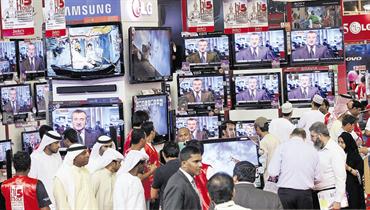
Consumer purchases at the retail and corporate levels are expected to pick up after Gitex, say industry executives.
Corporate budgets will be assigned after product announcements are made at the exhibition.
However, the show still faces competition from global rivals such as CeBIT and CES which are keenly anticipated by technology enthusiasts.
Emirates Business spoke to Kevin Chen, HTC's General Manager for Middle East and North Africa, Didier Trassaert, Senior Director, Emea, for Branded Products at Western Digital, Jai Shankar, Marketing Manager at Brother International Corporation Gulf and Patrick Hayati, Regional Director at networking firm Belkin MEA.
Is Gitex still seen as a hot spot for global launches? Or has it lost its old appeal?
Chen: Gitex is one of the most strategic technology events in the Middle East and provides an excellent base for new technology companies to promote their brands in the region, established firms to showcase their latest technologies and win business deals and customers to enjoy value deals on the various products.
Trassaert: Technology exhibitions such as Gitex are very important for the IT and technology industry. Businesses plan product releases and consumers hold their purchases until the event to reap benefits from attractive promotions and prices.
Jai Shankar: It might not be a hot spot for global launches right now, but it is definitely the place to unveil products for the Middle East and African markets. In addition, the Gitex events staged in Dubai remain the more popular platform for launching IT products in MEA despite the presence of the same event at Riyadh in Saudi Arabia.
Hayati: Gitex is an opportunity for Belkin to directly address one of the fastest growing technology markets in the world, with IT spending in MEA forecasted to reach $36 billion [Dh132bn] in 2009 according to IDC.
What are the advantages of launching new products at Gitex?
Chen: Gitex attracts visitors from the entire Middle East, from both the consumer and business segments. Visitors attend the exhibition expecting to witness something new in technology and value-adds. Also, Gitex provides a platform to create brand visibility.
Trassaert: We intend to use Gitex to launch into another year of growth in the Middle East. We will showcase our latest range of products and meet a number of existing and potential customers and partners from across the region. Gitex will serve as a reminder that the Middle East boasts one of the fastest growing IT markets in the world.
Jai Shankar: Launching a product at Gitex gives companies an extensive opportunity to connect with a large number of channel partners and regional distributors as well as clients from the corporate and enterprise sectors, who consistently have a large turnout at the event to learn the latest in the Middle East market. More notably, the event happens just before the peak business season and well before CeBIT.
Hayati: At this year's Gitex we are not only looking to increase our brand awareness but also to educate visitors on the Belkin product offering. We would also like to continue growing our existing customer base and expand on our new partner network in the region.
Are product launches in the UAE and Middle East happening in line with global launches?
Chen: It all depends on the strategies of the respective organisations, timing, the market's readiness to accept the new product and other factors.
Trassaert: As technology evolves and advances we have seen a parallel demand for increased capacities of hard drives. We have responded to this demand by increasing the capacities of some of our most popular drives. The Middle East remains an attractive ICT market for us and Gitex remains a perfect platform for launching products.
Jai Shankar: From our standpoint, this is not the case, as product launches within our market are segmented into two periods: The first half, usually during CeBIT, and the second half during Gitex for the MEA.
Hayati: Yes definitely. As the region continues to boom despite the global downturn, we are seeing more and more organisations are recognising the huge potential of the Middle East. For example, a recent IDC report states the total IT spend for all 52 countries will be $1.4 trillion in 2009, with countries from the Middle East and Africa region accounting for $36bn. In addition, the IT spend in the UAE alone is at $4.1bn, showing that the UAE is one of the fastest growing markets.
How attractive is the UAE or the Middle East for global launches?
Chen: The UAE is the Middle East's business hub and is becoming popular worldwide, so it certainly would not be a bad strategy to have a global launch in this part of the world.
Jai Shankar: Although the UAE has excellent promise I believe that it might take some more time for it to become a centre for global launches such as CeBIT and Messe Frankfurt, as companies still see this mostly as a regional hub.
Does it make business sense to have launches in the region? What part of the region and which exhibition is most attractive to have launches?
Chen: Yes, we do have regional launches of our flagship products every year since our setup in the Middle East. Recently, in partnership with etisalat, we launched the HTC Magic, an Android-powered device.
Trassaert: It does make business sense to have launches in the region, particularly in Saudi Arabia and the UAE, as these two markets are the biggest markets in the region for business and ICT.
Keep up with the latest business news from the region with the Emirates Business 24|7 daily newsletter. To subscribe to the newsletter, please click here.