GCC states' spending up 26% in H1
The UAE and its five partners in the Gulf Co-operation Council boosted actual expenditure by nearly 26 per cent in the first quarter of 2008. The excess spending has been blamed for high inflation, according to official figures.
The surge in their oil income, which is expected to hit a record $600 billion (Dh2,204bn) in 2008, has tempted the six members to overshoot spending as was the case in 2007 and 2006, said the Saudi-based Federation of GCC Chambers of Commerce and Industry (FGCCI).
While such a surge has allowed them to spend more on projects and consolidate their overseas assets, it has put pressure on their economies and contributed to higher inflation rates, FGCCI said in a study, sent to Emirates Business.
"GCC states appear to be pursuing a strategy of high spending on development to boost growth and create jobs for nationals despite the effect of this increase on prices that have pushed inflation to record levels," the study said.
"Available data showed the combined actual expenditure by the six countries surged by around 26 per cent in the first quarter of this year. This increase was coupled with efforts to expand the capacity of local economies to absorb higher expenditure, but the absence of flexibility in their fiscal and monetary policies because of the peg between local currencies and the US dollar has led to heightened inflationary pressures, which are compounded by high population growth, soaring prices and house rents."
The report said high actual spending sharply accelerated the GCC economies in the first quarter of 2008, with the nominal GDP racing by 27.9 per cent compared with around 14.8 per cent in 2007.
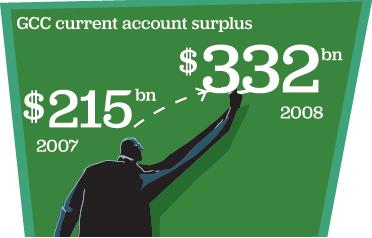
Their combined current account surplus also hit a record high of $215bn last year and was projected to swell further to nearly $332bn this year, accounting for about 31 per cent of the GDP in 2008 compared with 27.5 per cent in 2007.
"Oil export earnings of the GCC states are also expected to hit a record $600bn this year, nearly 57 per cent higher than 2007 revenues of nearly $381 bn. This is because of the sharp increase in crude prices due to demand, speculation, geopolitical tensions and other factors," it said.
The report blamed high public spending, the dollar peg and other factors for surge in inflation rates in the GCC. It noted such an increase has combined with a spate of interest rate cuts in the GCC to match US rate cuts to largely boost domestic liquidity, which is normally associated with inflation. Its forecasts showed GCC money supply could grow by 17.4 per cent in 2008, including 21.8 per cent in Qatar and 18.7 per cent in the UAE.
"The GCC financial and monetary policy will remain restricted by the peg between the local currencies and the US dollar. This has pushed down interest rates in the GCC following a series of US rate cuts, leaving member states with little room for maneuvering. In such a situation, the policies of the GCC central banks remained confined only to stemming liquidity by issuing certificates of deposits or other tools," it said.
In a recent report, the International Monetary Fund urged the GCC governments to cut down spending as one of the tools to tackle inflation. But most of them appeared to have been unable to lower expenditure as they were tempted by the sharp rise in their oil income and the need to finance new projects and shelved ventures. Experts believe a rapid growth in the GCC's population and developing needs was another key factor in the surging expenditure.
Official figures showed the GCC states overshot budgeted spending by between 10 and 20 per cent last year but the surplus emerged far higher at the end of the year because the growth in their income outpaced that in spending.
The projected budget surplus of around $33bn shot up to nearly $110bn at the end of 2007, half of which was recorded in Saudi Arabia, the world's largest crude exporter. However, the balance was slightly lower than the 2007 surplus of around $121bn.