US prepared to 're-write' Farm Bill
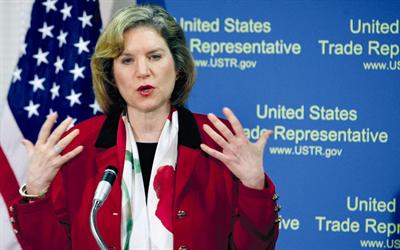
The United States took the first bold step in a week of crunch trade talks yesterday, slicing $1.4 billion (Dh5.1bn) from any previous offer to limit contentious, trade-distorting subsidies to American farmers.
US Trade Representative Susan Schwab told a news conference that Washington was prepared to rewrite elements of its recently passed Farm Bill to ensure that US subsidies deemed to unfairly enhance the competitiveness of American farmers are limited to $15bn annually.
While Congress may view the move skeptically, in one fell swoop the Bush administration's top negotiator shifted pressure on Brazil, India and other emerging economies to up their markets for industrial goods — a key demand of rich countries in the World Trade Organisation's seven-year trade round.
Emerging countries have demanded a cap closer to $12bn for the United States, noting that US subsidies have fallen to around $9bn annually amid higher prices for basic commodities.
The poorer countries charge the payments with providing rich-world farmers an unfair competitive advantage that hinders Third World development.
But the Bush administration — and the US Congress — have sought flexibility in case crop prices fall and American farmers need greater support.
Washington is currently allowed to distribute over $48bn in subsidies linked to price, production and other trade-distorting criteria.
It agreed last year to come to at least below $16.4bn in a move that generated criticism for American farm groups. The European Union and Japan are also offering steep cuts in subsidy limits.
"Anyone who understands farm programs will understand how significant the reduction is implied by this number," said Schwab, noting that US subsidies have exceeded her proposed limit in seven of the last 10 years.
Without a global trade deal, they may exceed $15bn again as part of the United States' new, five-year farm bill worth nearly $300bn that Congress passed over US President George W Bush's veto.
Schwab described the concession as a "major move, taken in good faith, with the expectation that others will reciprocate and step forward with improved market access" for farm and industrial exports. Rich and poor countries have clashed repeatedly in the WTO talks launched in Qatar's capital in 2001, now known as the Doha round.
Developing nations want agricultural tariffs and subsidies in rich countries to come down so they can sell more of their produce, while the US, European Union and others seek better conditions in emerging economies for their manufacturers, banks, insurers and telecommunications companies.
Negotiators are hoping for agreement this week on a deal that would liberalise world agriculture and manufacturing, setting the stage for an overall trade accord by the end of the year.
But there is widespread skepticism.
More cuts needed
A new offer by the United States to cut the limit on its trade-distorting farm subsidies to $15bn is not serious and bigger cuts are needed, a senior officials from India and Brazil said on Tuesday.
"My immediate response is it doesn't pass the 'laugh test'," the senior official, who asked not to be named, told Reuters.
He said the new proposed ceiling was double current actual outlays for US farmers of about $7bn, while the United States was asking developing countries to open markets by making real cuts in their actual agricultural and industrial tariffs.
"This is only the second day of the talks here so we imagine there is room for manoeuvre to reduce them further," the Brazilian diplomat said on the second day of a week of negotiations at the World Trade Organisation to rescue a global trade deal.
Brazil wants the United States to go to the bottom of a range of between $13bn and $16.4bn for its farm subsidies, as proposed by WTO mediators, the diplomat said.