Focus now on South Africa’s efforts on Zimbabwe
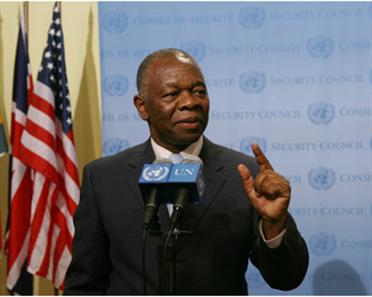
South Africa made the link itself during deliberations at the United Nations that ended on Friday with Russia and China vetoing the US-proposed sanctions.
South Africa’s UN Ambassador Dumisani Kumalo said meetings mediated by Mbeki were under way between Zimbabwean President Robert Mugabe’s party and its opposition. Kumalo pleaded with his colleagues on the Security Council to “give space” to that dialogue.
South African officials say the goal of the talks is forming an inclusive government in Zimbabwe. Both Mugabe and Zimbabwean opposition leader Morgan Tsvangirai say they are willing to share power, but they differ on who should lead.
Mugabe’s ZANU-PF wants Mugabe at the head of any coalition government, something the opposition and Mugabe’s critics in the West have rejected. Tsvangirai bases his claim to leadership on the first round of presidential voting, in which he beat Mugabe and two other candidates, but did not win the 50 percent plus one vote necessary to avoid a runoff against second place finisher Mugabe.
Tsvangirai, meanwhile, has accused Mbeki of bias toward Mugabe, and called for a second mediator to be brought in.
Nicole Fritz, head of the Southern Africa Litigation Centre, an independent human rights group that has closely followed the Zimbabwean situation, worried that without the pressure of sanctions, Mbeki would be able to make little headway as mediator.
The failure of the sanctions resolution “buys Mbeki time,” she said. “My sense is that buying Mbeki time is not going to do us any good.”
In a statement on Saturday welcoming the defeat of the resolution, South Africa said it believed “imposing sanctions would indeed have impacted negatively on the current dialogue process among Zimbabwean political parties.”
The process is at a very preliminary stage – Tsvangirai argues it cannot even yet be labeled talks.
Tsvangirai is not alone in questioning Mbeki’s mediation, which began more than a year ago at the request of the main regional body, the Southern African Development Community.
Mugabe, accused of a brutal crackdown on political dissent and ruining a once vibrant economy, has repeatedly praised Mbeki. That hasn’t helped the South African leader’s case among critics here and abroad who have likened Mbeki’s “quiet diplomacy” to appeasement of Mugabe.
During a visit to South Africa earlier this week, Liberian President Ellen Johnson Sirleaf called for another “high profile” African mediator to join Mbeki in trying to find a solution for Zimbabwe. Sirleaf is an admirer of Mbeki – she noted he had helped broker the agreement under which Liberian war lord Charles Taylor went into exile in 2003, opening the way for peace in her beleaguered country, and said she hoped he could do the same for Zimbabwe.
South Africa also has won praise as a mediator in Burundi, Ivory Coast and elsewhere on a troubled continent. But in Zimbabwe, Mbeki is accused of showing too much loyalty to Mugabe out of respect for the Zimbabwean leader’s past as an anti-colonial hero, or out of shared skepticism about African trade union movements. Tsvangirai is a former labor leader, and South Africa’s trade union movement has long presented a powerful challenge to Mbeki from the left when it comes to setting economic and other priorities here.
Mbeki “is now Mugabe’s champion,” said Tiseke Kasambala, a Zimbabwe specialist at Human Rights Watch who expressed frustration Saturday at the failure of the UN sanctions resolution. “He’s no longer a neutral mediator.”
Mbeki, though, argues that confronting Mugabe could backfire. And his supporters have said he deserves credit for a first round of presidential voting that was seen as relatively free and fair. Thanks to an agreement Mbeki helped broker, results of that first round were posted at individual polling stations, an innovation that made rigging difficult.
Hopes raised by the first round, though, were quickly shattered by an onslaught of attacks on opposition supporters blamed on Mugabe’s police, soldiers and party militants. It became clear Mugabe planned to use violence to ensure victory in the second round. Tsvangirai withdrew from the race. Mugabe went ahead with the vote on June 27 despite denunciations from around the world that it was a farce.
Now, Mugabe is staking his claim to rule on the June 27 vote, which his state-run media lauded on Saturday for its “crushing result and its permanence.”