Bolivians to vote on whether to keep president
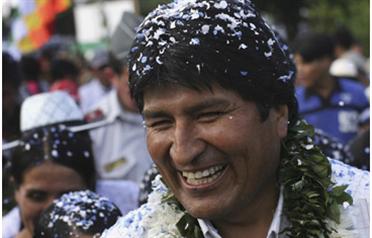
Polls open at 8am (1200 GMT) and close at 4pm (2000 GMT). Alcohol, the carrying of firearms are prohibited during the day. Voting is compulsory under threat of a 150-boliviano ($21; Dh77) fine, a large sum in Latin America's poorest nation.
The recall plebiscite was called by Morales in an attempt to subdue opposition governors who are defying his leftwing reforms and demanding autonomy from his government.
A stalemate between the president and six of the governors has plunged Bolivia into crisis and stymied some of Morales's efforts to turn it into a socialist state modeled on that of Venezuela.
Pre-poll surveys suggest Morales will be reconfirmed in his post, thanks to massive support among the indigenous majority from which he hails and which makes up 60 percent of Bolivia's 10-million strong population.
"I am not afraid of the people," he said Saturday, as he urged "calm" voting.
Most of his political enemies are also expected to ride high support in their states – in the wealthier, more conservative east – to remain in their gubernatorial chairs.
One or two governors, though, face the possibility of being recalled.
One of them, Manfred Reyes of the central states of Cochabamba, has vowed to ignore any result ousting him, raising the prospect of violent clashes in his divided region in the wake of the plebiscite.
Differing interpretations between congress and the National Electoral Court on what percentage of ballots are required to topple a governor could generate disputes.
Poll observers from other Latin American nations have expressed concern at the potential for confusion.
"This is a problem," Carlos Alvarez, heading up a group of poll observers from South American countries in the Mercosur trade bloc, told La Razon newspaper.
UN Secretary General Ban Ki-moon was closely watching the referendum and "calls on all political and social actors to ensure a peaceful climate throughout the electoral process and its aftermath," his office said.
Several of Morales's allies, including Nicaraguan President Daniel Ortega and the governments of Ecuador and Venezuela, voiced their support of the Bolivian president ahead of the referendum.
The government of Brazil, which relies on natural gas supplies from Bolivia, issued a statement saying it hoped the plebiscite would contribute to "national reconciliation."
If Morales loses, presidential elections have to be held within three to six months.
If a governor loses, an interim governor is appointed by the government pending an election.
Analysts, including Herve Do Alto, a French political specialist living in La Paz, and Jim Shultz, the US director of the Cochabamba-based Democracy Center, said the referendum was a test of Morales' support for his reforms.
If he is reaffirmed by a big margin, they said, he will likely immediately pursue changes that include rewriting the constitution to benefit the indigenous population who make up most of the poor in the country.