McCain intensifies attacks on Obama Iraq policy
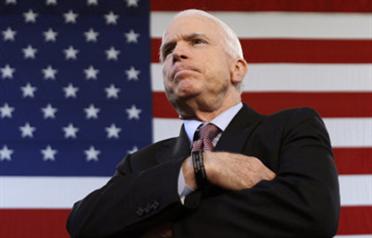
As Obama prepares for his second trip to Iraq – he was last there in January 2006 – McCain also said on Thursday he found it “remarkable, remarkable that somebody with no military experience or background” would have issued such a pledge without first having gone to Iraq for a briefing with the US commander, Gen David Petraeus.
McCain, a former fighter pilot who was shot down over Hanoi and spent five years as a prisoner in North Vietnam, is banking on his long experience in military affairs and foreign policy to overcome voters’ preference for Obama as the candidate who can best right the American economy.
The precipitous unraveling of the US economy has become the No 1 issue with US voters with a little more than four months remaining before the November 4 presidential election.
McCain said Obama’s plan to pull most American forces out of Iraq within 16 months of taking office was a recipe for “defeat, chaos, increased Iranian influence in the region and probably a wider war.”
The four-term Arizona senator, speaking with reporters on his campaign bus, also insisted that the change in military tactics and introduction of 30,000 more US forces into Iraq beginning early last year “had been a success.” The last of the additional troops left Iraq earlier this week.
Obama credits the so-called surge in troops with bringing down violence in Iraq, but said it had only further diverted attention from the real dangers – the resurgent strength of the Taliban in Afghanistan and America’s failure to kill or capture al-Qaida chief Osama bin Laden. He and his top deputies are believed to be hiding in the rugged mountains along the Afghan-Pakistan border.
Obama’s trip schedule has not been announced, but he was expected to visit both Iraq and Afghanistan before moving on to Jordan, Israel, the West Bank and Europe.
McCain has visited Iraq eight times, Obama just once. Asked later whether he thought Obama’s trip to Iraq and Afghanistan was a political stunt, McCain said he did not.
“The fact is I’m glad that he’s going to Iraq. I’m glad that he’s going to Afghanistan. It’s long, long overdue if you want to lead this nation and secure our national security,” he told reporters on his campaign bus.
“If he was so concerned about Afghanistan and the threat there and the need to send additional troops, don’t you think he should have gone there?” McCain asked.
Later in the day, however, he said he thought other parts of the trip seemed geared toward politics. “If he has political rallies in other places, obviously it’s a political trip,” he said, referring to the possibility of an Obama speech at the Brandenburg Gate in Berlin.
As he prepared for the journey, Obama restated his determination to end the Iraq war and, in a new offering, said he would send an additional two battalions – about 7,000 troops – to Afghanistan.
McCain quickly said he would add three battalions, about 10,500 soldiers, but then backtracked shortly afterward, saying the added forces could come from Nato countries that also have troops in Afghanistan.
The Obama campaign, meanwhile, reported on Thursday it raked in $52 million (Dh191 million) last month as his prodigious fundraising climbed back to near the record monthly total and more than doubled the June take of McCain, who had his best month of the year.
Campaign financing, vital to candidates’ ability to spread their message and always heavily scrutinised, has become even more of an issue in this presidential contest. Obama became the first candidate to decide against taking public financing, the $84 million in federal money available for each candidate after he is formally nominated at his party convention. The Democrats gather in Denver, Colorado late next month; the Republicans will assemble in Minneapolis, Minnesota, in early September.
No other candidate has opted not to use public financing – which precludes private fundraising – since it became available in 1974.
While he continues to easily outdistance McCain – who raised $22 million in June – Obama and the Democratic National Committee still lagged behind the combined total available to McCain and the Republican National Committee.
Obama campaign spokesman Bill Burton said the June donation haul left the campaign and the party with a total of nearly $92.3 million in the bank at the start of this month. Together, the McCain campaign and the Republican National Committee began July with about $95 million on hand.
The Democratic National Committee said it raised $22.4 million in June, a dramatic increase from the $4.7 million in May. The spike in fundraising came after Obama and the party formed a joint fundraising effort. Donors can give a maximum contribution to the party of $28,500. Still the Democrats fell short of their Republican counterparts, who raised $26 million in June.
Obama’s fundraising peaked in February, when he took in a record $55 million for the month. Since then his numbers had been in steady decline: $41 million in March, $31 million in April, $22 million in May. That said, $22 million in any other cycle would be record-breaking.
When he announced last month he would not take public funds, after earlier saying he would, Obama said he changed course because of the money advantage held by the Republican party and what he called its willingness to conduct “smears and attacks” funded by allied but unregulated organisations – known as 527 groups. One such organisation crippled the 2004 campaign of Democratic Sen John Kerry by raising doubts about his service in the Vietnam war in the so-called “swift boat” television ads.
“The public financing of presidential elections as it exists today is broken,” Obama said on June 19. “And we face opponents who’ve become masters at gaming this broken system.”
Meanwhile, former Vice President Al Gore, whose environmental activism earned him a Nobel Prize, said both Obama and McCain were “way ahead” of most politicians in the fight against global climate change.
Rising fuel costs, climate change and the national security threats posed by US dependence on foreign oil are conspiring to create “a new political environment” that Gore said will sustain bold and expensive steps to wean the nation off fossil fuels.
“I have never seen an opportunity for the country like the one that’s emerging now,” Gore, a Democrat who has endorsed Obama, told The Associated Press in an interview previewing a speech on global warming he was giving on Thursday in Washington.