Obama in Afghanistan pushing foreign policy credentials
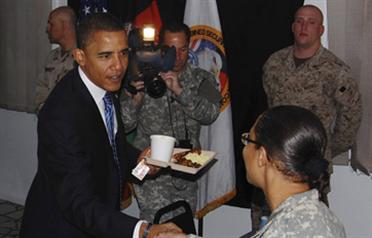
Obama’s first overseas tour since securing the Democratic nomination last month could be key to honing his foreign policy strategy with less than four months before the election. His rival for the presidency, Republican Sen John McCain, has criticised Obama for not spending more time in the region and for developing a policy without more firsthand knowledge.
Obama met for breakfast with US troops on Sunday and was to meet with Afghan President Hamid Karzai as part of a congressional delegation.
While officially part of the delegation’s fact-finding tour expected to take him to Iraq, Obama arrived on Saturday amid the publicity and scrutiny accorded a likely Democratic nominee for president rather than a senator from Illinois. Security was tight and media access to Obama was limited by his campaign; his itinerary in the war zones was a closely guarded secret.
Obama and others in the delegation received a briefing inside the US base in Jalalabad from the Afghan provincial governor of Nangarhar, Gul Agha Sherzai, a former warlord.
“Obama promised us that if he becomes a president in the future, he will support and help Afghanistan not only in its security sector but also in reconstruction, development and economic sector,” Sherzai told The Associated Press.
The area where the meeting took place is not far from where Osama bin Laden escaped US troops in 2001 after his al-Qaida terrorist group led the September 11 terrorist attacks in the US.
With the ousted Taliban regime resurgent and given the al-Qaida goal of terrorizing the US, Obama has argued that the war in Afghanistan deserves more attention as well as more troops.
He has proposed sending two more combat brigades – about 7,000 troops – to Afghanistan. McCain is also advocating sending more forces to the war-battered country.
In his weekly radio address Saturday, McCain, a former Navy pilot and Vietnam prisoner of war, insisted his “many years of military and political experience” made him better suited to lead the US to victory in Iraq and Afghanistan.
“In a time of war, the commander-in-chief’s job doesn’t get a learning curve,” the veteran Arizona senator said.
McCain also chided Obama for giving a speech announcing “his strategy for Afghanistan and Iraq before departing on a fact-finding mission” to both countries.
“Apparently, he’s confident enough that he won’t find any facts that might change his opinion or alter his strategy. Remarkable,” McCain said.
Traveling with Obama were Sens Chuck Hagel, a Nebraska Republican, and Jack Reed, a Democrat from Rhode Island. Both military veterans, the senators have been mentioned as potential Obama vice presidential running mates, although Reed has said he is not interested in the job and Hagel would be an unlikely cross-party choice.
At the start of their Afghan trip, the delegation met with top military leaders and troops at Bagram Air Field, the main US military base north of the capital, before going to Jalalabad.
Obama advocates ending the US combat role in Iraq by withdrawing troops at the rate of one to two combat brigades a month. He supports increasing the military commitment to Afghanistan, where the Taliban-led insurgency is at its strongest in seven years.
In an interview with German magazine Der Spiegel released on Saturday, Iraqi Prime Minister Nouri al-Maliki called Obama’s suggestion of 16 months “the right timeframe for a withdrawal” and said US troops should leave Iraq “as soon as possible.”
Al-Maliki said he was not seeking to endorse Obama. But his statement was a sharp contrast to the Bush administration policy, supported by McCain, opposing a set timetable for withdrawal.
A top McCain adviser, Randy Scheunemann, responded by accusing Obama of advocating “an unconditional withdrawal that ignores the facts on the ground and the advice of our top military commanders.”
The top US commander in Iraq, Gen David Petraeus, said on Saturday that after intense US assaults there, al-Qaida may be considering shifting focus to its original home base in Afghanistan, where American casualties are recently running higher than in Iraq.
Obama has expressed frustration with the efforts by Afghanistan’s neighbor Pakistan to go after militants in its territory. That stance may strike a chord with Karzai, who has directly accused Pakistan’s intelligence service of supporting the Taliban insurgency by plotting bombings and other attacks in Afghanistan – claims that Pakistan, a key US ally in its war on terror, flatly denies.
But Obama has also chided Karzai and his government, saying it had “not gotten out of the bunker” and helped to organise the country or its political and security institutions.
The Democrat, who is seeking to become the first black US president, spent much of last week outlining his foreign policy views, even as the faltering US economy eclipsed Iraq as the top campaign issue in the November election.
Obama’s trip affords the first-term senator a chance to promote his plans to mend rifts with allies weary of the Bush administration and end the Iraq war.
Campaign officials have announced stops in Jordan, Israel, Germany, France and Britain.