Philippine rebels say peace process could collapse
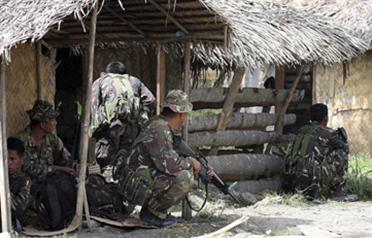
The military has launched ground and air attacks on rebel positions in response to a guerrilla rampage Monday that left 37 people shot or hacked to death in several villages.
Al-Haj Murad, chairman of the Moro Islamic Liberation Front (Milf), told a news conference at a rebel base near southern Cotabato city that the military has started indiscriminate attacks while pursuing rebel commanders blamed for leading the rampage.
The rebels, who have been fighting for Muslim self-rule in the predominantly Roman Catholic nation’s south for decades, have said that they regret a recent upsurge in violence and that the commanders responsible acted on their own. Murad said peace talks should resume, but he repeated earlier rejections of a government demand that the rebel commanders who led the attacks be turned over to face the criminal justice system.
“We cannot subject our members to the laws of the government,” Murad said. “We are a revolutionary force.”
He suggested that the correct forum to deal with the rebel commanders should be a cease-fire committee involving the government, the rebels and an international truce motoring group led by Malaysia.
Defense Secretary Gilbert Teodoro repeated the government’s demand. He accused rebel leaders of engaging in “extortion ... intransigence and arrogance” in their statements since the rampage when they should be showing “good faith to try to stop the conflict from escalating” by turning over the commanders.
“The law of the Republic of the Philippines should prevail ... and it will be under the law that we will prosecute them and judge them,” Teodoro told reporters on Saturday in Manila. “We hope the (rebels are) reasonable enough to see that it does them no good to coddle these criminals.”
Murad said a deadline of sorts looms because the truce group’s mandate is set to expire Aug. 31.
The military has reported heavy fighting in four towns since Thursday and estimated it has inflicted up to 100 casualties on rebel forces in ground battles and barrages of artillery and aerial bombing.
Brig Jorge Segovia, the military spokesman on the conflict, said about 85,000 people have been displaced, some by the rebel rampage, others while fleeing the military’s response.
Segovia said several rebel “satellite” camps have been overrun, some with foxholes and trenches. He urged guerrillas not affiliated with the commanders responsible for Monday’s carnage to get out of the way of the military’s pursuit, with troops narrowing their cordon of the area.
“While there has been resistance, the groups there have been running around because wherever they withdraw, they bump into some of our battalions” Segovia said. “We will run after them wherever it takes us.”
Eleven soldiers were wounded late Thursday in what the military called an ambush as the rebels tried to take control of a key highway.
Police said they have filed preliminary charges, including murder, attempted murder, robbery and arson, against 90 rebels, including the two commanders blamed for instigating Monday’s violence.
Local political leaders in the south have started arming civilians to protect against rebel attacks, a dangerous development that could further escalate violence, Amnesty International said on Friday.
Amnesty International said the rebels “should be held to account” for serious violations of international law, but also warned that the deployment of civilian militias on the government side “can set off a chain of reprisals and only increase the danger facing civilians.”
Just weeks ago, a peace deal to end the decades-long insurgency had seemed within reach after government and rebel negotiators initialed an agreement on an expanded Muslim autonomous region.
But Christian politicians in areas that would be affected challenged the deal in the Supreme Court, triggering the attacks by the rebels.
Solicitor General Agnes Devanadera told the Supreme Court on Wednesday that “circumstances have changed” after the recent attacks and the government will no longer sign the agreement.
Murad rejected any review of the agreement.
“It’s a done deal,” he said. “If the government will not change its position, there’s a possibility that the peace talks will collapse.”