Supreme Court halts Philippine peace deal
The agreement between Manila and the Moro Islamic Liberation Front (Milf), the country's largest Muslim rebel group, was set to be signed in Kuala Lumpur on Tuesday after more than 10 years of stop-start talks.
"There will be no signing tomorrow. I got a call from the [Supreme] court," Jesus Dureza, President Gloria Macapagal Arroyo's spokesman, told Reuters.
The deal was meant to widen an existing autonomous region for Muslims in the south of the largely Catholic country and give them wide political and economic powers, including control over mineral wealth in an area rich in nickel, gold, gas and oil.
"I don't know what will happen next," Mohaqher Iqbal, the Milf's chief peace negotiator, told Reuters.
Catholic politicians in the south had asked the Supreme Court to halt the signing ceremony arguing that they had not been consulted on the deal, which they fear will carve up the southern island of Mindanao into Muslim enclaves.
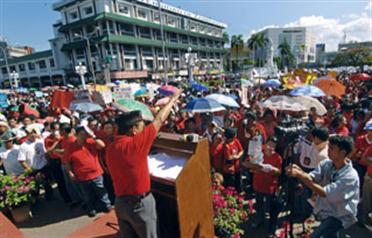
"Do not build a Berlin Wall among the people in Mindanao," Celso Lobregat, mayor of the mainly Catholic city of Zamboanga, had earlier told a crowd of around 10,000 people.
The Supreme Court has asked both sides to present their cases on August 15.
The agreement was meant to formally re-open peace talks to end nearly 40 years of conflict that has killed more than 120,000 people, displaced 2 million, and stunted growth in the region.
Analysts, however, are sceptical about whether the territorial deal will ever leave the drawing board, given its implementation is dependent on a comprehensive peace deal.
Both the Milf and Manila have committed to agree a final deal by November 2009, but deadlines have consistently been missed in over a decade of talks, punctuated by violent conflict.
Thousands of Catholics had demonstrated in two southern Philippines cities on Monday against the agreement.