Russia and Georgia battle on
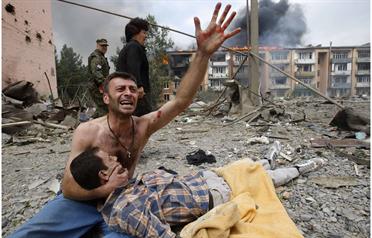
Fierce clashes between Russian and Georgian troops in the southern suburbs of South Ossetia's capital Tskhinvali were reported by Russian news agencies during the night. Georgia said it was under bombardment from Russian planes.
Russia has "started a full-scale military invasion" of Georgia, the country's UN Ambassador Irakli Alasania said in New York.
Moscow had vowed retaliation to defend Russians in Tskhinvali who had come under fire by the Georgian artillery and air assault – the worst fighting since the 1992-94 separatist war in the region.
"Georgian forces are controlling the entire territory of South Ossetia except Java," a city north of Tskhinvali, Georgian President Mikheil Saakashvili said in a televised address.
"We are fully controlling Tskhinvali," he added, although the rebels shortly afterwards said that they were in control, according to the Interfax news agency.
"The Georgian side is right now firing on residential parts of Tskhinvali," South Ossetian government spokeswoman Irina Gagloveva said in televised comments after nightfall. Later Russian reports said shelling had subsided.
Saakashvili said 30 people had died on the Georgian side, but separatist leader Eduard Kokoity put the overall death toll from Friday far higher.
"Slightly more than 1,400 people have died," Kokoity said, cited by Interfax. "This information will be checked, but this is the approximate number, based on information from relatives."
In a claim that Moscow denied, Georgia's interior ministry said five Russian aircraft had been shot down.
The Russian military said in a statement that more than 10 Russian peacekeepers had been killed in Tskhinvali as Georgian ordnance slammed into their barracks.
Georgian authorities have evacuated the presidential building and other government offices in the capital Tbilisi amid fears of Russian bombardment, a top Georgian official told AFP on Saturday.
Other Georgian officials said that Russian planes on Friday had bombed near a military base in Vaziani, a military airport in Marneuli, the port of Poti and a railway junction and an airport in Senaki.
On the diplomatic front, the United States – a champion of Georgia's bid to join Nato – called for an immediate ceasefire and Russian withdrawal.
"We call on Russia to cease attacks on Georgia by aircraft and missiles, respect Georgia's territorial integrity, and withdraw its ground combat forces from Georgian soil," Secretary of State Condoleezza Rice said in a statement.
Television images on Friday clearly showed Russian tanks, armoured personnel carriers and trucks rumbling towards South Ossetia – plus Georgian ground forces hammering rebel positions with lorry-mounted rockets.
In the streets of Tskhinvali, home to an estimated 20,000 people, tanks were seen burning, and women and children ran for cover, hunched over in terror.
An AFP reporter in South Ossetia saw women, children and elderly people riding buses toward the Russian border, fleeing the fighting.
In the Georgian city of Gori, wounded Georgian soldiers in camouflage uniforms were seen arriving at a military hospital by the dozens.
The International Committee of the Red Cross (ICRC) said hospitals in Tskhinvali were teeming with casualties.
"Ambulances cannot move, hospitals are reported to be overflowing, surgery is taking place in corridors," an ICRC spokeswoman said, adding inhabitants were taking shelter in basements with no electricity or phone service.
"If this is not war, then I wonder what is," Georgia's ambassador to the Organisation for Security and Co-operation in Europe, Victor Dolidze, told a crisis meeting of the OSCE's permanent council in Vienna.
The European Union, Nato and United States all called for a halt to hostilities.
In emergency talks in New York, the UN Security Council failed to agree a call for an immediate ceasefire as Russia and Georgia blamed each other for the conflict. Talks were due to resume Saturday.
Russian Prime Minister Vladimir Putin, in Beijing for the start of the Olympic Games along with other world leaders including US President George W. Bush, blamed Georgia.
"They have in effect begun hostilities using tanks and artillery," said the former president, still a powerful figure in the Kremlin. "It is sad, but this will provoke retaliatory measures."
South Ossetia broke from Georgia in the early 1990s. It has since been a constant source of friction between Georgia and Russia, which disputes Tbilisi's hopes of joining Nato.
South Ossetia has long sought unification with North Ossetia, which is inhabited by the same Ossetian ethnic group but ended up across the border in Russia after the 1991 collapse of the Soviet Union.
"There should be only one Ossetia. We want to live with our brothers," said a 37-year-old man in Java who gave his name as Albert, as the Russian column rumbled by with grim-faced soldiers cradling their rifles.
Russian Foreign Minister Sergei Lavrov pointed an accusing finger at the West for extending military aid to Georgia.
"Now we see Georgia has found a use for these weapons and for the special forces that were trained with the help of international instructors," he said.
He added: "The number of refugees is growing. A humanitarian crisis is looming."