Russia recognises Georgia rebel regions
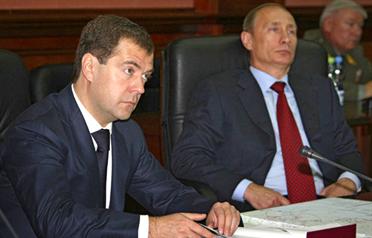
Both houses of parliament, which are controlled by Kremlin loyalists, swiftly approved non-binding resolutions calling on President Dmitry Medvedev to recognise the pro-Moscow breakaway regions of South Ossetia and Abkhazia.
The lower house, or State Duma, approved a second resolution calling on parliaments worldwide to back independence for the two regions, saying they had many more reasons than the former Serb province of Kosovo to aspire to international recognition.
Georgia and Russia fought a brief war over South Ossetia earlier this month after Tbilisi sent in troops to try to retake the province by force, provoking a massive counter-attack by land, sea and air by Moscow.
Medvedev, who was working in the resort of Sochi, just along the Black Sea coast from Abkhazia, did not immediately comment on the resolutions, but said ties with Nato had "worsened sharply" as a result of the Georgia conflict.
"We are ready to take any decision, up to halting relations altogether," he said at a meeting in Sochi with Dmitry Rogozin, the Russian envoy to Nato.
In the South Ossetian capital Tskhinvali, jubilant residents drove down Stalin Street with South Ossetian and Russian flags hanging out of the windows, thrusting their arms into the air and shouting "Victory, Victory".
The resolutions could either signal Medvedev's intentions or be designed to strengthen his hand as he negotiates the status of Russian forces in Georgia with the West.
"Today it is clear that after Georgia's aggression against South Ossetia, Georgian-South-Ossetian and Georgian-Abkhazian relations cannot be returned to their former state," upper house speaker Sergei Mironov said during the debate. "The peoples of South Ossetia and Abkhazia have the right to get independence."
Moscow has so far always stopped short of recognising the two rebel regions as independent, though Foreign Minister Sergei Lavrov signalled a tougher line recently when he said the world could "forget about" Georgia's territorial integrity.
Formal recognition by Russia of the independence of South Ossetia and the Black Sea province of Abkhazia would put it on a collision course with the United States and other Western nations which insist on Georgia's territorial integrity.
In Tskhinvali, officials followed the Russian parliamentary debates on live television in a building pockmarked with shrapnel and bullets.
Murat Dzhioyev, the South Ossetian rebel administration's foreign minister, said: "In less than 100 years, the Georgian military has three times carried out genocide against the Ossetian people. Why are they killing us? Because we simply want to live as equals with all the other nations."
In Georgia, Kakha Lomaia, secretary of the country's security council, said the Kremlin would isolate itself internationally if it recognised the breakaway regions.
"If it does this, Russia will further isolate itself from the entire world, and will force the international community to seek more active ways to restore the territorial integrity of Georgia," Lomaia told Reuters.
France, the current European Union president, called a September 1 meeting of EU leaders to discuss the crisis and review the bloc's relations with Russia.
French President Nicolas Sarkozy brokered a ceasefire in the conflict, which has killed hundreds of people and made thousands homeless. But the six-point peace plan signed by all sides is vaguely worded and Russia claims a continued mandate to station large numbers of troops in Georgia.
Germany, criticising Russian legislators' resolution, said it expected Medvedev to ignore their recommendation, and said Russia had not yet met its obligation to pull back all its troops under the French-brokered peace plan.
French Foreign Minister Bernard Kouchner was cautious about the likely EU reaction. "We're not talking about sanctions," he told France Inter radio.
"Getting a ceasefire, stopping hostilities and the troop withdrawal in eight days, that's quite a lot already. We'll have to see. We have to take stock of the situation."
Apparently anticipating hostile moves by the West, Prime Minister Vladimir Putin said on Monday that it would make sense for Russia to pull back from some commitments already made during negotiations for entry to the World Trade Organisation.
Moscow has withdrawn most of its forces from central and western Georgia and says those still in place are peacekeepers needed to avert more bloodshed and protect South Ossetia and Abkhazia.
Georgia and the West object to the scale of the Russian-imposed buffer zone adjoining the two rebel regions, which hands Moscow pressure points on key oil and trade routes through Georgia to the Black Sea.
Western governments have been alarmed in particular by the presence of Russian troops around Poti, Georgia's busiest Black Sea port. A senior military official said Russian forces would carry out regular inspections of cargo at the port.
The United States on Sunday delivered 55 tonnes of aid aboard the warship USS McFaul, a gesture of support for its close ally, Georgian President Mikheil Saakashvili.
That move, together with other sailings by Western navies, angered Moscow, which regards the Black Sea as its back yard.
Col.-General Anatoly Nogovitsyn, deputy head of the General Staff, told a daily news briefing that "the fact that there are nine Western warships in the Black Sea cannot but be a cause for concern".
Despite repeated demands for a complete Russian pullback to positions before the conflict, the West lacks leverage over a resurgent Russia, whose oil and gas it depends on.