Russians dig in but still promise Georgia pullout
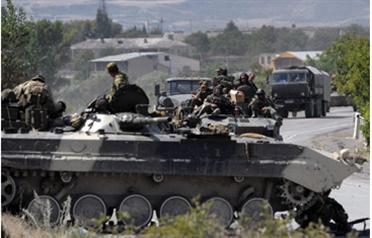
But a top Russian general said on Thursday it could be 10 days before the bulk of the troops is gone, and the mixed signals from Moscow left Georgians guessing about Russia’s intentions nearly a week after a cease-fire deal.
Under the deal, Russian forces are to pull back to positions they held before intense fighting broke out August 7 in the Russian-backed Georgian separatist region of South Ossetia. Russia says it will keep troops in South Ossetia – where Russia had a peacekeeping contingent for more than a decade – and in a buffer zone in Georgia proper around the region’s border.
Strains in relations between Russia and the West showed no improvement. Nato, Moscow’s Cold War foe, said Russia had halted military cooperation with the alliance, underscoring the growing division in a Europe that had seemed destined for unity after the Soviet Union collapsed.
Western leaders remained adamant that Russia remove its troops and do it quickly.
President George W Bush told Georgia President Mikhail Saakashvili that the US “expects Russia to abide by its agreement to withdraw forces,” White House spokesman Gordon Johndroe said. The Georgian leader called Bush on Thursday.
While refugees from the fighting crammed Georgian schools and office buildings, a scattering of people left in a half-empty village said they were badly in need of basics.
“There is no bread, there is no food, no medicine. People are dying,” said Nina Meladze, 45, in the village of Nadarbazevi, outside the key crossroads city of Gori. She said she stayed because she could not leave elderly relatives behind while other villagers fled to the capital, Tbilisi.
She said the village has been virtually abandoned since the war broke out. “I cannot go on like this anymore, I cry every day,” she said.
Russian President Dmitry Medvedev promised earlier that his forces would pull back by Friday. Defense Minister Anatoly Serdyukov reiterated that late Thursday, saying the troops would begin moving on Friday morning. But at Igoeti, about 50 kilometers (30 miles) west of the Georgian capital Tbilisi, no signs of change were apparent as the sun rose.
The commander of Russian land forces, Gen Vladimir Boldyrev, said it would take about 10 days for troops not involved in manning the security zones to complete their withdrawal to Russia, moving “in columns in the established order.”
That suggested Russian soldiers could still be holding territory in Georgia up to the end of August.
Russian troops are also allowed a presence on Georgian territory in a security zone along the border with Abkhazia, another separatist Georgian region, under a 1994 UN-approved agreement that ended a war there.
Around the Black Sea port of Poti – outside any security zone – signs seemed to point to a prolonged presence. Russian troops on Thursday excavated trenches, set up mortars and blocked a key bridge with armored personnel carriers and trucks. Other armored vehicles and trucks parked in a nearby forest.
Officials in Poti said the city had been looted by the Russians over the past week. Associated Press journalists saw Russian troops carry tables and chairs out on armored personnel carriers on Thursday as residents protested.
Some Russian troops and military vehicles were on the move on Thursday, including 21 tanks seen heading toward Russia from inside South Ossetia.
French Foreign Minister Bernard Kouchner hailed the report of tank movements.
“We are waiting ... for the Russians to respect their word,” Kouchner told reporters in Paris. “We waited twice with dashed hopes. This time, it appears that there is at least the beginning of a fulfillment.”
Outside the South Ossetian capital, Tskhinvali, several ethnic Georgian villages were burning Thursday – many days after fighting ended – and bore evidence of destruction from looting. Some Ossetians said they were not prepared to live alongside ethnic Georgians anymore.
“It’s not they, it’s we who will erase them from the face of Earth,” said Alan Didurov, 46.
Renowned conductor Valery Gergiev, who is Ossetian, led a requiem concert for the dead on Thursday night in Tskhinvali – part of an effort to win international sympathy for Russia’s argument that its invasion was justified by Georgia’s attempt to regain control of South Ossetia by force.
“We want everyone to know the truth about the terrible events in Tskhinvali ... with the hope that such a thing will never again happen on our land,” Gergiev said before the concert, held in front of the badly damaged South Ossetian legislature before a crowd flanked by two armored personnel carriers.
In a move sure to heighten tensions, a US Navy guided missile destroyer loaded with humanitarian supplies headed toward Georgia through Turkey’s straits between the Mediterranean and the Black Sea. It was the first of three US warships carrying blankets, hygiene kits and baby food to Georgia.
The United States has carried out 20 aid flights to Georgia since August 19. The UN estimates 158,000 people have fled their homes.