Western states scramble to prevent Georgia-Russia war
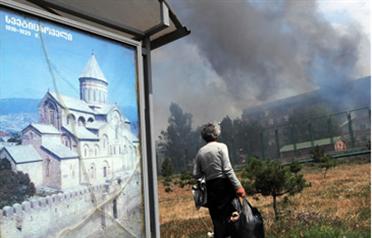
Envoys from the US, EU and Organisation of Security and Co-operation in Europe (OSCE) were being deployed to Georgia to seek an end to the fighting in Russian-backed South Ossetia, a breakaway region of Western-backed Georgia.
On Friday, Deputy Secretary of State John Negroponte summoned Russian Charge d'Affaires Alexander Darchiyev to the State Department to press Moscow to cease military operations in Georgia.
"The United States calls for an immediate ceasefire to the armed conflict in Georgia's region of South Ossetia," US Secretary of State Condoleezza Rice said in a statement on Friday.
"We call on Russia to cease attacks on Georgia by aircraft and missiles, respect Georgia's territorial integrity, and withdraw its ground combat forces from Georgian soil," she said.
The United States was working actively with its European allies to launch international mediation to end the crisis, Rice said, adding that senior US officials have spoken with the parties in the conflict.
"We underscore the international community's support for Georgia's sovereignty and territorial integrity within its internationally recognized borders, as articulated in numerous UN Security Council resolutions," she said.
US president George W Bush spoke to Rice and National Security Adviser Stephen Hadley about the crisis from Beijing, where he is attending the Olympic Games, White House spokeswoman Dana Perino told reporters.
Russian tanks and troops surged into South Ossetia on Friday to repel a Georgian offensive to reclaim the region amid fighting said to have left hundreds dead.
On Saturday, the Russian army announced it had "liberated" the South Ossetian capital of Tskhinvali as Georgia declared a "state of war."
South Ossetia broke from Georgia in the early 1990s. It has since been a constant source of friction between Georgia and Russia, which disputes Tbilisi's hopes of joining Nato.
South Ossetia has long sought unification with North Ossetia, which is inhabited by the same Ossetian ethnic group but ended up across the border in Russia after the 1991 collapse of the Soviet Union.
The Georgian government, led by President Mikheil Saakashvili, announced it would withdraw its 2,000 troops that are part of the US-led coalition in Iraq to help the fight in South Ossetia.
The EU presidency said it was in contact with all protagonists and working to secure a ceasefire "so as to avoid an extension of the conflict."
The EU "calls on all parties to cease hostilities and to resume, without delay, so as to secure a political solution to the crisis, which respects Georgia's sovereignty and territorial integrity," it said.
EU foreign policy chief Javier Solana has been busy on the phone talking with, among others, Russian Foreign Minister Sergei Lavrov and Georgia's Foreign Minister Ekaterine Tkeshelashvili, a spokeswoman said.
At the United Nations, however, the Security Council failed to agree on Friday on a statement calling for an immediate truce in South Ossetia. The 15-member body was scheduled to try again on Saturday.
Diplomats said a Belgian-drafted compromise text also urges the warring sides to "show restraint and to refrain from any further acts of violence or force," calls for respect by the parties of past accords and for the provision of humanitarian aid to victims.
Russian Ambassador Vitaly Churkin insisted on the need for Georgia to agree to a formal renunciation of the use of force by either side.
Georgia's reintegration minister, Temur Yakobashvili, told France's Le Figaro newspaper's website that Western diplomats would have a huge say over the outcome of the conflict.
Asked what will happen next in the Caucasus, he said, "much will depend on the reaction of the West."
The Washington Post called the situation in South Ossetia Saturday "a grave challenge to the United States and Europe."
The newspaper said in an editorial it was unrealistic to expect UN Security Council action because of a likely Russian veto.
"Thus, the United States and its NATO allies must together impose a price on Russia if it does not promptly change course," the editorial concluded.