UAE's noble fishermen brave stormy weather
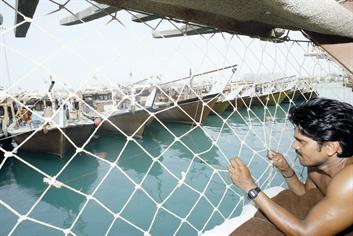
Blackened by the scorching sun that pinches his half-naked body everyday, Benu Kuti finishes washing and begins hanging his simple clothes on a small thin rope on his wooden boat. With a soaking piece of cloth wrapped around his waist and legs, Kuti is heavily sweating when he finishes the chore and sits down to wipe his forehead.
Kuti is one of hundreds of Indian fishermen who live on their boats in conditions that seem as bad as those of the infamous Vietnamese boat people.
They lack proper living quarters, kitchen facilities, cooling systems, electricity, and other essential requirements.
And what they are paid monthly by their local employers could be earned by a senior bank employee in one day.
Yet these fishermen, with their primitive tools, feed fish to nearly one million people in the capital every day. They know that Abu Dhabi counts on them for its fish and without their daily struggle in the perilous Gulf waters, the capital could be deprived of fish.
"This fishing harbour is the only source of fish for the people in Abu Dhabi. There are more than 300 boats that carry at least three fishermen each," the 45-year-old Kuti said, as he sat on the deck and kept wiping sweat off his face with a small towel.
"The boats set sail at dawn but we take turns as some of us go to the sea twice or three times every week.
"We reach as far as 200km and each boat comes back with nearly a tonne of fish after three or four days. The catch, of course, belongs to the boat owner."
Kuti kept wiping his face and then moved down his heavily-tanned chest and belly as the sun was approaching its peak.
"Look there," Kuti said, pointing to dozens of other Indian fishermen who were busy with washing, hanging clothes, or rubbing their bodies with wet towels.
"They all live on these boats, it's our home and the sea is our life. I love this profession because I feel that I am part of the sea. I can't imagine working somewhere else."
Kuti came to Abu Dhabi nearly 17 years ago and used his fishing experience back home to work as a fisherman in Abu Dhabi.
He became captain of the boat two years ago and although the promotion meant a little more money, he still considered himself underpaid. Before he was promoted, he and most other fishermen were paid between Dh500 and Dh700 a month. His wage is a bit higher now but for the other fishermen, it has remained unchanged. At times, most of them do not get paid and business comes to a complete standstill for three or four months while the boat owner is away.
"We have asked for more money but who will listen to us?" said Abdul Rahman Babu, another Indian fisherman.
"What we are getting now is hardly enough to feed ourselves, while some times we are not paid for months. Last year, we did not go to the sea for more than three months because the boat owner was out of the country. How can we go fishing when we do not have enough diesel and equipment?"
Before oil was struck more than 40 years ago, the fishing profession in Abu Dhabi and the other emirates was controlled by UAE nationals as it was the main source of living, along with pearling. But most have deserted the industry and turned to more profitable businesses following the discovery of oil.
As a result, the fish industry in the UAE is now dominated by expatriates, mostly Indians, and is one of the slowest growing sectors. According to official figures, the farming and fishing sector has recorded an average growth of two per cent over the past decade, while its value added stood at Dh12.79 billion in 2007, only 1.7 per cent of the GDP. From more than 12,000 boats and 20,000 fishermen in early 1990s, their number in the UAE has plummeted to less than 4,000 boats and 8,000 fishermen.
Yet the UAE has remained one of the key Arab fish producers, with an output of more than 100,000 tonnes last year, of which nearly 30,000 tonnes were produced by Abu Dhabi. Sandwiched between the giant Port Zayed and the northwestern flank of the capital, Abu Dhabi fishing harbour spreads across one square kilometre of the lagoon-like area. Scores of traditional Arabian fishing boats, better known as dhows, are seen packing the water every day while the remaining vessels are out on a fishing mission.
Located at the entrance of the harbour is the bustling, air conditioned fish market, which gets its daily supplies from the catch brought by the fishermen. An estimated 500 tonnes of fish are brought to the fish market every week, which is enough to feed Abu Dhabi and ensure self-sufficiency in fish.
The boats set sail at dawn and can reach as far as Qatar's territorial waters. They often sight sharks and other large sea creatures, but there have been no reports of attack.
"We have caught sharks a couple of times but we have not faced danger. They can not jump on our boat and we usually avoid them unless we hit them by accident," Kuti said. "What was disturbing us before was the frequent harassment by the American warships as they used to intercept us and ask questions, but now they don't do this quite that often."
The sun was already at its peak as was the nearby fishing market. Kuti and his work mates were getting ready to nip over to a nearby small and shabby fisherman restaurant for their lunch. Many of the fishermen whose boats were anchored away from the concrete pier were seen stepping over confidently from one boat to another to reach the quay as the massive dhows were tied closely to each other.
Surprisingly, their lunch rarely includes fish. "Being a fisherman does not necessarily mean I have to eat fish everyday," Ratesh Pradha said. "Most of our lunch is rice and chicken or meat. We eat fish but perhaps once a month."
As they began grouping for the 50-metre trip to the restaurant, the smiling Indian fishermen appeared to be accustomed to their routine-but-serene lifestyle. They were surely aware of the risks and hardships of their profession but they looked content, perhaps knowing they have no choice but to carry on for their livelihood.
Yet, there was another motive, which sounded as powerful as their struggle for a living. It was their love of the sea, of their simple life and of their home boats.
The fishermen spend more time in the sea and aboard their boats than on land. They go onshore only for their meals and prayers or when they need a walk along the quay past the giant modern vessels anchored at the nearby Port Zayed.
During summer, most of them leave their bodies exposed to the pinches of the sizzling sun, concealing only the lower part of the body with the traditional skirt-like wizra.
As the sun begins retreating behind the skyline and darkness envelopes their tiny port, they sit on the dimly-lit deck chatting in an atmosphere of serenity that is occasionally shattered by the noisy giant vessels arriving or leaving Port Zayed.
Despite the annoying humidity and the invading smell of the sea and the fish market, the fishermen sleep on the deck of their floating homes, avoiding the suffocating heat inside the boat. They retire early to be ready for the dawn fishing journey, while they take turns between sleep and steering the boat during the three-day trip.
"Most of us have been serving here for at least 10 years. We have become strongly attached to the sea and this provides us with a sort of solace but does not make us forget our problems in this profession," Kuti said.
"We have a lot of problems such as low wages, no proper homes, poor work conditions and lack of any incentive except for our love of the sea. We are not allowed to have our own boats and we are never rewarded for our good work.
"It is not an easy job and the salary involved is nothing compared to what we are giving. In this salary, we can hardly feed ourselves although we are feeding Abu Dhabi."
The numbers
100,000: tonnes is the UAE's annual fish production, of which 30,000 tonnes are produced by Abu Dhabi
Dh12.79 bn: is the value added by the UAE farm and fish sector
1.7%: Sector accounts for only 1.7 per cent of GDP
4,000: Boats and 8,000 fishermen operate in UAE
Dh500-Dh700: is the average salary of a fisherman