China finds a taste for the sweet stuff
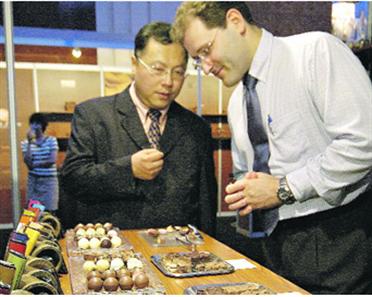
Award-winning French dessert chef Hugues Pouget has his work cut out for him as he tries to turn the Chinese into chocoholics.
"In Europe, we have centuries of history about chocolate. Here, there's none," says Pouget, a 31-year-old champion of the France Des Desserts competition who started teaching Chinese chefs how to make gourmet chocolate in May.
"But Chinese people like to learn Western styles. They especially love chocolate with peanuts, mangoes and strawberries."
Lured by a huge potential market, Barry Callebaut, the world's biggest chocolate maker, moved its Asia headquarters to China from Singapore in January and brought Pouget to its Chocolate Academy in Suzhou, a city of quaint ancient pavilions and acres of new factories 90 minutes from Shanghai.
The Swiss company hopes that chocolate recipes cooked up at the academy, its second in Asia after a Singapore centre, can tempt Chinese consumers to gobble up the 25,000 tonnes of chocolate a year it will be churning out at a nearby factory.
Major global chocolate brands such as the Hershey Company and Cadbury Plc, already Barry Callebaut clients in other parts of the world, have swarmed China.
China's 6.46 billion yuan a year ($922m, Dh3.46bn) chocolate market is less than one per cent of the world's total.
Yet rising wealth and the increasing influence of Western tastes are fuelling annual market growth of more than 10 per cent, compared to one to two per cent in Europe, according to market intelligence company Euromonitor International. Today, an average Chinese eats only 100g of chocolate a year, with consumption concentrated in affluent coastal cities such as Shanghai, Beijing and Guangzhou.
"I don't think the Chinese will ever eat 10kg per head like the Swiss, but they may eat 2kg per head like the Japanese and the Koreans," Barry Callebaut Asia Pacific Vice-President Maurizio Decio says.
China's chocolate nibblers today are mostly aged 15 to 24, according to a survey by Sinomonitor. Young affluent Chinese might be developing a sweet tooth, but the taste buds of most Chinese favour salty foods.
Salted pork, fish, crab and beans are a common feature on Chinese breakfast tables, while youngsters often snack on salted dried fruit and drink salty soda pop.
Beijingers consume 12g to 15g of salt a day on average, compared to 6g suggested by the World Health Organisation.
And it's not just taste that's a challenge.
"There's a misconception that chocolate is fattening and associated with diabetes and heart disease. That's why many health-conscious Chinese avoid it," says Xiao Mingchao, head of research at Sinomonitor.
Still, a survey by the company showed that 42.3 per cent of urban Chinese consumed chocolate at least once during 2007, up from 37.9 per cent in 2006 and 34.9 per cent in 2005, spurred by billions of dollars in marketing and branding by foreign chocolate makers. "Deep-pocketed multinationals like Mars have been building their brands in the Chinese market for many years," says Zhao Yanping, secretary-general of the China Association of Bakery and Confectionery Industry.
"Chocolate is not a necessity. It's more about branding and emotional attachment."
Mars Inc has spent heavily to make M&M's classic slogan, "Melts in your mouth, not in your hands", familiar to large numbers of Chinese, while its Dove chocolate has cultivated an image of silky elegance.
Hershey, which last year created green tea-flavoured "kisses" for the Asian market, will open a Chocolate World flagship store in Shanghai in the next couple of months.
The store will offer thematic activities, chocolate-making demonstrations, chocolate desserts, beverages and plenty of sweets, as it aims to promote its brand and become China's No2 chocolate seller by 2010.
A handful of Western brands, which began entering China in the 1980s, now account for more than half of China's chocolate market.
Local competitors such as Golden Monkey have found it hard to link their brands to an image of Western luxury and have mostly stuck to cheaper compounds using little cocoa butter.
Four players, Mars, Cadbury, Nestle and the Ferrero Group, controlled a combined 41.3 per cent of the China market in 2006, according to Euromonitor.
Many Chinese buy chocolate only for gifts, not for personal consumption, as sweets occupy a special place in the country's tradition of gift-giving for special occasions.
Young people in Chinese cities, drawn by marketing campaign images of romance and Western lifestyles, buy chocolates for Valentine's Day and Christmas. Chocolate also competes with hard candies and hard-boiled "happiness eggs" as gifts for wedding guests.
Pleasing the Chinese palate remains the key to long-term success, providing chocolate-makers with a culinary challenge as Chinese taste buds range from favouring hot and spicy food in the Sichuan region of central China to a preference for sour food in the northeastern provinces.
"Koreans like a sour taste, but Chinese are very different," says Lee Kwang-Hoon, president of the Chinese unit of South Korea's Lotte, which started selling chocolate in China last year.
"The challenge is not to make quality chocolates, but to understand what Chinese really like," he adds.
But chocolate-makers will not thrive on confectionery alone. Chocolate is increasingly being used as a dessert ingredient in China's fast-growing bakery market, according to Barry Callebaut.
"Most chocolate in China is not consumed as such, but is consumed as an ingredient in cakes, biscuits and coatings for ice creams," Decio explains.
The numbers
$922m: The yearly worth of China's chocolate market
100g: The amount of chocolate an average Chinese person consumes per year
42.3%: Of urban Chinese consumed chocolate at least once during 2007
10%: The annual growth of the Chinese chocolate market
Chocolate facts
- Chocolate is made from the seeds of the tree theobroma cacao. The ancient Aztecs venerated the cacao tree and used its beans as a form of currency
- In 1875, Swiss Daniel Peter perfected the manufacture of milk chocolate
- The Ivory Coast produces 45 per cent of the world's £6.6bn cocoa crop
- The United States is the biggest consumer of chocolate in the world
- In the United Kingdom £1.3bn was spent on chocolate bars in 2006
- Dark chocolate contains iron, calcium, magnesium and potassium