Wordsmith turns to the lens
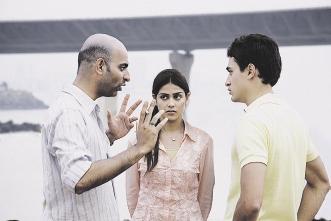
Five minutes into the interview and the award-winning writer turned director Abbas Tyrewala is testing his vocal prowess by singing the ad jingle he wrote for his first-ever professional gig: Seema Extrabright Tubelights in India. And even though a mere handful may recall seeing the ad on television years ago, Tyrewala hasn't looked back.
Best known for penning dialogues for critically acclaimed films such as Munnabhai MBBS and Maqbool, the wordsmith recently turned towards direction with his movie Jaane Tu Ya Jaane Na, which released last week in the UAE. The film has already broken box office records, with 100 per cent collections in its first week.
Emirates Business caught up with Tyrewala in a candid chat about his career change, his maverick ways, and yes, even Seema Extra Bright Tubelights.
Do we dare ask about the Seema jingle?
It was during college. My then girlfriend's mother was an ad filmmaker and on the eve of her shoot, the jingle writer deserted her. My girlfriend recommended me to her mother. I was given an hour to work on the concept and narrated what I had penned over the phone.
The following day, I was invited to the shoot as a production assistant to earn Rs500 and that's where I first heard my words being professionally used by someone.
[He proceeds to sing] And it even had a pun!
Was scriptwriting a profession you had always wanted to pursue?
I've always seen myself as a storyteller. Even at school from second grade, my teacher would ask me to tell stories in class. By seventh grade, it became plays.
Actually, they were all pretty bad comedies, which usually ended with emotionally dramatic scenes. You know the kind, a bunch of mad men and women running around spewing bad jokes. The piece de resistance was always mine, like once I went into a tirade about my child dying.
That was a comedy?
Of course. Most of the time we had just five minutes to prepare, so people performed some nonsense, and I constantly improvised to keep it from falling apart.
You've carved a successful career for yourself as a storyteller. So why switch to direction, especially when you even once went on record saying you are too lazy to direct a film?
It's true that I once said I was too lazy to direct a film. But even then I said I would attempt it after the age of 40 because most scriptwriters short-change themselves. I wanted to push the limits in scriptwriting. My biggest peeve are writers who are so eager to become directors that we don't have a scriptwriting culture in India.
But my career graph changed in 2005. One day, I was sitting in front of my computer and writing the first line of a movie and I suddenly felt the impact of 120 unwritten pages. That's when I knew that 12 years of writing had finally caught up with me. I had the biggest writer's block, and it didn't help at the time that I was going through depression in my personal life. I needed a new challenge.
Also, it's very lonely being a writer. I don't like people very much, so initially I had thought I would've been perfectly happy leading this life, but I realised I wasn't happy.
But why a frothy film like Jaane Tu…, especially when you are known for penning dialogues for films such as Asoka and Maqbool?
I was at the peak of my career after Munnabhai and Maqbool, when I had my writer's block and I started to drink. When I started to clean up my act, Jaane Tu… was the first thing I came up with. I knew I wouldn't have a problem finding someone to finance it.
But you had a problem when producer Jhamu Sughand backed out and you ended up with Aamir Khan?
He didn't back out, but was going through a financial crisis during that time. He passed away last month, and my greatest sadness is that I couldn't dedicate my film to him on screen; but it is emotionally dedicated to Jhamu Sughand.
After tasting direction, will you continue writing scripts for others?
No, I don't think I can go back to writing for someone else. Direction is what I see myself pursuing.
Who is the most promising director to come out of India today?
Shimit Amin [the director of last year's award-winning Chak De! India]