Why funky offices work
Google started it. Microsoft did it, too. And now, the trendy office philosophy has found more followers in the UAE, thanks to an increasing number of organisations intent on boosting morale and productivity in the workplace.
Google has "chill-out" aquariums and games rooms and Microsoft offers yoga classes. In the UAE, Emirates has a spa for employees to unwind while a number of advertising companies, including Leo Burnett, have invested in beanbag rooms to encourage creativity.
But advertising and public relations company TBWA/RAAD Middle East has gone one step further by putting its employees in charge of their own work environment.
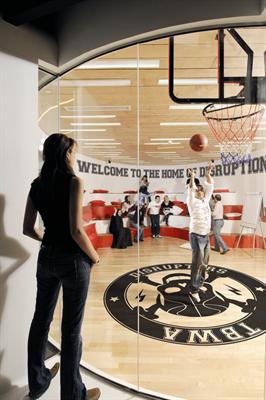
At their office in Downtown Burj Dubai, managers do not rely only on annual bonuses to increase productivity, but instead allow everyone to be involved in creating their ideal workspace. From custom-coloured walls to indoor basketball courts, the idea is to make employees happier at work, and therefore be better at their jobs.
Ramzi Raad, the chairman and chief executive officer, says: "I want my staff to feel at home and for this to be a place of relaxation as well as work.
"There are very few companies in the UAE that provide the right environment and so we told them when we moved: 'This is your work place, what do you want in it?'." Although the
CEO admits they have no tangible evidence that the introduction of social areas have improved performance, staff have been seen to be more enthusiastic. And that is what really counts, according to him.
"Whenever I walked around the offices I've worked in before, everyone sat at their desks with the same expression. But now I know our results will be different and the staff will produce far superior campaigns or marketing plans because they are enjoying their work," says Raad.
"The extra equipment also encourages people to take a break and they come back refreshed – however, I have to ask them to keep the noise down sometimes," he says.
Executives at the agency doubled up as interior designers after decorators employed by the firm failed to come up with a satisfactory working plan.
At the offices, visitors and staff are greeted by a tunnel leading to reception as a way of drawing people in. Then, as they walk through the office, gone are the typical white walls to be replaced by purples, blues and greens.
Some walls are covered in murals, while another is full of speech bubbles waiting for staff to fill them with their thoughts about the company.
While the main workspace sees desks in a row, dubbed "train line to success", the staff's favourite are the extra rooms that include a majlis, a table football and an indoor garden with beanbags instead of chairs.
There is also an indoor basketball court, which is surrounded by offices in the centre of the room.
Corporate Communications Director Jonathan Howell-Jones says: "A group of beanbags in a room does not create creativity – you need a room that helps you to think and come up with creative ideas and we believe the atmosphere of a garden does this."
Creating a funky and lively environment in the workplace is all good. But how do employers keep a tab on distractions?
"We want people to do what they want because they deliver more," says Raad. "But we are running a business – not a clubhouse – so we need to be alert to temptations. If our staff are relaxed they will be more creative, but we also had to provide an environment in which to do that."
Creative incentives
- "Chill-out" aquariums
- Various sports facilities, including games rooms and indoor basketball courts
- Beanbag rooms
- Canteens offering free healthy food to staff
- Spas to unwind
- Indoor gardens