Cairo pulls the plug on 'antiquities' clogging the roads
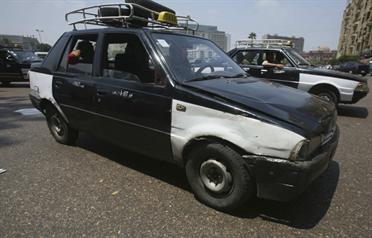
The Egyptian government wants Fawzi Zawar, 49, to give up his taxi. But Zawar, with a white moustache and white hair, is not about to let go of his 27-year-old South Korean Hyundai Pony.
Zawar earns E£600 (Dh412,) a month rattling through Cairo's streets in his vinyl-seat Pony, with its peeling white and black paint and no door handles, window knobs, or sun visors. That is more than he makes in his civil service day job.
Hyundai stopped producing the Pony some 20 years ago and now keeps one in a museum in Seoul. But Zawar's Pony is still running strong, battling the chaos on Cairo's roads and hauling tourists to the Pyramids on a good day.
"It only breaks down twice a week," Zawar says proudly. "I won't change it unless they force me."
Under a law passed earlier this year, the authorities will not renew the licences of any taxis older than 20 years, which may be the majority on the clogged and polluted streets of Cairo.
The fleet of Russian-made Lada 1300s, Cold War-era Romanian Dacia 1300s and Turkish Sahins may not rule the streets much longer in Cairo, where passengers pay what they wish for a ride in the contraptions without a meter.
"Taxis on the road have been operating 24 hours a day for 23 years, with two or three drivers each at one time," said Deputy Interior Minister Major-General Sherif Gomaa, who oversees traffic.
"Their suspension systems are destroyed, the steering wheels can separate from the steering shaft, and accidents happen, like falling into canals."
The drive to get rid of old taxis reflects a broader trend towards modernising consumer products in the most populous Arab country, where megamalls financed by Gulf Arabs are opening for the first time.
With economic growth at seven per cent a year, retailers, property developers, car makers and banks are posting record profits as Egyptians spend more, buying new products they once could not afford.
"You will see many of the older generation keeping their 20-year old stoves and refrigerators they bought when they got married," said Mena Sadek, analyst at Egyptian investment bank Beltone Financial. "But this is changing now."
The Egyptian government, which has overhauled its economy along free-market principles since 2004, says the taxis, besides causing crashes, break down so often they clog up roads, which is bad for business.
They also emit black clouds of smoke as they putter through the city, contributing to a layer of summer smog that settles over Cairo's skyline of minarets and apartment towers topped with satellite dishes.
"The traffic law has been overdue for a long time," said Simon Kitchen, an economist at Egypt's largest investment bank, EFG-Hermes. "There are a lot of very old vehicles on the road and that is a drag on the country's economic performance."
But persuading the owners of Cairo's antiquities on wheels to turn over the keys may be a tricky matter in Egypt, where discontent is rising due to soaring food costs.
Thousands of government workers hit the streets at night to supplement meagre salaries by driving a cab in a country where about a fifth of the population lives on less than $1 (Dh3.67) a day.
"This is oppression," said Ahmed Saeed, 41, pounding the wheel of his 1972 Fiat 124. "They will slaughter us! How will I feed my wife and children?"
Saeed, a father of five, said he would not be able to afford the E£70,000 he estimates he would need to buy a more modern car, even with a loan the government says it will give drivers to buy new cars.
The number of taxi drivers ballooned in the 1990s, when government decrees allowed any car to be converted into a taxi and permitted banks to give car loans, according to Khaled El Khamissi, author of Taxi, a 2006 book about Cairo cabbies.
Many of Egypt's unemployed took out a loan to buy a cab, swelling the number of taxis to about 80,000, Khamissi wrote.
Zawar bought his battered old Pony in 1995 for E£12,000, figuring his salary of E£500 per month from the Ministry of Social Solidarity would not be enough to support his five children.
Buying a new car, he says, would not be a good idea because passengers would refuse to pay him any more money.
The new traffic law includes other measures, such as increasing fines for violating traffic rules and allowing the licensing of three-wheeled rickshaw taxis, known as tuktuks, used commonly in Asia.
It may take more than higher fines to change the behaviour of Cairo drivers, who obey traffic lights only when a policeman is present and wander from lane to lane without warning.
The penalties range up to E£500 fines and even jail for offences such as speeding, eating and drinking while driving, or having a baby in the front seat, a common practice.
"It won't work for sure," said Adil Abdel Rahman, 48, driver of a Soviet-era Lada.
The police, he said, would probably target only the poor for fines, allowing the rich to dodge responsibility.
"Everyone plays with the law here," said Rahman.