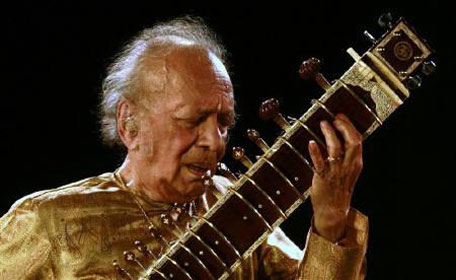
Sitar maestro Pandit Ravi Shankar passed away in San Diego on Tuesday. He was 92. He was admitted to the Scripps Memorial Hospital in La Jolla last Thursday after he complained of breathing difficulties. He breathed his last at 4.30 pm Pacific Time. Click to see gallery of Making music in heaven: Ravi Shankar joins Beatles' George Harrison "Although it is a time for sorrow and sadness, it is also a time for all of us to give thanks and to be grateful that we were able to have him as a part of our lives," the family said. "He will live forever in our hearts and in his music." Last week, the Sitar legend from Maihaar gharana, had wanted to speak to another legend Amitabh Bachchan. The actor wrote on his blog: "Strangely, and for the first time, I had a call from the house of the great sitar maestro Pandit Ravi Shankar. His wife Sukanya ji wanted to talk to me to get me to talk to Ravi Shankar ji, because he had expressed a desire to speak with me. He has been unwell she informed me and was going in for a surgery on Thursday. They are in California, USA." "This has been a most unusual occurrence. We all know Pt Ravi Shankar, who doesn`t? But I must admit that even though we have met on a few occasions, his association with my Father, our association with his elder brother the great dance exponent Uday Shankar, my own association with his son and daughter-in-law, and with Uday Shankar ji`s actress daughter... This has been the first time ever, when such a request was made to me," the actor had written. Ravi Shankar, the sitar virtuoso who became a hippie musical icon of the 1960s after hobnobbing with the Beatles and who introduced traditional Indian ragas to Western audiences over an eight-decade career, has died. He was 92. The prime minister's office confirmed his death and called him a "national treasure." Labeled "the godfather of world music" by George Harrison, Shankar helped millions of classical, jazz and rock lovers discover the centuries-old traditions of Indian music. He also pioneered the concept of the rock benefit with the 1971 Concert For Bangladesh. To later generations, he was known as the estranged father of popular American singer Norah Jones. As early as the 1950s, Shankar began collaborating with and teaching some of the greats of Western music, including violinist Yehudi Menuhin and jazz saxophonist John Coltrane. He played well-received shows in concert halls in Europe and the United States, but faced a constant struggle to bridge the musical gap between the West and the East. Describing an early Shankar tour in 1957, Time magazine said "U.S. audiences were receptive but occasionally puzzled." His close relationship with Harrison, the Beatles lead guitarist, shot Shankar to global stardom in the 1960s. Harrison had grown fascinated with the sitar, a long necked, string instrument that uses a bulbous gourd for its resonating chamber and resembles a giant lute. He played the instrument, with a Western tuning, on the song "Norwegian Wood," but soon sought out Shankar, already a musical icon in India, to teach him to play it properly. The pair spent weeks together, starting the lessons at Harrison's house in England and then moving to a houseboat in Kashmir and later to California. Gaining confidence with the complex instrument, Harrison recorded the Indian-inspired song "Within You Without You" on the Beatles' "Sgt. Pepper's Lonely Hearts Club Band," helping spark the raga-rock phase of 60s music and drawing increasing attention to Shankar and his work. Shankar's popularity exploded, and he soon found himself playing on bills with some of the top rock musicians of the era. He played a four-hour set at the Monterey Pop Festival and the opening day of Woodstock. Though the audience for his music had hugely expanded, Shankar, a serious, disciplined traditionalist who had played Carnegie Hall, chafed against the drug use and rebelliousness of the hippie culture. "I was shocked to see people dressing so flamboyantly. They were all stoned. To me, it was a new world," Shankar told Rolling Stone of the Monterey festival. While he enjoyed Otis Redding and the Mamas and the Papas at the festival, he was horrified when Jimi Hendrix lit his guitar on fire. "That was too much for me. In our culture, we have such respect for musical instruments, they are like part of God," he said. In 1971, moved by the plight of millions of refugees fleeing into India to escape the war in Bangladesh, Shankar reached out to Harrison to see what they could do to help. In what Shankar later described as "one of the most moving and intense musical experiences of the century," the pair organized two benefit concerts at Madison Square Garden that included Eric Clapton, Bob Dylan and Ringo Starr. The concert, which spawned an album and a film, raised millions of dollars for UNICEF and inspired other rock benefits, including the 1985 Live Aid concert to raise funds for famine relief in Ethiopia and the 2010 Hope For Haiti Now