When the veil offered women more freedom
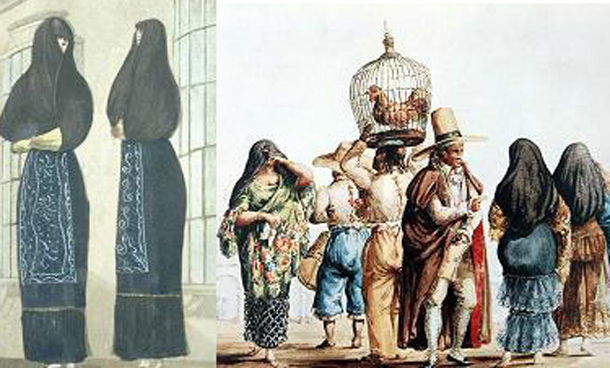
Europe's heated debate over the Islamic niqab has revived memories in Peru of its own tapadas, women from Lima who in centuries past wore long skirts and a face-covering veil.
The saya, an overskirt worn tightly at the waist and raised slightly to show ankles, and the manto, a thick shawl that covered shoulders, head and much of the face, inspired painters and writers for three centuries.
And they were once considered a distinctively national attire.
A legacy of the Moors, or Muslims, who fled persecution in Spain, "las tapadas Limenas" were especially common among the Spanish elite when they first arrived in Peru after the Spanish colonization in the 16th century.
The attire "was clearly intended to serve as a cover, to protect women's virtue and ward off temptation," explained Alicia del Aguila, a sociologist who has studied and written about the subject.
More freedom
Over time, the bourgeoisie and the middle class appropriated the saya and the manto, which became a way for women to hide from unwanted male attention, cover their faces and also conceal their social rank and skin colour.
The modest clothes provided "more freedom to those who wore them than ordinary women," argued del Aguila.
Such an approach is a far cry from the controversy stirred by the veil throughout Europe, where it is seen as a sign of the perceived Muslim oppression of women.
The lower house of parliament in France, where rundown city suburbs are home to Europe's biggest Muslim minority, has voted overwhelming to ban full Islamic veils in public spaces, and similar laws are pending in Belgium, Spain and some Italian municipalities.
But in Lima, the tapada loosened the stranglehold on women, giving them greater freedom while protecting their honour.
"In the 18th century, a woman who went out alone into the street was either a women who lived and worked there or a bad woman," said Jesus Cosamalon, an historian at Lima's Catholic University.
Especially prevalent in 19th century Lima, the tapadas made a big impression on European observers.
Some reacted with admiration. Others were troubled by this new form of female self-assertion.
"There is no place on Earth were women have more freedom than in Lima," Franco-Peruvian socialist and feminist Flora Tristan said in 1837 as she enthused about the women who, while covered, were free to stroll in the streets, at amphitheaters and even in Congress.
They could also be subversive – a man could flirt with an unknown woman who could pass as his wife – and both the Catholic Church and the Spanish sovereigns tried several times, in vain, to ban the tapadas.
Romantic tales embellished the mysterious, seductive aspect of the attire.
A tapada could cover a woman's entire face, leaving only a small triangle of light to shine through and exposing only a single eye. Others showed a tantalizing part of an arm.
Or just a shoe or a heel would poke playfully from the saya.
Killed by fashion
Women thus dressed were often "playing the eternal game of concealing and exposing," according to Del Aguila.
In the end, changing fashions spelled the demise of the tapadas.
The economic boom of the 1860s swept in new European elites attracted by the up and coming Parisian fashions.
As the 19th century drew to a close, social codes changed, and the tapadas disappeared amid a new desire to see clearly and control, explained Cosamalon, who drew a parallel to the advent of public lighting.
"What was dark was considered dangerous, bad," he said.
For del Aguila, the history of the tapadas shows that "how an attire is worn and its history is dependant on how people use it in the long term."
The future of the Islamic veil will "especially depend on what future generations will make of it. Perhaps they will be more secular and less bent on legislating the matter," she said.
As with the debate over the Islamic veil, "views and opinions for or against the tapadas came mainly from the outside, from the authorities or observers," said Casamalon.
"The only voice we didn't hear was from the wearer."