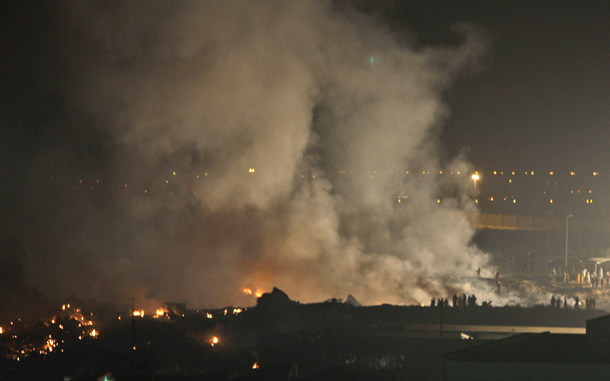
The UAE’s General Civil Aviation Authority (GCAA) has issued its final air accident investigation report on the crash of the UPS cargo plane that crashed on September 3, 2010, in the desert outside Dubai. On that tragic day, at about 7:51pm local time (1551 GMT), United Parcel Service (UPS) Flight 6, a Boeing 747-400F (N571UP), crashed while attempting to land at Dubai International Airport (DXB). The flight had departed from Dubai approximately 45-minutes earlier as a scheduled cargo flight to Cologne, Germany, but the flight crew declared an emergency and requested an immediate return to Dubai. The airplane impacted inside an Emirati army base near a busy highway intersection, approximately nine miles from Dubai’s international airport. The two flight crew members were fatally injured. The report published yesterday , says that “the investigation concludes with reasonable certainty that the location of the fire was in an element of the cargo that contained, among other items, lithium batteries.” The UAE GCAA’s report states that the fire began in the section of the cargo that included “a significant number of lithium type batteries and other combustible materials” and added that “the fire escalated rapidly into a catastrophic uncontained fire.” The 322-page report into the crash, which killed both pilots, points to the presence of lithium batteries in the cargo as a possible reason for the ignition that then engulfed to other combustible material around. “It is possible that a lithium type battery or batteries, for reasons which cannot be established, went into an energetic failure characterised by thermal runaway and auto ignited starting a chain reaction which spread to the available combustible material,” the report concludes. Malfunctioning lithium batteries have been more recently linked with the temporary grounding of the entire fleet of Boeing 787 Dreamliner aircraft after a fire in the battery of a parked Japan Airlines’ 787 aircraft was reported, followed by an emergency landing of an All Nippon Airways 787 due to smoke emerging from its lithium battery. “Lithium batteries have a history of thermal runaway and fire, are unstable when damaged and can short circuit if exposed to overcharging, the application of reverse polarity or exposure to high temperature are all potential failure scenarios which can lead to thermal runaway,” the GCAA’s report maintains. “Once a battery is in thermal runaway, it cannot be extinguished with the types of extinguishing agent used on board aircraft and the potential for auto ignition of adjacent combustible material exists.” The report states that investigators found no items other than the lithium batteries capable of causing the fire among the debris. “The cargo identified on scene included clothing, machined parts and subassemblies, flashlights, gun parts, costume jewellery, cases for electronic equipment, USB flash drives, un-populated circuit boards, espresso makers, automotive entertainment and navigation systems, bike frames, pellets for injection moulding, wrist watch components, rubber bracelets, cell phones, MP3 and MP4 players, mannequin heads, wigs, shoes,” the report states. “No items posing a flammable fuel load or capable of acting as an ignition source were visually identified except for batteries and battery containing devices,” it adds. The report also maintains that “shippers of some of the lithium battery cargo loaded in Hong Kong did not properly declare these shipments” in addition to not providing test reports as mandated by the UN Recommendations to verify that such these battery designs were in conformance with UN Modal Regulations. “At some point prior to the fire warning, contents of a cargo pallet, which included lithium batteries, auto-ignited, causing a large and sustained cargo fire which was not detected by the smoke detectors when in the early stages of Pyrolysis,” the investigation concludes. “The uncontained cargo fire directly affected the independent critical systems necessary for crew survivability. Heat from the fire exposed the supplementary oxygen system to extreme thermal loading, sufficient to generate a failure. This resulted in the oxygen supply disruption leading to the abrupt failure of the Captain’s oxygen supply and the incapacitation of the captain,” the report states. “The progressive failure of the cargo compartment liner increased the area available for the smoke and fire penetration into the fuselage crown area,” it says. “The rate and volume of the continuous toxic smoke, contiguous with the cockpit and supernumerary habitable area, resulted in inadequate visibility in the cockpit, obscuring the view of the primary flight displays, audio control panels and the view outside the cockpit which prevented all normal cockpit functioning,” it adds. The UAE GCAA’s investigation report lists the sequence of events that led to the tragic crash of the Boeing 747-44AF aircraft. ACCIDENT SYNOPSIS “On September 3rd 2010, a