Obama leaves Asia, but America stays
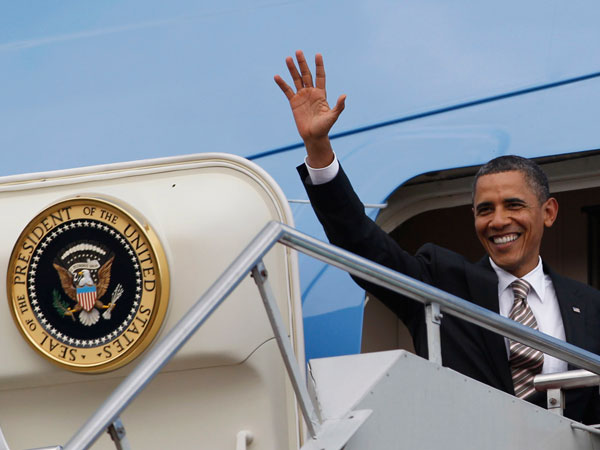
In a week-long Pacific odyssey, President Barack Obama tweaked an irked China's tail and sent Asia an unequivocal message that the United States wants to shape the region's future.
He flew home Saturday after having taken in a trio of summits, weighted America's military punch by announcing a new US Marines force in Australia, and vowed to stoke flickers of reform in Myanmar.
He also declared that a budget crunch in Washington would not see America's military and diplomatic clout in the region short-changed.
"Let there be no doubt. In the Asia-Pacific of the 21st century, the United States is all-in," Obama said.
His journey to Hawaii, Australia and Indonesia highlighted a US power shift from a decade of war to what he sees as America's destiny in dynamic Asia.
"I think that we have seen implementation here of a critical, strategic, reorientating in policy by the United States -- a rebalancing," said Obama's national security advisor Tom Donilon.
The dominant theme of Obama's travels was the growing US rivalry with China.
The two nations are economically interdependent, and have found limited common ground on issues like North Korea and Iran. But they increasingly squabble on currency, trade and even maritime security.
China reacted angrily to US lectures that as a "grown-up" economy it must obey the "rules of the road", and for now can only aspire to a new pan-Pacific trade pact that gathered pace at the APEC summit in Hawaii.
Obama insisted that the United States does not "fear" China, does not want to contain it, nor deny it the benefits of its rise.
But China warned him not to "politicise" trade nor "interfere" in South China Sea territorial disputes.
Shi Yinhong, a professor of international relations who directs American studies at Beijing's Renmin University, told AFP that US strategy would inevitably be seen inside China as an attempt to marginalize the country.
"The Chinese government and leaders have expressed their sincerity to the United States many times, have welcomed the United States joining the East Asia Summit, and do not crowd out the interests of the United States," he said.
"But what is regretful is that this goodwill has not had a positive response."
Washington is seeking to build a regional economic and security "architecture" in Asia to resolve disputes and promote rules-based trade.
It hopes such a model could eventually prompt China to reshape its definition of its own national interest on issues like intellectual property standards and currency policy.
The Trans-Pacific Partnership trade pact, the East Asia summit in Indonesia's Bali which Obama was the first US president to attend, and evolving ties with the Southeast Asian bloc are the building blocks of that strategy.
So are US garrisons in South Korea and Japan and prowling US Navy carriers.
Ernest Bower of Washington's Center for Strategic and International Studies said the TPP could be a "world-class" pact which eventually "compels China to abandon its attempts to seek its own model for integrating Asia".
But so far, China sees only encroachment.
A Xinhua news agency commentary Saturday warned the Pacific Ocean belongs to all countries sharing its shores, not just the United States, and called for a "reliable partner", not an American "arbitrator".
China plays a longer geopolitical game than harried US presidents who face four- or eight-year political clocks, so its considered response to Obama's trip may be slow to emerge.
But it has the advantage of geographic proximity and its own cards to play, with vast investment, trade and political influence with its neighbours.
The White House hopes to maintain momentum in Asia by reaching a deal on the terms of the TPP with its partners next year -- but deadlines in world trade talks tend to slip.
A visit to Myanmar by Secretary of State Hillary Clinton next month to prod budding reform efforts could also invigorate US engagement but again anger China.
"They see everything we do with Myanmar as suspicious," said David Steinberg, of Georgetown University.
US activities across the South China Sea and in Australia, where Obama plans to deploy up to 2,500 Marines, are also viewed "with suspicion" by Beijing, he said.
But Obama had a more pressing audience back home as he sought to persuade Americans that their president, facing a tough 2012 re-election bid, has one thing on his mind: jobs.
So he made huge play of news that Indonesia's Lion Air will buy 230 Boeing 737 jets for ê21.7 billion, in a deal that the White House says will support more than 100,000 American jobs.
Jobs are also the reason why America is in Asia to stay, according to Google executive chairman Eric Schmidt, who briefed reporters in Hawaii.
"The fastest way to create more jobs in America then is to increase our exports to the fastest-growing parts of the world, which happen to be in Asia," he said. "QED."