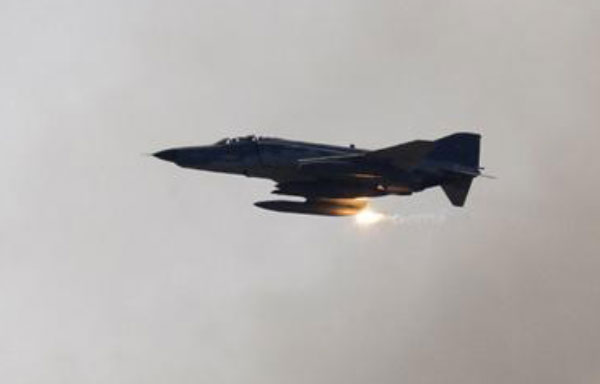
Ankara warned it would respond decisively to the incident that threatened to open a new international dimension in the 16-month revolt against Syrian President Bashar al-Assad. Syria said the Turkish aircraft was flying low, well inside Syrian territorial waters when it was shot down. With the second biggest army in Nato, a force hardened by nearly 30 years of fighting Kurdish rebels, Turkey would be a formidable foe for the Syrian army which is already struggling to put down a 16-month-old revolt. It is not possible to ignore the fact Syria shot down a Turkish fighter jet: Gul Meanwhile, Turkish President Abdullah Gul said on Saturday it was not possible to ignore the fact that Syria had shot down a Turkish fighter jet and said everything that needed to be done following the incident would be done, Turkish media reported. "It is not possible to cover over a thing like this, whatever is necessary will no doubt be done," Gul told reporters from the central Anatolian city of Kayseri. The Turkish military said it had lost contact with one of its F-4 fighter jets off the southern Turkish coast near Syria on Friday morning and Damascus later acknowledged it had shot the plane down. Turkish Prime Minister Tayyip Erdogan, who had been returning from a summit in Brazil when the news broke, called an emergency security meeting on his arrival in Ankara and in a statement his office said Ankara would act "decisively" once all the details had emerged. Syria has said the Turkish aircraft was flying low and well inside Syrian territorial waters when it was shot down. Gul said it was normal for jets to briefly cross into foreign airspace and said a probe into the incident would look at whether in fact it was downed while in Turkish airspace. "When we think of the speed of these jet planes while flying above the sea, crossing over borders for a short distance and then back again is a little bit routine," said Gul. He said because of the serious nature of the incident it was not possible at this stage to give any more detailed statement. Asked whether Turkey was in contact with Syria over the incident, Gul said telephone contact had been made and said: "Because there is no security there, we withdrew our representatives from Syria. This does not mean there is no contact." Gul said Turkish and Syrian forces were still working together to search for the two missing crew of the aircraft. "Turkey will present its final stance after the incident has been fully brought to light and decisively take the necessary steps," the office said after a two-hour emergency meeting between prime minister, the chief of general staff, the defense, interior and foreign ministers, the head of national intelligence and the commander of the air force. Turkish media had reported earlier that Syria had apologized for the incident, but Erdogan made no mention of any apology. Ankara, which had drawn close to Syria before the uprising against Assad, turned against the Syrian leader when he responded violently to pro-democracy protests. Turkey now gives refuge to the rebel Free Syrian Army on its frontier with Syria. Erdogan, whose enmity with Assad has assumed a strongly personal nature, gave no hint what action he might contemplate. Syrian military statement A statement by the Syrian military said the Turkish plane was flying low, just one kilometer off the Syrian coast, when it was hit by anti-aircraft fire. The plane fell in Syrian waters 10-kms (seven miles) west of the village of Um al-Touyour. "The navy of the two countries have established contact. Syrian naval vessels are participating along with the Turkish side in the search operation for the missing pilots," it said. Syria has some of the most sophisticated air defences in the Middle East, supplied by Russia. Turkish state television interviewed witnesses on the country's Mediterranean coast, near the Syrian border, who said they saw two low-flying fighter jets pass overhead in the morning in the direction of Syrian waters but only one return. Ankara has previously floated the possibility of setting up some kind of safe haven or humanitarian corridor inside Syria, which would entail military intervention, but has said it would undertake no such action without U.N. Security Council approval. Turkey has said however that Assad must go. Turkey hosts about 32,000 Syrian refugees and allows the rebel Syrian Free Army to operate from its territory. The opposition Syrian National Council meets in Istanbul. It was unclear why the Syrians had shot down the aircraft, which, having left a base in Malatya, was flying close to a corridor linking Turkey with Turkish forces on Northern Cyprus. "The Syrian military may have taken a calculated gamble by downing the Turkish plane, which could boost the morale of Assad's loyalists after increased defections from the military we have seen," Yasser Saadeldine, a prominent pro-opposition Syrian political commentator, said. "A Turkish retaliation would fit into t