Tibet protesters held in Beijing
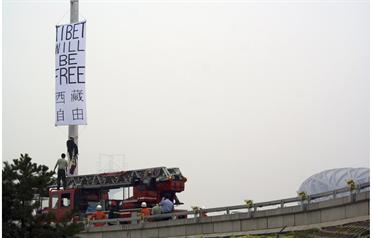
They displayed Tibetan flags and banners declaring "One World, One Dream: Free Tibet" and "Tibet will be free," the group Students for a Free Tibet said in an email. One of the banners also said "Free Tibet" in Chinese.
The four breached the general Chinese ban on protests, especially over restive Tibet, by scaling power poles near the heavily guarded Bird's Nest Stadium, where the Olympics open on Friday, Xinhua news agency reported. The protest also came as the Games torch began passing through Beijing under tight security.
Tenzin Dorjee, deputy director of Students for a Free Tibet, said the protest was intended to dramatise complaints about Chinese rule in Tibet as Games preparations climax.
"As the Chinese leadership prepares its display of grandeur and power in Beijing ... it is waging a ruthless campaign of repression inside Tibet," he said in the emailed statement.
The protesters were being investigated by police, Beijing Games spokesman Sun Weide told a news conference. "The Chinese government has very clear laws and regulations," he said.
The two British protesters were Iain Thom, 24, and Lucy Marion, 23, and the two Americans were Phill Bartell, 34, and Tirian Mink, 32, said a statement on a Students for Free Tibet website (freetibet2008.org).
A photo showed a person wearing a climbing helmet and gear scaling what appeared to be a light tower below a pro-Tibet independence banner.
A British embassy spokesman said its staff were seeking access to its detained nationals. A US embassy spokeswoman said privacy rules for citizens prevented her from commenting on the matter.
Police rushed to the scene after 12 minutes and took them away, the Xinhua news agency said. Approaches to the Bird's Nest Stadium are guarded by many police and soldiers, but Students for a Free Tibet said the protesters showed the banners near it for nearly an hour.
The International Olympics Committee said it expected Beijing authorities would "act with tact and understanding" in responding to such acts. "People will use the platform of the Olympic Games to draw attention to their causes," IOC spokesperson Emmanuelle Moreau said.
DINGY HOTEL VIEWING
Separately, a small group of foreign reporters attended the screening of a new documentary about what Tibetans think of the Olympics, produced by a pro-Tibet independence group.
Held in secrecy in a dingy Beijing hotel, the screening was not interrupted by officials, though the German organiser, Jean-Jacques Schwenzfeier said he was aware he could be deported.
"It wasn't possible for Tibetans to participate like they wanted, so this was the minimum we could do, to show our presence," he said.
The Beijing Games torch relay was dogged by protests over Chinese rule in Tibet when it made its way through Paris, London and other cities earlier this year.
China has accused followers of the Dalai Lama, the exiled Tibetan Buddhist leader, of stirring unrest in Tibetan regions in March in a bid to upstage Olympic preparations. The Dalai Lama has denied the claim and said he does not oppose the Games.
But groups campaigning for Tibetan independence have said they will use the Games to voice their demands.