UAE Updates Laws on Protection of New Plant Varieties, Endangered Animals and Plants
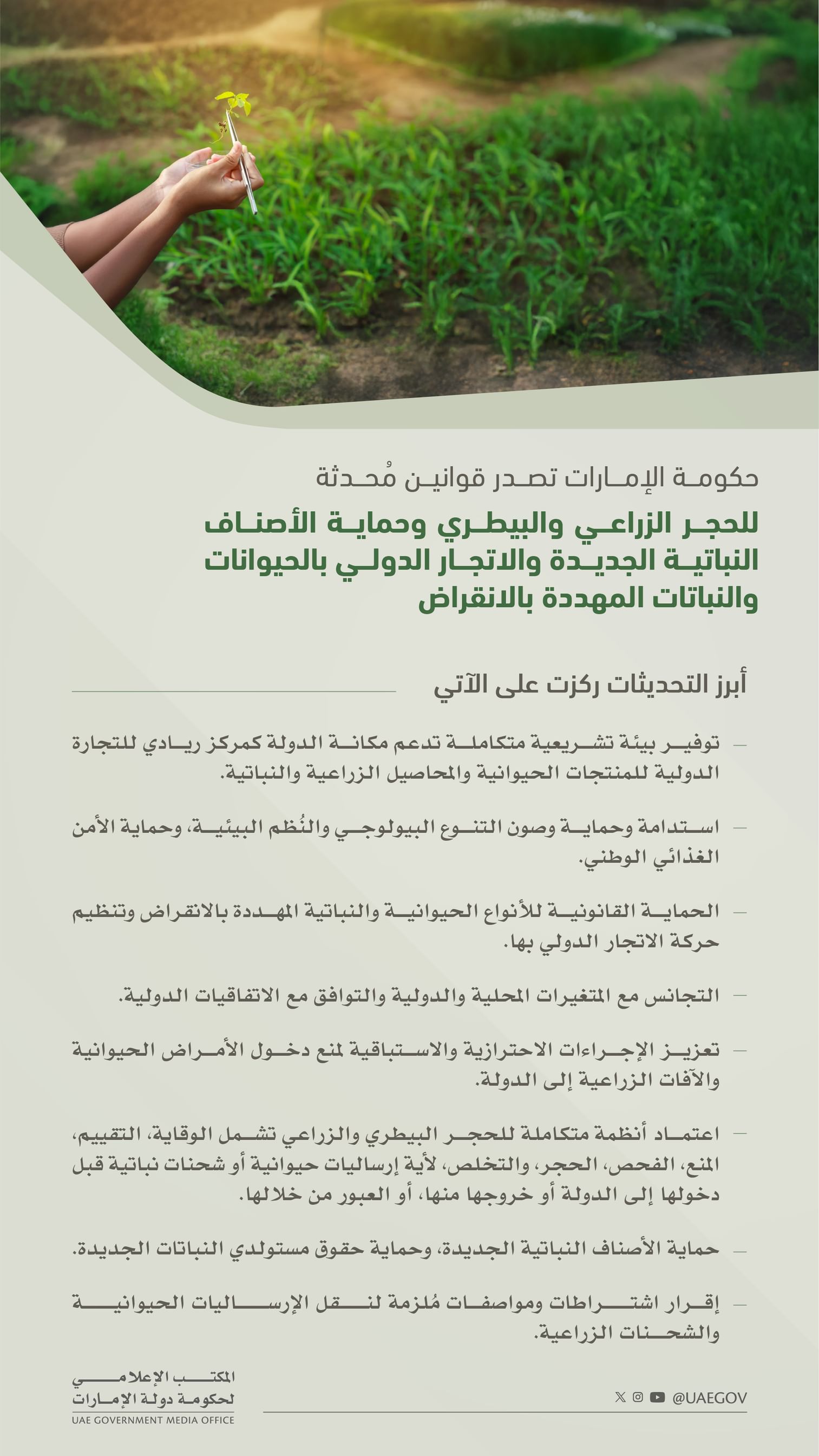
The Government of the United Arab Emirates has issued a comprehensive package of updated federal laws to support and develop agricultural and veterinary quarantine, protect new plant varieties, and regulate the international trade in endangered animals and plants, as part of ongoing efforts to further develop the legislative and regulatory framework governing these vital sectors.
The new law supports the UAE’s strategic direction in protecting and conserving biodiversity, strengthening legal protection for endangered animal and plant species, and regulating their international trade in accordance with the Convention on International Trade in Endangered Species of Wild Fauna and Flora.
The law replaces Federal Law No. 11 of 2002 concerning Regulating and Controlling the International Trade in Endangered Species of Wild Flaura and Flora, which has remained in force for more than 22 years without amendment. The updated legislation responds to developments in the protection of endangered species, reinforces the UAE’s compliance with CITES requirements, and enhances the effectiveness of enforcement by granting broader executive powers to the national administrative authority, enabling timely regulatory action and strengthened oversight. It also expands the scope of legal protection in line with periodic amendments to the CITES appendices and procedures.
The law introduces updated and precise definitions for key terms, including endangered species, pre-convention specimens, falcon passport, shipment, and phytosanitary certificate, while revising existing terminology to ensure consistency with the UAE’s legislative drafting framework.
Its provisions apply across all territories of the UAE, including free zones, with respect to specimens and endangered species listed in the annexes attached to the law and any subsequent amendments thereto.
The law prohibits importing, exporting, re-exporting, transiting, or introducing from the sea of any endangered specimens through all border points of the UAE, reinforcing national sovereignty over border controls and preventing circumvention of regulatory requirements.
The law further defines the competencies of the national administrative authority, namely the Ministry of Climate Change and Environment, as the entity responsible for implementing the law, overseeing enforcement related to international trade in endangered animal and plant specimens, combating illegal trade, issuing relevant certificates, and prescribing any conditions deemed necessary for their issuance.
It grants the Authority new powers not provided for under the previous legislation, including the authority to dispose of seized specimens pursuant to the judicial rulings. The law also introduces provisions regulating transit specimens, allowing for the suspension of transit and seizure of specimens where export or re-export certificates are absent or where discrepancies are identified between the specimens and accompanying documentation.
Penalties have been significantly strengthened, with fines ranging from AED30,000 to AED2 million, and custodial penalties of up to four years in certain cases. Violators are required to bear all associated costs, including those related to seizure, transport, care, storage, and disposal of specimens, with mandatory deportation in the event of recidivism for foreign offenders.
Veterinary quarantine constitutes the first line of defence against the introduction and spread of infectious animal diseases, contributing to the protection of public health, the conservation of biodiversity and ecosystems, and the safeguarding of national food security.
The new Law on Veterinary Quarantine, replaces Federal Law No. 6 of 1979 concerning Veterinary Quarantine, which had remained in force for 45 years, aligning national legislation with international standards and requirements in animal health and enhancing oversight of animal consignments imported into, exported from, or transiting through the UAE.
The law updates and expands definitions to reflect scientific and international developments, introducing terms such as veterinary quarantine procedures, veterinary health certificate, animal waste, animal feed, and border entry point. Its provisions apply to all animal consignments entering, leaving, or transiting the State.
The law empowers the competent authorities to adopt proactive precautionary measures, including import bans and temporary quarantine restrictions, based on scientific indicators or international alerts regarding the spread of transboundary animal diseases, including emerging diseases and those listed by the World Organisation for Animal Health.
Animal consignments may only enter the UAE through approved border entry points designated by the Ministry of Climate Change and Environment. The law establishes an integrated veterinary quarantine system encompassing prevention, assessment, prohibition, inspection, quarantine, and disposal of infected animals.
Agricultural quarantine represents a critical safeguard against agricultural pests and diseases that directly impact food security, public health, environmental protection, and the safety of international agricultural trade.
The new Law on Agricultural Quarantine replaces Federal Law No. 5 of 1979 concerning Agricultural Quarantine, modernising the framework to align with amendments to the International Plant Protection Convention and reinforcing the UAE’s global standing as a leading centre for the trade of agricultural commodities.
The Law introduces updated terminology, including phytosanitary regulations, regulated articles, pests, quarantine pests, beneficial organisms, and phytosanitary certificates. Its provisions apply to plants, plant products, beneficial organisms, and regulated articles imported into, exported from, or transiting through the UAE.
Penalties have been increased, with fines reaching AED500,000 and mandatory deportation in the event of recidivism for foreign offenders.
Law on the Protection of New Plant Varieties aims to protect new plant varieties, regulate breeders’ rights, encourage agricultural innovation, and enhance food and biosecurity. It was issued to replace Federal Law No. 17 of 2009 and aligns national legislation with best international practices and standards set by the International Union for the Protection of New Varieties of Plants.
It establishes a Register for the Protection of New Plant Varieties within the Ministry of Climate Change and Environment and defines the competencies of the Registrar. The law defines the breeder to include the person who bred or discovered and developed the variety, their employer, or their legal successor.
Protection is granted where a variety is new, distinct, uniform, and stable. The protection period is set at 20 years, and 25 years for vines and trees.
The Law revises novelty requirements, extends protection to all plant genera and species, and clarifies standards of distinctness and uniformity. Penalties for violations include custodial penalties of up to three years and fines of up to AED250,000.