- City Fajr Shuruq Duhr Asr Magrib Isha
- Dubai 04:20 05:42 12:28 15:53 19:08 20:30

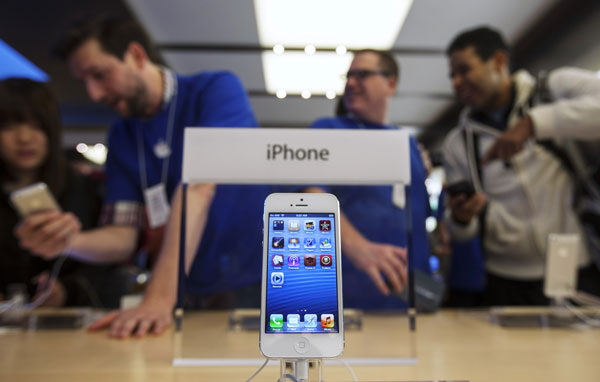
An Apple iPhone 5 phone is displayed in the Apple Store on 5th Avenue in New York, September 21, 2012. (REUTERS)
Demand growth for the iPhone 5, Apple Inc.’s (NASDAQ:AAPL) spearhead smartphone, reached the proverbial nadir in the first quarter of 2013, new research and statistics suggest.
According to Canalys, an independent analyst firm, the growth in demand for Apple’s smartphones was at the lowest level since the launch of the original iPhone back in 2007.
What this means, in effect, is that ‘the biggest thing to happen to iPhone since iPhone’ isn’t necessarily the best thing for iPhone sales. In fact, going by demand trends in Q1 2013, it is the worst thing to happen to iPhone since iPhone.
And the hit that Apple Inc. (NASDAQ:AAPL) is braving isn’t limited to just sales numbers. There’s something else that makes the sales slowdown pale in comparison. And that’s Apple’s struggling share price.
In August of 2012, when the price of an AAPL share was hovering at about $675 apiece and a few weeks before the unveiling of ‘iconic’ iPhone 5, Emirates 24|7 had the audacity (you can now call it foresight) to write this piece: 5 reasons why iPhone 5 will crash Apple’s soaring share price .
Indeed, as Apple launched the iPhone 5, Apple’s share price (NASDAQ:AAPL) surged to an all-time high of $705.07 on September 21, 2012, almost as if cocking a snook at naysayers such as yours truly. But then reality caught up, with Apple Inc., its share price, investors, and consumers.
Apple’s share price has been sinking like a stone in water ever since reaching that all-time high, and dropped to $385.10 last month, on April 19, 2013. That was a decline of more than 45 per cent in less than seven months. Ask any financial analyst worth his salt, and he’d tell you that that’s very bad, especially for the world’s most valuable firm .
As it is, the iPhone 5 isn’t the best to ship out of the Cupertino-based firm’s stables, and we minced no words in letting you know of our thoughts about the smartphone. Read: Apple iPhone 5: Top 6 defects and disadvantages .
Also read: Nine reasons not to buy Apple’s new iPhone 5 just yet
And if the Cupertino giant’s own woes weren’t enough, there’s all these Samsungs, HTCs, Sonys and BlackBerrys of the world launching their own respective ‘iPhone-killers’ during the first quarter of 2013 (or thereabouts). No wonder then that iPhone sales aren’t doing all that well.
But don’t get us wrong – there has been growth, and quite decent one on that. Apple Inc. sold 47.8 million iPhones in Q4 2012, and that jumped to 59.6 million iPhones in the first quarter of 2013. Standalone, that’s growth. A little under 25 per cent growth in one quarter is great going in any market, any industry, especially if the base is a huge 50 million (almost).
But here’s the catch – the overall market witnessed a quarterly growth of 42.6 per cent in Q1 2013 when compared with Q4 2012, while Apple shipments grew 24.7 per cent, or much, much less than the market average. So if the overall market is growing, and Apple’s growing at about half the market’s pace, should it still claim it’s growing? Its market share certainly isn’t.
According to Canalys data, Apple had a global smartphones market share of 22.1 per cent in the last quarter of 2012. Within three months, that dwindled to 19.3 per cent in the first quarter of 2013. And no, Samsung did not benefit from Apple’s loss.
Samsung’s market share declined too. From 29 per cent in Q4 2012, Samsung Electronics’ share of the global smartphones market shrunk to 26.6 per cent in Q1 2013. But while one can attribute that to Samsung fans stalling their device purchase in anticipation of the Galaxy S4’s availability, there was no such anticipation for a new iPhone to hit the market in Q1 of this year.
This means that the decline in iPhone demand growth, and its subsequent market share loss, is organic. And that’s worrying, indeed.
By all estimates, the current quarter will not bring any cheer to iPhone demand either, with anticipation building up for a June/July unveiling of the next iPhone – which would translate into an August/September in-store availability of the new device. So, one can write another couple of quarters off the iPhone demand graph.
But if the demand destruction that Apple has seen cannot be attributed to the Galaxy S4 from Samsung (which has lost share) or HTC One from HTC (remains categorised among ‘others’, with a global market share of less than 3 per cent), then what is to be blamed?
It is Apple’s hype-creating machinery coupled with the rumour-mill that churns out juicy gossip and alleged features of ‘imminent’ new iPhone iterations even before the previously announced iteration becomes available across the world.
The hype and hoopla did work to Apple’s advantage in yesteryears. There wasn’t much choice available to someone looking for a sturdy, good-looking phone with incredible apps, and customers chose to wait for the upcoming iPhone with bated breath and a loaded wallet.
The story, however, is very different today. The market is getting increasingly flooded with killer smartphones, and there is no dearth of smartphones that are decisively better than the iPhone in some respect or another.
Android-powered HTC One is one such superbly crafted device with a plethora of apps, specs and (almost) everything that a user wants in a smartphone. The only thing it lacks is Apple’s marketing muscle.
Another Android-powered smartphone, the Samsung Galaxy S4, has bigger marketing muscles than Apple, and boasts of some cutting-edge specs and comes loaded with a huge number of apps. The only thing it lacks is Apple’s glossy metal build quality.
The BB 10-powered BlackBerry Z10 and Q10 are two engines of BlackBerry’s comeback train, and offer good quality and unique BBM offerings. The only thing these two devices lack are Apple’s huge number of user-friendly apps.
There are others too in the race, but each one of them lacks something or another that Apple has. You see, the Apple iPhone remains a benchmark against which other smartphones are measured, despite the haemorrhaging demand growth.
But if Apple keeps bleeding market share at the current rate for another two quarters, its global share of the smartphones market will come down to about 15 per cent (or less) by the end of Q3 2013. That’s not a leader’s share by any stretch of imagination.
And we might need to look for another device against which to benchmark every other smartphone. Will Apple launch a killer iPhone 5S or iPhone 6 and continue to give us a measuring gauge, or will we need to look for another benchmark? The next iteration of Apple could well be a defining moment in Apple’s history. The Cupertino giant could become another Nokia or IBM and fade away for years, or it could well change everything again and remind everyone what a great innovator it is.
 Follow Emirates 24|7 on Google News.