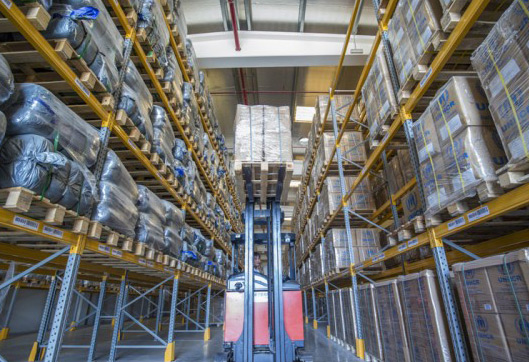
A massive plan to triple the size of the UAE-based International Humanitarian City (IHC), including warehousing space, are hoped to allow the world’s largest humanitarian logistics hub and its member United Nations aid agencies and NGOs respond more efficiently to several crises and disasters simultaneously to meet a sharp rise in global demand for emergency aid, IHC’s incoming Chief Executive Officer Giuseppe Saba said today in an exclusive interview with Emirates News Agency (WAM). The fact that in the past four years IHC has received a massive demand from the humanitarian community represented by the UN and NGO agencies, struggling to cope with the sharp rise in emergencies, justifies the massive expansion of the IHC to 360,000 square meters of warehousing facilities, that was announced in December 2016, and approved by Vice President, Prime Minister and Ruler of Dubai, His Highness Sheikh Mohammed bin Rashid Al Maktoum, in January, according to Saba, a logistics pioneer and former head of the United Nation's Humanitarian Response Depots (UNHRD). "A few years ago, IHC underwent its first tripling in size, up to the current 105,000 square meter space in the Dubai Industrial City. The total number of shipments delivered for emergency responses by IHC's members from 2011 to 2016 climbed to 8,211 worth AED 2.298 billion - $625.9 million. In addition to this, from 2009 to2014, IHC’s humanitarian impact has increased by 87 per cent," Saba told WAM. These statistics, he stressed, affirm H.H. Sheikh Mohammed bin Rashid's' vision in establishing the UAE as a hub for providing humanitarian aid in emergencies and for disaster relief, through securing the logistic infrastructure, facilities, and services required to enable its members to achieve their objectives across the globe. "The continuing rise in demand, along with UAE's strategic location, serving two thirds of the world's population and the highest risk geographical areas, justify the need to triple the IHC's size once again," Saba said. To help its members meet their immediate growth needs, IHC will expand the current facilities by an additional 20 per cent (20,000 square meters), to reach 120,000 square meters of storage space. It will then embark on the broader expansion plan, which will result in tripling the size of the IHC a second time to reach 360,000 square meters. In December, HRH Princess Haya bint Al Hussein, Chairwoman of IHC, and wife of H.H. Sheikh Mohammed bin Rashid, said the expansion plan comes as the IHC, the only humanitarian free zone in the world, has grown to host 9 UN humanitarian agencies, and over 50 international non-profit organisations, intergovernmental organisations and commercial companies. In June 2016, under the guidance of H.H. Sheikh Mohammed bin Rashid, HRH Princess Haya and the IHC Board began a phase of addressing the internal structure of the organisation in order to expand the IHC operations and reach. An Executive Committee was appointed with HRH Princess Haya as Chairwoman. The following is the full text of WAM’s interview with Giuseppe Saba, the incoming Chief Executive Officer of IHC. H.H. Sheikh Mohammed bin Rashid Al Maktoum recently announced he will triple the size of the International Humanitarian City, up to 360,000 square meters, why such a massive expansion? A few years ago, IHC underwent its first tripling in size, up to the current 105,000 square meter space in the Dubai Industrial City. In the past four years, IHC has received a massive demand from the humanitarian community represented by the UN and NGO agencies, trying to cope with the sharp rise in emergencies. The total number of shipments delivered for emergency responses by IHC's members from 2011 to 2016 climbed to 8,211 worth AED 2,298 billion - $625.9 million. In addition to this, from 2009-2014, IHC’s humanitarian impact has increased by 87 per cent. These statistics affirm His Highness' vision in establishing the UAE as a hub for providing humanitarian aid in emergency situations and for disaster relief, through securing the logistic infrastructure, facilities, and services required to enable its members to achieve their objectives across the globe. The continuing rise in demand, along with UAE's strategic location, serving two thirds of the world's population and the highest risk geographical areas, justify the need to triple the IHC's size once again. The current demand for space is immediate, while the expansion will take some time; how will IHC support its members in the immediate period? To help its members meet their immediate growth needs, IHC will expand the current facilities by an additional 20 per cent (20,000 square meters), to reach 120,000 square meters of storage space. It will then embark on the broader expansion plan, which will result in tripling the size of the IHC a second time to reach 360,000 square meters. The plot that will be used for this expansion is located in the Al Maktoum airport area and in proximity to the