- City Fajr Shuruq Duhr Asr Magrib Isha
- Dubai 04:20 05:42 12:28 15:53 19:08 20:30

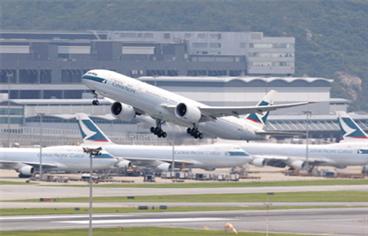
(REUTERS)
With Air China last week boosting its stake in Cathay Pacific, the globally renowned Hong Kong airline has moved a step closer to becoming a mainland company, say analysts.
By increasing its holding to 29.99 per cent, Air China boosted its position to just a hair's breadth below the 30 per cent that would trigger a mandatory takeover offer, while also doubling its presence on the Cathay board to four members.
Yet the move was met with rumblings of disquiet in some corners, amid fears a Chinese takeover may tarnish a carrier regarded as a key emblem of Hong Kong's "One Country, Two Systems" autonomy from the mainland, and even pose an existential threat to the city.
"The sale raises the spectre of Cathay one day being a mainland-controlled firm," said Hong Kong's South China Morning Post, adding that "mainland airlines are not highly regarded here.
"Damage to Cathay's standards, quality and reputation would be damage to Hong Kong," it said.
Although Air China has refused comment on whether or not it plans to launch a formal bid, industry watchers believe that it eventually will. "I think that an eventual merger is a possibility," said Corrine Png, transport analyst at investment bank JP Morgan.
"This transaction is a positive step towards it," she added, noting that a deal may occur in two to three years time if regulatory hurdles concerning China air traffic rights can be navigated.
Yet Png also warned against reading too much political significance into Air China's stake-building, and argued that little has actually changed. "People shouldn't see this as Air China doing national service," she said.
"Citic Pacific, who sold the shares, is a state-owned enterprise in China as well, so the Chinese interest has always been there. Air China will bring synergies, whereas Citic was just an armchair investor," she said.
Indeed, if viewed as a whole, says Png, the Chinese interest in Cathay reduced from 35 per cent to 33 per cent under the new deal.
Driving last week's sale was Citic Pacific's desire to offload what it considers to be non-core assets in the wake of a foreign exchange scandal that saw its profits plummet last year. The subsidiary of China-based parent company Citic Group therefore sold most of its Cathay stake.
Air China purchased 12.5 per cent of it for H$6.34 billion (Dh3bn). The other counterparty was majority Cathay owner Swire Pacific, a subsidiary of British family-run John Swire & Sons and a remnant of the city's colonial era, seemingly at odds with Air China's communist party-linked board. It bought an additional two per cent.
Swire will pay $1.01bn to raise its controlling stake to just under 42 per cent, a position it says it plans to maintain. "I would stress that the new shareholding will not mean any change in the current strategy and operational and financial management of Cathay Pacific," said Swire and Cathay chairman Christopher Pratt.
Yet for how long is uncertain, say analysts. With Citic's stake now reduced from 17.5 per cent to 2.98 per cent, there is still potentially enough up for grabs for Air China to play with – although such a move would need consent from all other parties under the current structure.
"Swire had little choice but to tip in further funds, to prevent its stake being diluted and to avoid the mandatory offer trigger," said Derek Sadubin of consultancy Centre for Asia Pacific Aviation.
Of the remainder of Citic's holding, "it will be interesting to see who picks up this stake, given Air China's position at the limit of its shareholding in Cathay", he said.
JP Morgan's Png notes that any potential combination between the two would create Asia's largest airline by market capitalisation, fleet size, assets and passenger traffic. Air China is already the world's largest by market capitalisation.
However, she adds that further integration "could be an issue given their different management culture".
Both carriers, which currently co-operate on code sharing for some routes, owned 17.5 per cent stakes in each other prior to the deal as part of a 2006 move that also saw Cathay take over smaller rival Dragonair.
The deal may also have raised eyebrows given the financial strife of China's loss-reporting aviation sector in 2008, but Hong Kong's flag carrier has also been hit hard by the global economic slump, and in July reported a 27.1 per cent tumble in revenue for the first half of the year. Air China, on the other hand, said it expects to return to profit in the first half of the year after announcing a net loss of 9.3 billion yuan for 2008, news agency Xinhua reported recently.
Analysts therefore see any potential tie up as mutually beneficial.
"Cathay Pacific's assets are attractive to Air China as it can help Air China's ambition to be an international super carrier," said Li Lei, Beijing-based aviation analyst for Citic Securities.
"A deeper tie with Air China can boost Cathay's shares of the mainland travel market."
Keep up with the latest business news from the region with the daily Emirates Business 24|7 newsletter. To subscribe to the newsletter, please click here.
 Follow Emirates 24|7 on Google News.